Thursday, 27 November 2014

an ace of I./ JG 26 Lt Karl Willius, Do 17 of KG 76, Ju 52 in the Demyansk pocket ebay photo find # 103


current sales from ebay.de seller iq152 here

Below; an ace of I./ JG 26, Karl 'Charly' Willius. His aircraft - probably FW 190 A-3 'Yellow 5' (WNr. 5227 - ?) is displaying under the cockpit the flags of the nations against which he has flown ; the Netherlands, Belgium, France, probably followed by the 'Union Jack' of the UK and the hammer and sickle of the Soviet Union (?) In late January 1943, I./JG 26 was moved to the northern Front in the East in an exchange with III./JG 54. The 'Schlageter' appear to have welcomed this shift with a certain relief - they no doubt imagined that pickings might be easier on the Eastern Front and their chances of suvival, when faced with a perceived weaker enemy, commensurably improved.. In addition they were to convert on to the latest FW 190 A-4 and FW 190 A-5 sub-types. These aircraft were marked up with a wide yellow theatre band around the rear fuselage. Willius flying with 3./JG 26 retained his preferred number 'Yellow 5' in the East. He already had a certain amount experience flying in Russia, having flown extensively in combat with JG 51 before moving back to the Western Front during August 1941.

Hospitalised in Louvain, Belgium with a short illness during November 1943, Willius married his nurse and his wife later gave birth to a baby girl. As Staffelführer with the rank of Leutnant in 2./JG 26, Willius was shot down by P-47s on 8 April 1944 while combatting a USAAF raid over Holland and listed as missing. He would be awarded a posthumous Ritterkreuz for his 50 victories including 11 four-engine bombers (his last a B-24 on the 8 April raid). His body, still at the controls of his Fw 190 A-8 'Black 5' (WNr. 170 009), was discovered in the Zuider Zee on 23 October 1967!


Above, Do 17 crash-landed during the campaign in the West - emblem of KG 76 on the nose. Below; Stuka of III./ StG 1


 Above; JG 5 Emil and Beute Fokker T-8


Ju 52 in Greece - inscription on reverse reads "..before take off for Crete..". Picture dated 1942


Unidentified machine with Kommandeur chevrons


More from Michael Meyer;


above; Ju 52/3m "GA+WW" of 4./KGrzbV 900 in Roslawl during February 1942 prior to flying into the Demyansk Kessel (pocket). The crew of pilot Jürgen Pfau is seen shovelling snow away from the machine. Below; another Ju 52/3m of 4./KGrzbV 900 "GA+WW" assigned to Fw. Kramer also in Roslawl in February before flying into the pocket.


Pilot Fw. Becker hugging the ground (im Tiefflug) en route into the Demyansk pocket at the controls of Ju 52/3m "CH+HY" of 4./KGrzbV 900 during March 1942.


Michael Meyer's current Ebay sales are here

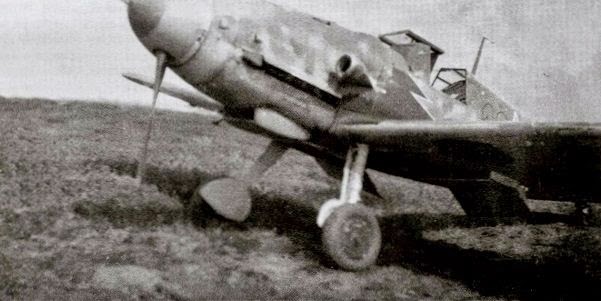
.. an interesting Gustav apparently on the strength of IV./ JG 51 but featuring the JG 2 Adlerflügel or 'exhaust eagle' from the previous post - evidently a machine previously assigned to JG 2 (posted by 'Laco Pilot' on the Bf 109 FB page)


and finally today a few from Marko Auer's current sales, link below;

emergency landing at sea off the coast of Norway


and below, three views of a Klemm KL 35 trainer from the Flugzeugführerschule  FFS A/B 9 in Grottkau..


 Marko Auer's Ebay sales are here

Tuesday, 25 November 2014

scenes from Théville - Fw 190s of III./JG 2 during June 1942 " In the skies of France " Vol 3 Mombeek/Roba


A selection of early JG 2 Fw 190s. For the text that follows I've relied heavily on Erik Mombeek's superlative " In the skies of France " Vol 3. (French text only).


A-2/3 "Yellow 4" of  III./JG 2 machine at readiness. Ground crews taking a break.


III./ JG 2 took delivery of its first Fw 190s during May 1942, a month later than Greisert's II./ JG 2 and following a visit to Beaumont by the C-in-C of Luftflotte 3 GFM Hugo Sperrle. The first three images below show a Fw 190 A-2/3 'gelbe 2'. My first thought was that this could be "Sepp" Wurmheller's although I have to thank George Morrison for a more positive identification - too few Abschussbalken. This 'yellow 2' was most probably the regular machine assigned to Ofw. Karl Nowak and shows some ten rudder victory markings. His Warte would add just two more - his 11th and 12th returned on 3 June 1942- before he was shot down and killed by Spitfires over the Channel on 10 June 1942. The stylised eagle's head design was of course a feature of 9./ JG 2 machines. Wurmheller flew with 5./JG 53, then the Stab JG 2 (still using 109 Fs), then 1./JG 2. He flew several "weisse 3" before choosing "gelbe 2" in 9./JG 2.


Below; markings option in the Eduard Fw 190 'Early Versions' Royal Class box (released December 2017)


Below; well-known PK- Foto of the machine assigned to the Kommandeur Hptm Hans Hahn - Fw 190 A-2 (WNr. 223). This was a Focke Wulf aircraft constructed in the spring of 1942 and delivered to the Stab III./ JG 2. According to Peter Rodeike's caption commentary ("Jagdflugzeug 190" page 68) the upper surfaces  may have received a partial overspray with a "dunkelgrünen Farbton". Note though the much better quality reproduction below and in the Mombeek/Roba volume 'Dans le Ciel de France'. The aircraft is wearing the small white fuselage band commonly seen on Stabsmaschinen of III./ JG 2. The yellow rudder displays 61 victory Balken, Hahn claiming two Spitfires around midday on 6 May 1942 for his 60th and 61st. Scrambling from Théville to head off Circus no. 159 (Bostons to Caen) the Fw 190s of III./ JG 2 tangled with Spitfires over the French coast north of Fécamp 'chasing' the RAF fighters back across the Channel; 

" it was a magnificent warm day, not a cloud in the sky and no wind. From out in the middle of the Channel you could see the two coastlines and visibility was such that I could see the Isle of Wight and the English coastline all the way to Dover..."  (Lt. 'Poldi' Wenger 3./ JG 2)


Below; "blue 11", a Friedrich of the Jabostaffel JG 2


Above; possibly a scene from Beaumont-le-Roger where the Friedrichs of 1./ JG 2 operated alongside the Geschwaderstab.

Below; Fw 190 A-2 "white 11' of 7./ JG 2 (WNr. 105) features the Staffel Zylinderhut emblem on the nose (a thumb pressing down on the British top hat)  rather than the III. Gruppe cockerel's head. After only a few hours flight time the exhaust has already stained the lower forward fuselage and this area of the airframe would soon be over-painted with the usual black trapezoidal eagle wing or Adlerflügel shape outlined with a white border. Probably assigned to Ofw. Alfred Knies, the preferred wingman of Stk. Egon Mayer. (cf. Mombeek "Dans le ciel de France " - Vol 3.) Knies claimed a Spitfire shot down on 6 June 1942.


Above; Fw 190 A-2/3 "gelbe 11" (probably WNr. 2187) of 9./ JG 2 features the stylised eagle wing with an Adlerkopf (eagle's head) on the cowling. Note the small bulge on the gun cowling, a feature of Arado-built Fw 190s. "Yellow 11" was the usual aircraft of Ofw. Fritz Hartmann - the rudder featured at least eight Abschussbalken by the time Hartmann handed the machine over to 8. Staffel later that year where his victory markings were removed. See photos on p176 in Erik Mombeek's superlative " In the skies of France " (Vol 3)


Two views of Fw 190 A-2 (WNr. 2194 ?) "white 12" of 7./ JG 2 which sustained 20% damages in a forced landing at Théville on 6 June 1942. 7. Staffel pilots claiming Spitfires in June 1942 include Ofw. Willi Stratmann, Uffz Guenther Toll and Lt. Jakob Augustin. Augustin flew "white 8" (WNr. 333) and returned his 12th victory on 6 June 1942. Stk. of 7. Staffel, Oblt. Egon Mayer returned his 43rd and 44th victories on 3 June 1942 at the controls of his usual "white 7". JG 2 filed some 23 claims for Spitfires on this date alone. In a letter home, another 7./ JG 2 pilot Uffz. Otto Kleinert wrote;

"... on one of my first sorties from Théville with 7./ JG 2 on 3 June 1942 we ran into a formation of about ten Spitfires and shot them all down - our Focke Wulfs are largely superior to their machines. I flew as Lt. Augustin's wingman but really saw very little of the action, so close did I stick to my leader's rudder. After we landed I was somewhat surprised to learn that we had accounted for so many enemy machines. Of course as a relative beginner I had little appreciation of the bigger picture..."  ( 'In the skies of France' -Vol 3)


Offered on Ebay via solo-fotos here

Our look at Erik Mombeek's superlative "Dans le ciel de France" Vol 3 elsewhere on this blog
http://falkeeins.blogspot.co.uk/2012/07/dans-le-ciel-de-france-jagdgeschwader-2.html

another small Luftwaffe blog article that looks a little more critically at over-claiming in JG 2 during 1941
http://falkeeins.blogspot.co.uk/2011/06/luftwaffe-fighter-ace-claims-and.html

Monday, 24 November 2014

Ju 88s on Sicily, crash-landed Fieseler Storch in Greece, He 59 in Red Cross markings - Ebay photo find #102


Ju 88 A "7T+.K" of 2./KGr 606 in Catania in July 1942


Above; three views of KG 30 Junkers Ju 88 on Sicily currently on offer here


He 59 "WL-APIE" of Seenotstaffel 1 with Rot Kreuz Red Cross markings pictured in the North Sea during 1939

Do 17 Z of I./KG 2 showing the Holzhammer Wappen


Michael Meyer's Ebay sales are here

koelsch333 Ebay sales, shown here courtesy of Marco;


Saturday, 22 November 2014

Bf 109 F-4 of 8./JG 27 on Rhodes and Crete, January/February 1943 pilot Liebhold - Ebay photo find # 101 - edit 28/11 more 'striped' pictures added


nice JG 27 Bf 109 F/G photo selection from Michael Beuckmann's current Ebay sales. According to the inscription on the rear of the photo the first images here depict machines (most probably F-4 Trop 'Red 3' and 'Red 5') of  8./ JG 27 at readiness on Maritsa airfield, Rhodes - note the striped camouflage effect over the wings! The aircraft are (presumably) finished in Sandgelb with squiggles and stripes of Olivgrün. 8./ JG 27 deployed to the island of Rhodes in mid-Janury 1943 from Crete for some six weeks, being tasked with intercepting British torpedo bombers attacking German and Italian shipping running supplies to island garrisons throughout the Aegean. On 11 February 1943 Oblt Werner Schroer donned his best uniform to fly back to Crete to get married and during the course of this flight claimed two British Beauforts. My max bid of 50 Euros was quickly out-bid - final selling price was well over 300 euros!..Click on the images to view large. At bottom, Oblt. Werner Schroer.


http://www.ebay.de/itm/Foto-Piloten-Me-109-Bf-109-JG-27-Bereitschaft-Rhodos-Griechenland-G-/381054280112?pt=Militaria&hash=item58b89ae1b0&autorefresh=true


Liebhold with Italian comrades, "Red 7" in the background - note "striped" upper surface camouflage


Below; "writing a few words of greeting to my beloved Marianne following my award of the EK II. 24 January 1943 "   - Liebhold with Schroer in deckchair and sunglasses and Schroer's "Red 1" in the background


Staffelhund 'Wussl' with Bf 109 F-4 'Red 5' 8./ JG 27 in the background...and again with pilot Liebhold


http://www.ebay.de/itm/Foto-Me-109-Pilot-Liebhold-und-Werner-Schroer-JG-27-Einsatzbesprechung-G-/381063734093?pt=Militaria&hash=item58b92b234d


Also on offer from the same seller and apparently in the same album, two views of a well-known "White 1" "Harro" a III./JG53 machine; picture taken in North Africa, also apparently featuring the same pilot (Liebhold) in these views. (thanks to Franck BENOITON for help with this ID!)


.


John Weal profile by way of illustration; note the III. Gruppe Balken on the other side of the fuselage band!


Saturday, 15 November 2014

P-51 Mustang 'T9 +HK' Wanderzirkus Rosarius, JG 1 Husum 1944


" ..The day was rounded off with a demonstration of captured American aircraft, in particular a P-51 Mustang. It was stressed that our Bf 109s and Fw 190s were generally superior to this type. We soon realised on our first combat sortie that this statement was not entirely accurate....”  Uffz. Kurt Scherer II./JG 4


In 1943, Hauptmann 'Ted' Rosarius was tasked with forming a Versuchsstaffel of captured enemy aircraft that would serve to familiarise pilots of the Reichsverteidigung (Defence of the Reich) with the strengths and weaknesses of Allied fighter aircraft. This unit, 2.Staffel of the Versuchsverband Oberkommando der Luftwaffe (Trials and Research Unit of the Luftwaffe High command) received all captured aircraft. Once flown and tested, they toured frontline fighter units. This unusual formation became known as the Wanderzirkus Rosarius (Rosarius' travelling circus). Thanks to the 'Rosarius Circus', German pilots had the opportunity to take a closer look at their principal opponents and hopefully gain better knowledge of the equipment pitted against them.

The increasingly difficult tactical situation the Luftwaffe was experiencing during 1944 meant that demonstrating and carrying out what would be known today as 'dissimilar combat training' had become a necessity.  Fighter pilots tend to fly mock aerial combats against their own - men trained in the same fashion and flying the same aircraft. Such training, while useful, cannot replace actual combat experience. In his memoir, Walther Dahl wrote of the ever decreasing number of experienced pilots in the Luftwaffe ;

 "...despite the successes we had enjoyed over the course of our recent sorties, a number of gaps had started to appear in our ranks. Seasoned Staffelkapitäne, experienced Schwarmführer, Leutnante, Feldwebeln and Unteroffiziere - pilots who were the backbone of our unit - had all been posted missing in action . Men such as Oblt. Hirschfeld of 6./JG 300 who was lost in combat on 28 July 1944 and posthumously awarded the Knight's Cross. There were plenty of new young replacements, all volunteering to fly with the Sturmgruppe but virtually none with any front-line experience. Despite the constraints on time, fuel and aircraft availability, it was down to us to complete the training of these youngsters, to " fly them in " under operational conditions as it were..."

 (translation by this blog author)

 The lack of experience of the younger pilots could be partly compensated for by the demonstrations of the Rosarius Circus - the unit toured the airfields defending the Reiche demonstrating how enemy aircraft performed and how they could be beaten or countered.

The fact that Rosarius' Circus was composed of not only different models, but foreign models - with no spare parts supply to speak of - meant that maintaining the aircraft in 'service' must have been a mechanical and logistical nightmare. However, the unit seemed to maintain a decent readiness record, good enough to allow it to fulfill its mission. While Dahl and JG 300 were based at Wörishofen airfield, they were visited by the 'Circus';

 "...one morning enemy fighters such as P-51s, P-47s, Lightnings along with the heavy bomber types, could be seen peacefully arrayed alongside our own machines, when their appearance over the field would normally have provoked anything but a friendly reaction.. formation leaders (Verbandsführer) were given the possibility of flying these machines in mock combat and thus becoming more closely acquainted with their characteristics, a factor that was not to be under-estimated in air combat with our opponents. Following this session, flight leaders would hold a series of training lectures with their men and were able to pass on recommendations from their own observations and experience at the controls of these aircraft..".


 A B-17 was also used on such tours to show the Luftwaffe's pilots what the aircraft's strength were, and, more to the point, what its weaknesses were. By studying what the defensive guns' firing arcs were, where the armour and fuel tanks were located, German pilots gained invaluable knowledge.

 The 'new' image show-cased here depicts P-51 B Mustang 'T9+ HK' parked on Husum airfield during late 1944. Pilots and personnel of JG 1 crowd around the machine. 

Ideally, pilots would have been able to test all of the aircraft flown in by the Circus. However, submitting fragile and rare aircraft to inexperienced pilots was not always a practical option; equally, unseasoned pilots would not have been able to judge the aircraft as quickly and efficiently as the more experienced fliers.

  The 'Zirkus' may have partially compensated for the Luftwaffe's increasing technical, tactical and "human" inferiority. However, the tide of the air war had already turned.