Showing posts with label Me 262. Show all posts

Wednesday, 31 July 2024

Me 262 - the 'ultimate' aircraft design of WW II ..or an undeserved reputation ?


no preamble, no intro, but a heads-up for a must-read piece written by 'Drix' over on his  aviation blog

Drix writes in French so you may need to hit the 'translate' button if using Google

https://aviadrix.blogspot.com/2024/07/le-messerschmitt-262-indispensable.html


And a comment posted by Alain Breton;

" As usual with Drix, an article that sets the record straight.  While it is undeniable that German engineers made a major contribution to the development of modern aerospace technologies, it is also true that in many respects they played the role of sorcerer's apprentice, and that their ‘successes’ often owed more to propaganda than to reality.

In the particular case of Messerschmitt, the Luftwaffe's ‘spearheads’ in 1938-1939, the Bf 109 and 110, never had a real successor: the 209/309s were a fiasco that never made it past the testing stage, and the 210/410s were even worse, as they reached the mass production stage despite not being very good - to put it mildly!

The Bavarian manufacturer's real claim to fame was to have pushed the development of a fighter designed around a very small engine (and a very small pilot...) to the furthest limits to produce the 109 K, which was still ‘in the game’ in 1945 - quite an achievement for an aircraft designed 11 years earlier! (In fairness to the British, they did much the same with their Spitfire! )

Turning to the Me 262, it is probable that its 'reputation' owes much to a combination of surprise on the part of the Allies, who were certainly not expecting to find such an aircraft in the middle of their B-17 ‘boxes’, and post-war German accounts, led by Galland, which made it the victim of the Führer's interference with his determination to transform this racing beast into a bomber. The reality is less rosy and the aircraft had weaknesses as well as qualities. It was a machine - with its unresponsive and difficult-to manage engines, huge take-off run, lack of maneuverability - that could really only be entrusted to ‘experienced’ pilots, which was precisely what the Luftwaffe lacked most towards the end of the conflict!

One last detail: the aircraft's ‘large mass’ was a handicap not only once it was in the air, but also from the moment it was manufactured, using materials that were becoming increasingly rare! With this in mind, the decision was taken in the autumn of 1944 to rush through the He 162 with its single engine and mostly wooden construction...."


Friday, 7 June 2024

Stenographic record extract of the meeting with the Reichsmarschall on Whit Monday, 29 May 1944, subject Me 262


 Stenographic transcript excerpt of the review discussion with Reichsmarschall Göring that took place on Whit Monday, 29 May 1944 at the Obersalzberg. Subject of the discussion; the Me 262.


RM Göring; "..Ich habe die Herren trotz der Feiertage hierherbitten müssen, da in der Frage der Me 262 die letzten Klarheiten geschaffen werden müssen. Der Führer hat mit mir noch einmal die Lage durchgesprochen, die sich dadurch ergeben hat, das Sie (Petersen) die Äußerung gemacht haben, dass das Flugzeug sei nicht geeignet, Bomben mitzunehmen. Ich habe dem Führer gesagt, dass Sie es nicht so gemeint hätten.."


"I have asked you gentlemen to come here today, despite the public holiday, as the final clarifications on the issue of the Me 262 must be made. The Führer has discussed with me once again the situation that has arisen because you (Petersen - Kommandeur E-Stelle Rechlin) stated that the aircraft was not suitable for carrying bombs. I told the Führer that you would not have meant it like that..."

Petersen;  "..it was Field Marshall Milch who said that, not me! On the contrary, I pointed out that you could use balancing counterweights...."

RM Göring: "..No, that was not the case - one thing I know for sure, the Führer was the first to mention compensation weights. He immediately asked how heavy the onboard armament is and what happens when it is removed. It was the Führer who came up with the idea of making this possible by leaving out unnecessary weight. And as far as I recall - I'll have to check through the minutes once again - it was you who started saying that the aircraft could not carry bombs..."

Petersen:  " no, that's not the case. It was the Field Marshall who said that, for the time being, the Me 262 is not hauling bombs - 'es kommt ohne Bombe'. That was a mistake. I discussed it with him in the car after the meeting and he said that he had got the wrong end of the stick..."

RM Göring: "..the Führer was right to be very upset about it and said that everything he had ordered done had not been followed.."

Messerschmitt:  "..  and yet all his instructions have been complied with.."

[..]

RM Göring:  "..it was precisely to avoid misunderstandings like this that I ordered, firstly,  that the aircraft not be described as a 'Jabo' but as a 'Schnellstbomber' *** and, secondly, that the General der Kampfflieger take charge. ..[..] of the test machines which have been fitted with armament, some of which will be developed and trialed further as fighters in accordance with the wishes of the Führer.

Bodenschatz: " ..and he has further emphasised that the testing of the fighter should continue.."

RM Göring: ".. and only the testing!  In order to avoid any mistakes and confusion for you, I have nevertheless 'deactivated' the fighter side and only 'switched on' the General der Kampfflieger, so that it cannot happen that today the General der Kampfflieger comes to you (Petersen) for testing and five days later the General der Jagdflieger does likewise. Of course this may happen but you should be clear on one thing - the General der Jagdflieger may only pursue testing for development and finalisation of the fighter with the test machines that he now has, while the main series, part of which is also coming to your trials, should be purely for the fast bomber."

***  translated by Dan Sharp in his 'Me 262 -development & politics' as 'super-speed bomber'.


Wednesday, 12 July 2023

RIAT Air Tattoo Messerschmitt Foundation Me 262


..footage captured by the Battle of Britain museum at Hawkinge and reposted using the 'embed' code supplied by FB. Escorted by a BBMF Spitfire the @airbus Messerschmitt Foundation Me 262 replica was seen heading across Kent en route to the Fairford airshow in Gloucs this week/end. The replica '262' will be based for a short period at RAF Coningsby following the show..a single click to view here..


A few images from Fairford by the inimitable Tad Dippel. And if you're wondering, yes, I know Tad - we met up at the 2016 RIAT. A fantastic photographer..


Thursday, 25 May 2023

Messerschmitt Me 262 A-1 WNr. 111711


A previous blog post shows Me 262 A-1 WNr. 111711 at Wright Field, Dayton, Ohio, 1945 - see right. These still captures from REDA archive colour footage at pond5.com quite clearly depict WNr. 111711 following Hans Fay's defection/arrival at Frankfurt - presumably. The tarp and the foliage suggest otherwise. I have read that the branches around WNr.111711 are the result of US troops’ hasty efforts to conceal Fay’s aircraft soon after its landing - they had only arrived at the airfield a few days prior to this. They then later removed them to inspect the machine.


thanks to Snautzer for the find.

Sunday, 23 October 2022

'Messerschmitt Me 262 - Development and Politics' by Dan Sharp (Mortons) - new Luftwaffe books


Available now from UK publisher Mortons is this significant new work on the Me 262 by Dan Sharp. This is not the previously announced "Secret Projects of the Luftwaffe Vol. 3: Messerschmitt Me 262" which was planned to focus squarely on the 'secret projects' and sub-variants of the type.  Nor is it a book about combat ops or even a book where every page looks familiar because the reader has already seen the images a dozen times elsewhere. In fact, this is really a book for people who've read the Me 262 story elsewhere - probably different, conflicting versions of that story - and wondered which was the definitive version. As Dan points out, up to this point there probably hasn't been a 'definitive' version. So the small-ish and small format soft-back of the 'Secret Projects..' series has become a new and much larger work as the author explained;

" ..the further I went into the primary source material the more apparent it became that the truth about what happened to the Me 262 throughout its development diverged somewhat from all existing written accounts. As a result, I expanded the book to encompass all aspects of the aircraft's development - the projects, the sub-variants, the prototypes and the full production variants - as well as the discussions that went on about them. The book went from 30,000 words to 160,000 words, from 248x185mm to 297x210mm, from 150 images to 300, and from 150 pages to 328. The original title and cover art no longer reflected the book's contents and as such I persuaded the publisher to change both. This has indeed created some confusion, for which I am sorry, but I believe that the book as it stands now is a great deal better than it would have been in its original form...". 

There is very little about combat operations in Dan's new book. The content is focused on exactly what it says in the title -  'Messerschmitt Me 262 Development and Politics'. As usual with his books, the text is grounded in cited primary source documents throughout.  As the author explains, older references about units operating the Me 262 etc. are still as valid as ever they were but all previous references concerning the type's developmental history are somewhat out-of-date. 

" if I make a point about something in the book you can see what evidence there is underpinning it, should you wish to. Taking surviving German wartime documents as a whole, a very significant proportion of them - I would hazard a guess at something like 10% - either concern the Me 262 directly or contain information which informs the Me 262's story. This amounts to literally thousands of documents and I have, consequently, collected and processed most of these, distilling the information they contain into the book.." 

Many of the images in the book are drawings from Messerschmitt reports - and many of them are, I believe, previously unpublished. Some have appeared in 'cleaned up' form in the works of, for example, Smith and Creek, but anyone who has read any of Dan's previous works will know that you get the original drawing - as scruffy as it might be. The images, like the text, are presented in chronological order - with any given image on the page having been produced at around the same time as the events being described in the text on that page. Where relevant, the author has noted where those images actually come from too - so for example the famous side view of the Me 262 V1, as well as detail shots of the same aircraft, all appear together in a single original report, the written content of which Willy Messerschmitt personally described as 'nonsensical'. Author Sharp again; 

 " ..I hope to provide additional context and richness to the Me 262 development story where previous works have simply used those photos and others without offering any insight on their background and origin. I read other people's books as widely as possible both before and during the writing process, so I'm well aware of what has previously been written about the Me 262; I was able to test assertions made in those books against the primary sources to see whether they had any validity..."

So to repeat, there are, for example, no biographies of the key players involved in the Me 262 story, no technical explanations of how a turbojet works, no lengthy back-story about the Messerschmitt company and its founding etc. The author's 160,000 words are concerned exclusively with the design, development, discussion and decision-making - with a side order of production. Dan Sharp again;

" my principal aim with this book was to find out what actually happened to the Me 262 all the way through from 1938 to 1945 by using the historical sources rather than whatever appears in other people's books. What emerges, I think, is a rather more complex and nuanced story than anyone, including me, would have expected..." 

 Also on this blog;

Saturday, 1 January 2022

Notes on the Me 262s of JV 44. Munich, Innsbruck, Salzburg, Hans Ekkehard Bob, Heinz Bär (part 1)


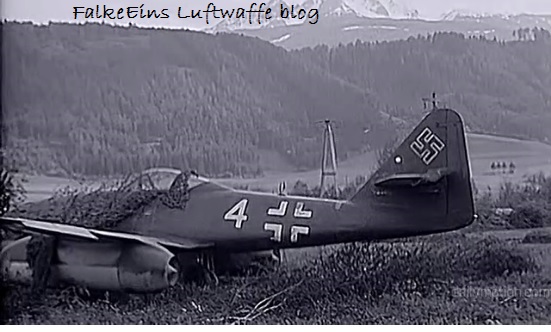
A view of what may or may not have been W.Nr. 170 061 "white 4" of JV 44 seen in a US film excerpt at Innsbruck-Hötting. 

A small post looking at some of the Me 262 Turbos assigned to JV 44. It is relatively well established which aircraft were assigned to Galland's outfit.  Czech writer Martin Sila, " ..at the beginning of its existence, JV 44 received 12 Me 262 aircraft, which probably received a fuselage designator (white) from "1" to "11" while Galland's command machine (the twelfth machine) displayed a ' white double chevron'. In photos the machines look as if they are painted with a uniform color, but in reality they are finished in two shades of green. Some serial numbers from this first group of twelve aircraft are also known.."

Late on JV 44 "absorbed" a number of aircraft from other units (III./EJG 2, KG 51, trial prototype machines). Robert Forsyth's "JV44 The Galland Circus" narrative highlights just how chaotic the circumstances around the unit's formation and its subsequent operations were, with aircraft arriving from a number of units and pilots bringing their own machines with them! Even the Luftwaffe High Command didn't always know the strength of this unit!  

Below;  two JV 44 Turbos that may depict "White 6" and "White 3" W.Nr. 111740 and W.Nr. 111746 operational with JV 44 at München-Riem in April 1945. This image is apparently captioned "Me 262 General Galland and Lt. Willi Roth, Staffelkapitän of 4./JG 103 [sic]." Lt Roth is listed as one of the JV 44-pilots in the well known document dated 27. April 1945 but not mentioned in Forsyth. Notable JV 44 pilots from JG 103 included former instructors Ofw. Dobnig and Ofw. Rudolf Nielinger. 'White 6' is usually assigned to Steinhoff...


The aircraft in which Johannes Steinhoff was badly burnt on 18 April 1945 was "white 6" (WNr. 111740) and Galland flew his last combat sortie on 26 April 1945 in 'white 3' (WNr. 111746). This machine was not destroyed (as has been generally stated) that day, but only damaged. Another well-known member of JV 44 Franz Stigler stated that this "white" 3 "was his machine. According to Sila, "..Stigler's role in the JV 44 is overestimated. He served as Techn.Offz. As to combat flights, it is interesting that other witnesses from JV 44 do not mention him in their recollections .."

The "sister" machine to WNr. 111745 was "white 5" which Eduard Schallmoser damaged heavily on 4 April colliding with a P-38. "White 5" was one of the twelve Me 262s which Jagdverband 44 had taken over in March 1945. A number of pilots flew it in combat. Schallmoser had been assigned to JV 44 as a freshly trained fighter pilot, after completing an accelerated training programme in the Me 262. On 4 April 1945, his Rotte met a group of twelve P-38’s of the 15th USAAF in area of München-Riem, which the German pilots attacked. In the following combat Uffz. Schallmoser collided with one of the Lightnings piloted by Lt. William Randle as a result most probably of his excessive speed. While Schallmoser managed to land his damaged “White 5”, Lt. Randle bailed out of his Lightning and became a POW. 


Below;  'white 6'  in the background seen behind the tail of 'white 5' on the right. The Kennziffer '6' is partially obscured by the camouflage netting. Both machines display the typically basic JV 44 camouflage scheme consisting of RLM 82/83 on the upper surfaces. Eduard Schallmoser is on the right. 


In late April 1945 Galland's unit was ordered to depart Munich - effectively ceasing combat operations - and commencing on April 28, JV 44 began transferring to bases (or rather field strips) in Austria - Salzburg and Innsbruck. Of particular interest is the (unknown) fate of Galland's own 'white double chevron'. According to one account 'white double chevron'  was flown to Innsbruck on 29 April 1945. In Innsbruck, Major Hans Ekkehard Bob was ordered to the landing ground at nearby Hötting to prepare for the arrival of jet aircraft. The runway strip area had to be extended to 1,200 metres necessary for takeoffs and landings by Me 262 and an attempt was made by Bob to adapt the airstrip to the necessary length. However there was no J2 fuel at the base. Bob's efforts were in vain. 

There were two airstrips at Innsbruck at that time. At Innsbruck-Reichenau, a few kilometers east of Hötting, at least two Me 262s came into land, and according to one account, Me 262 A-2a "White 1 "  almost hit buildings on the run-out. The landing strip was still too short for a Me 262 to take-off from, so of the 12 Turbos that landed  in Innsbruck according to Bob's recollections,  all were stuck and subsequently abandoned. However if Galland's  'white double chevron' did go to Innsbruck it does not appear to have been documented photographically there by US personnel. From the video material available there is no sign of such a distinctively marked machine. More on this in part 2.


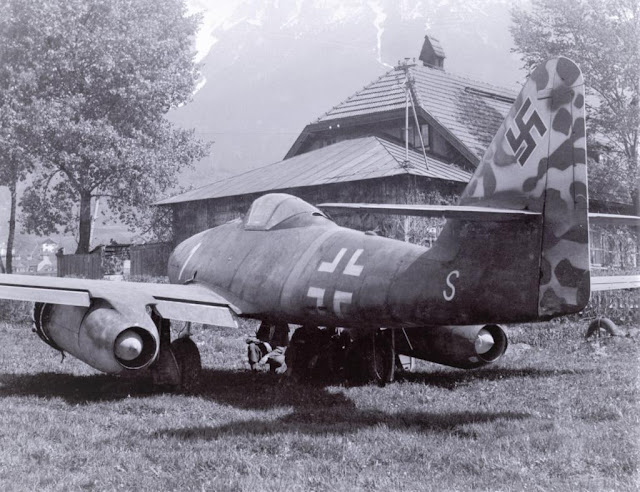
'White 8' (above) -Me 262 A-1 "White 8 S", WNr. 500492 - was one of possibly two Me 262s that landed at Reichenau, a few kilometers east of the temporary airfield at Hötting where the other JV 44 Me 262s landed and were dispersed. Note that the machine was previously with III./EJG 2 operating from Lechfeld, with the white `8`on the nose and narrow yellow fuselage band behind the cockpit.

  On the evening of 29 April 1945, at about 1800 hrs., Ofw. Rothert of 2./Fl.U.G. 1 transferred Me 262 A-2a WNr. 170047 'white 1' from München-Brunnthal to Innsbruck-Reichenau. The port view of this machine  (last of the four images) shows the white 'S'  ('Schule') under the horizontal stabilizer - as seen in the well-known Kommando Nowotny line-up from where it went to JV 44. 


Major Bob remained in Innsbruck until 3 May 1945, when he received an order to 'disable' his jets  and transfer to Salzburg which he did as the US Army approached. Based on this information, it is possible to state that all of the Me 262s abandoned here were unserviceable.. 

At least 12 Me 262 Turbos were flown to Innsbruck. However a memo dated 2 May quoted in O'Connell's 'Me 262 Production Log' states that as many as 22 Me 262s of JV 44 were transferred to Hötting and that 7 of them crashed on landing. [The memo states that there was 25 cm. of snow at Hötting on 2 May.]

 JV 44 Me 262s that can be identified at Innsbruck (primarily Hötting airfield) included;

 W.Nr. 111 712 (EZ 42, no Kennziffer)
 W.Nr. 500 490 Me 262 A-1a. No markings, full-fuselage RLM 83 camo 
 W.Nr. 111 857 (original "white 5")
 W.Nr. 111 751
 W.Nr. 500 524
 W.Nr. 112 360
 W.Nr. 170 047 - "white 1"   Innsbruck-Reichenau
 W.Nr. 111 974 - "white 8"   Innsbruck-Reichenau
 W.Nr. 170 061 - "white 4"
 W.Nr. ??? ???  - "white 11"
 W.Nr. ??? ???  - "white 12" (according to David. E. Brown the 113 series aircraft ...)
 W.Nr. ??? ???  -  "red 1" ( another 113 series machine ...)


Below;  Me 262 A-1a, uncoded, JV 44, WNr.111857, Innsbruck-Hotting. Previously 'white 5', III.EJG 2. NSG 9 Stuka D-3 with exhaust flame dampers in the barn in the background.


(to be continued)


Monday, 14 December 2020

Willy Messerschmitt, Stellungsnahme zum Projekt ‘Volksjäger’ - was the He 162 vs. the Me 262 a bad idea ? Production and engines compared.


In late 1944 Willy Messerschmitt issued a statement from Oberammergau that argued against the development and production of the planned Heinkel He 162 'Volksjäger'. The two companies, Heinkel and Messerschmitt were commercial rivals, although the war situation had gone far beyond that point. In his latest video Kris from the 'Military Aviation History' channel on youtube (see link below) looks at Messerschmitt's warnings that the development of a 'cheap', 'mass-produced' and untested 'disposable' new jet at this late stage of the war would disrupt existing types - while competing for the allocation of scarce resources - even though - as a recent publication argues - a cheap, easy to construct single-engine jet fighter was exactly what the German war effort required.  It is doubtful though whether Messerschmitt could have anticipated such rapid development of the single-jet Heinkel fighter that first flew on 6 December 1944. 


The video compares the two machines from a production standpoint.  Why was it that of a total of 1,433 Me 262 airframes constructed, only 358 machines became operational, given that Allied air attacks accounted for the loss of only roughly one third of these. In other words only one quarter to one third of total Me 262 output was of any benefit to the German war effort - and produced at tremendous cost. This was despite the widespread introduction of slave and concentration camp labour in the type's production. The main advantage of the He 162 lay in its comparatively low production costs - 1,500 man hours per machine as opposed to the 9,000 man hours required to build each Me 262 at a unit cost of 150,000 Reichsmark, twice that of the He 162. Despite these advantages - and as predicted by Messerschmitt - the new type  inevitably encountered developmental difficulties, so that by the end of the war only around 275 He 162s had been constructed with another 800 nearing completion or under production. However, a large proportion of these never received engines. The video looks at the two jet engines and their construction. The Jumo 004 in the Me 262 and the BMW 003 in the He 162 both required considerably fewer man-hours to build that the Jumo 213, DB 603 and BMW 801 piston engines in service and " were less resource-intensive.." In a six month period the single Nordwerk plant produced - underground - some 1,955 Jumo 004 jet engines from a total Jumo production run of between 4-6,000 depending on the sources.  These were required for the both the Me 262 and Ar 234 types. BMW produced only some 560 jet engines during the war, despite the BMW 003 being even less resource intensive than the Jumo engine (no more than 0.6 kg of nickel per unit) and construction being broken down into easily made and assembled components. Being cheaper it was ideal for the He 162. The main reason for production delays were the modifications required to adapt the engine for installation above -rather than under - the wing on the He 162. 

But did the He 162 have the impact on Me 262 production  that Messerschmitt claimed it would have ?  On paper, production capacity had become available with the abandonment of bomber types and even piston-engined fighter production was restricted to only a handful of types from 1945..

A single click to view here..
 

Friday, 4 December 2020

Sunday, 16 June 2019

James V. Crow RIP - Dora 9 'Red 1' of the Platzschutzstaffel


posted by Steve Sheflin on TOCH

"..I am saddened to report that my friend James V. Crow passed away on Friday 03 March 2019 at his home. Jim was 79 years young, and a gentleman in the broadest sense of the word. The Luftwaffe research community, as well the rest of the world, has lost a star and a friend. Jim is finally with his lovely wife Erika again. Respectfully, Steve Sheflin..."

and from David E. Brown

"..This is a huge loss for many of us who have had the benefit of working with Jim and the honour of having him as a friend. Jim was unselfish in his sharing of Luftwaffe and related photos from his collection that be began building in the 1960s.."

Pick up any Luftwaffe book at random and chances are you will come across a credit for 'James V. Crow'. A veteran US serviceman who lived and worked in Germany for a number of years, Jim devoted much of his spare time to acquiring photos of WWII German aircraft and amassed an enormous collection of rare images. I was always thrilled that Jim would want to share his photo collection with a minor-league translator and blogger such as myself.  He was always ready to send out 'new' photo material for whatever project or article that I happened to be working on. I introduced him to Kagero and many of his photos appeared in their 'Monograph' series - until the day that they failed to return some of his late-war Ju 88 images. Originals - since Jim didn't scan or 'photoshop'. Occasionally he went to the print shop and had copies prepared. Maybe the images sent to Kagero went 'missing' in the post back to him after being used in the monograph (Vol III Junkers Ju 88 is full of his rare images..) We never did get to the bottom of that business. Hopefully I always did the 'right' thing by Jim in sending him a copy of whatever book/monograph or article that his photos had appeared in as a result of my involvement and I of course always sent him small sums of money in exchange for images which he appreciated. And Jim must have written to me many times for help in identifying and captioning where possible his latest images. Jim's notes always appeared on the back of photocopies of the photos in question—I don't think Jim bothered with typing and as far as I am aware never used a computer and everything that went with it. He would always write in long-hand - unfortunately I always had trouble deciphering his hand-writing. He was a fund of stories as well - dining out on his relationship with Hans Ulrich Rudel and his glamorous wife in Chicago during the 70s. ( The Rudels were invited by the US government to participate in the development of the A-10 Warthog, conceived for close air support - 'Stuka Pilot' was required reading for the design team).

The two gentlemen quoted above have put it far better than I could - even if you didn't know him James V. Crow will be sadly missed by all in the Luftwaffe enthusiast community...


Starboard view of 'Red 1' of the Platzschutzstaffel (airfield protection squadron) of JV 44 in front of the control tower at München Riem airfield after the capitulation. Operating from the opposite end of the field to the Me 262 Turbos of JV 44, the Platzschutzstaffel followed specific orders; take off ahead of the Me 262s in Rotte formation, maintain a 1500m altitude umbrella and under no circumstances break off to chase enemy fighters. This view reveals that the cockpit has been ravaged by fire, possibly following orders to destroy the aircraft as the end neared. Built in December 1944 by Fieseler at their Kassel factory, this Dora is finished in the 82/83/76 scheme. Factory stencilling is intact. Undersurfaces are red with thin white stripes as a recognition marking for the airfield flak gunners. Behind the Siebel to the left of the picture is Fw 190 D-11 'Red 4'.  Via Crow. Click to view full screen.


Saturday, 8 December 2018

“Mosquitos over Berlin” - a chat with Andreas Zapf; Moskitojagd, Kurt Welter and Me 262 jet night fighters


The history of the two-seater versions of the world's first jet fighter has been somewhat neglected. That has not stopped more than a few 'urban myths' taking root around these machines, especially in their role as 'night-hunters'. However Andreas Zapf has virtually single-handedly corrected this state of affairs with his huge " Mosquitos über Berlin. Nachtjagd mit der Messerschmitt Bf 109 und Me 262 " published earlier this year by VDM. Adapted, built and deployed in virtually the last months of the war from the Messerschmitt Me 262 two-seater training aircraft, the history of this aircraft and its employment by the so-called Kommando Welter against the fast  Mosquitos of Bomber Command - a machine which was all but "invincible" - is described in what will undoubtedly be the last word on the subject - "Mosquitos over Berlin". Andreas recently took time out to sit down with us at the Luftwaffe blog to discuss the book, Kurt Welter, Me 262 night fighters and Moskitojagd !


 “...Late in the summer of 1944, the skies over the Reich were mostly dominated by the Allied air forces. The heavy bombers of the USAAF at day, those of the RAF at night. In addition the fast de Havilland DH.98 ‘Mosquito’ of the Light Night Striking Force roamed the skies over Germany – and with little or no opposition went more or less unchallenged. Besides the ever present Flak, there was not much they had to fear. ‘Not much’, however, is relative. With their fast and agile Messerschmitt Bf 109s, some specialized units such as 10./JG 300 and later II./NJG 11 operated especially against the fast ‘Wooden Wonder’. And starting in December 1944, the first nocturnal missions using the Me 262 jet fighter were added to the threat. Starting out as ‘Kommando Welter’ and being taken into regular operations as 10./NJG 11 later, a handful of skilled pilots flew the single-seater Me262 A and later the Me 262 B-1a/U1 twin-seater to counter the nightly Mosquito attacks. A new book by German author Andreas Zapf book shines a light on the almost untold story of the Nachtjagd with the Me 262. 596 pages, 160 b/w photos, 69 reproduced documents, 24 maps and flight maps are adding to a story reproduced from material hidden in archives around the world, flight logs, written accounts and many hours of personal discussions with those involved. Enjoy the untold story of a unique unit and their nocturnal stalking of the famous ‘Mosquito’...”

Hello Andreas. Congratulations on the publication of your impressive new book ! I've reproduced the jacket blurb above by way of an introduction to our discussion. Firstly, how did you come to research and write the story of “Mosquitos over Berlin”?

Hello Neil – and “thank you very much for the flowers!” – and of course, thank you very much for taking the time to have this little talk about my book and our mutual hobby.

As for choosing the topic, that was pure coincidence – I took over a collection from a fellow researcher some years back who has been writing his books on the German Nachtjagd and other topics a few years back in the 1980s. Contained within the lot was a copy of a Luftwaffe Flugbuch (“flight log”) showing nocturnal flights with Messerschmitt Me 262 B-1a/U1. And there have been letters between the original owner of the files and a variety of pilots that flew the Me 262 with “Kommando Welter”.

This sparked my interest and I started to comb the available literature, just to find out that it was an absolute “stepchild”, hardly mentioned at all and where it was, with a variety of “truths” that were not backed by any sources one could fall back to. In other words: I was unable to say if the previous authors worked on fact, fiction, or hearsay. So I set out to improve and update the story – how difficult could it be? One small unit, a few aircraft, only a couple of months towards the end of the war… naïve and foolish, I can tell you…

Being a Bundesluftwaffe officer, a wreck recovery archeologist and airfield series author, I guess your father inspired your interest in WWII Luftwaffe ?

I think, any boy growing up and and developing a love for books sooner or later raids his father’s “library”. I don’t know what other boy are finding – but besides the usual suspects, my hunting grounds were filled with books about air war, the Luftwaffe and all that. Not a few books but plenty of them. I remember having read Werner Girbig’s “Die nicht Zurückgekehrten” and Toliver/Constable’s “Holt Hartmann vom Himmel!” amongst the first ones… it just caught up with me later, I guess. So yes: inspiration certainly came from that side.

Back to Mosquitos. I'm intrigued to know just how big a problem they were for the Germans. Did you work out how many raids Mosquitos actually flew against Berlin during the war? I read somewhere that they were overhead on 36 consecutive nights? 

One of the last things I did before wrapping up and getting the book ready for the printers was a trip to Los Angeles to meet one of the nicest guys I have ever had the honor to meet: Jorg Czypionka. Jorg was a flight instructor with FFS A/B 115 in Austria for most of the war, then was posted to 10./JG 300, stayed with it when II./NJG 11 was formed from it, and finally was posted to 10./NJG 11 in March 1945.

When he read the manuscript, his comment was “ ..so much on the Mosquitos and in comparison it almost looks like we didn’t even fly anymore!” . That hurt a little because I knew they did everything to do their job in a world that was rapidly falling apart around them – so I went and did the math – and amended a chapter in my book, so let me quote myself:

“..Taking March 1945 as an example, we can review the entire set of morning and evening reports of the Luftwaffeführungsstab Ic which lists the missions flown against Mosquito bombers attacking Berlin. They are listing 33 missions with Me 262, spread out across 13 nights. An additional 8 flights with the Ta 154 ‘Moskito’ – also hunting for the fast twin bomber – are documented. Plus seven aircraft of an unidentifiable unit. All in all, a total of 48 missions.

The Light Night Striking Force in return has reached full strength and weather denied flying only on two occasions. Without looking at the early returns, dropouts for other reasons, etc. the Mosquitos mounted some 2,280 missions to Germany. The Luftwaffe pilots were hopelessly outnumbered.

From September 1944 to May 1945, 180 missions against Mosquitos to Berlin are documented, around 60 of them for the jets. During that time frame, the Light Night Striking Force mounted more than 11,000 combat missions to Germany.”

I think, these numbers give anyone of us an idea of the odds during those final months of the war. And yes, the more squadrons the Light Night Striking Force assembled, and the more Mosquitos were readily available, the more flights they managed to pull of – and indeed, the prime target became Berlin. It was rarely the only target during the nightly missions – but it was regularly on the target list and yes, 36 consecutive nights sounds about right.

I'm sure many think that the Me 262s deployed as night fighters were bomber killers as they were by day. This isn't the case though is it? Did the Kommando regularly fly by day as well? I know Becker has one recce Lightning Abschuss? 

Initially, the Me 262 of “Kommando Welter” and more importantly the later 10./NJG11 were primarily tasked to intercept and shoot down the Mosquitos bound for Berlin. And only those. Jorg Czypionka told me that on more than one occasion, when the raids were targeting other cities, even close by, they were not given permission to engage. It was Berlin only. Different story during daytime though – here, the otherwise “useless” jets were indeed tasked to intercept Mosquitos and F-5Es on recce missions. Becker got one that is confirmed and I think, I can pin another F-5E on Fritz Reichenbach. But all in all, not on more than maybe 5 – 10 days.

Because the jets were so fast even hunting Mosquitos was fraught with difficulty wasn't it ? - high-closing speeds, no way of slowing down to accurately aim and fire?

Yes, the Me 262 was fast, sometimes too fast. Combined with the relatively low speed of the Mk108 rounds, this gave the pilots not more than one or two seconds to actually aim and fire. Karl-Heinz Becker misjudged and had to fly through the debris of ‘his’ F-5E, subsequently belly landing his bird. Lt. Herbert Altner tried to reduce thrust too quickly on his first flight with the Me 262 B-1a/U1 and experienced a flameout with subsequent loss of the twin seater. It was not an easy attack, especially not at night. You need to remember: despite the Me 262 B-1a/U1 being “the symbol” for Welter’s night fighting activities, only one pilot ever flew her in combat. The others were flying barely modified Me 262 A single-seaters… no speed brakes, a somewhat fragile engine control, darkness all around… today, we would call any pilot flying under these conditions a “reckless flyer”.

How did Welter manage to persuade the powers-that-be that he warranted his own 'Kommando'? Because of his success in 10./JG 300? He was after all still relatively unknown and a junior officer wasn't he ? We hear so much about Hitler wanting the 262 as a bomber and yet here he is apparently authorising the type to fly at night as a fighter? And can you explain what 'Objektjagd' was - the 'Objekt' being Berlin I assume?

Well, that’s a bunch of questions there. First of all, let’s clarify “Objekt”. Yes, the “Objekt” was the to-be-protected target, for the Me 262s mostly Berlin. In other words: rather than hunting free, the night fighters were bound to the Objekt where they used the searchlights to guide them to their prey.

The question about how Welter got to his “Kommando” is an interesting one. Honestly, I never found an answer. There are different stories told, some of them range from “possible” to “bullshit”. Unfortunately, the war may have erased all documented evidence and time certainly has obscured the memories of those that talked about it in the recent years.

The only thing that I know is that Welter got his Knight’s Cross in October 1944 – and documents from Rechlin show the first preparations of their Me 262s (which Welter initially was allowed to use for his trials) around End of October/early November 1944. And on December 12, 1944, Hermann Göring authorizes the trials formally, initially with 3 Me 262 (Welter) and 3 Arado Ar 234 (Bonow). But the first ideas of using the Me 262 (and also the Arado Ar 234) as night fighters dates back to a time before Welter got the Knight’s Cross.

So all I can say is that it looks like he got the “Kommando” the formal way – not, as some are suggesting, by pulling off a stunt flight then then being summoned to Göring. And he may have gotten it because he was in the right place at the right time. After all, he was a successful and skilled night fighter, he got a high decoration and he was eager to improve his success rate.

In your reading and research did you get a better idea of Kurt Welter, the person and the pilot - he was presumably the gifted night fighter that some say but perhaps a little obsessive and 'difficult'? I read in Peter Cronauer's article in Flugzeug Classic (2014) that Welter avoided flying from around mid-March 1945 and drank a lot. And of course filed many unfounded claims?

One of the predicate rules of me writing is “in dubio pro reo” – “if in doubt, for the accused”. Of course, when you deal with Kurt Welter, the first thing you come across is the classification as blunt liar and as an over-claimer. But I think, the story is not that straight forward. But let’s start with the beginning of your question: yes, I learnt a great deal about Kurt Welter and I am happy to say that it was enough to dedicate an entire chapter of 25 pages to his biography.

He certainly was a gifted night fighter and someone described him as a man with “cat’s eyes”. My friend Jorg claims his landing skills were about average but in the air, he was a gifted fighter and skilled marksman. Those that knew him in their letters (and Jorg in person) describe him as “demanding” and maybe a “womanizer” but I have not heard a bad word about him from all that I got from Karl-Heinz Becker, Herbert Altner, and Jorg Czypionka.

He also was what we would call ‘quick-tempered’ today. On the other hand, it seems he also was an ‘organizer’, a man that could get things done. I never met him, obviously, but what I am seeing is a man that – like so many others – went through a war, aged before his time and most certainly suffered the consequences from a world falling apart around him.

Did he drink? I would guess so – but many of them did and as one of the night fighter pilots told me: ‘We never knew if we had another day to live so hell, yes, we drank as if there was no tomorrow.’ – and some of them certainly drowned their fear and despair. But for all I know, he was not the alcoholic that some describe him today.

Did Welter avoid flying? Another good question – again, those that knew him said he always was the first to fly and if there was only one aircraft available, it would have been his. I know he was grounded for some time in February. I know he never flew the twin seater in combat. But did he duck out and put the others in harms way? I did not find a single piece of evidence for that. He was certainly flying in March – when the unit lost their home base, Burg near Magdeburg, after the USAAF raid on 10 April 1945, they supposedly were able to save most of the aircraft and bring them to Lübeck – but there are also intercepted messages about low combat readiness. In general, not too many flights were flown from Lübeck, as it seems – and maybe Welter was busy on the organizing side rather than the combat side.

Which brings us to the last topic and my apologies for the lengthy answer: his claims. First and foremost, I have deliberately denied my book a “scoreboard”. There is too little evidence to create one. But if you search the Internet, you will find more than once place that lists the claims attributed to Welter.

The most interesting question is: where did those claims come from? For Karl-Heinz Becker, we have the Abschussmeldungen. Also a single one for Herbert Altner. But I have yet to see anything for the others, including Welter. I know that Hans Ring and Emil Nonnenmacher compiled their list of Luftwaffe claims and I know that all the dates for Welter are contained in a shortened list of their research which I have a copy of. BUT: no sources given. And what distinguishes these entries in their list from all others: they only got a date but never a time.

You can also use the morning reports of the Luftwaffe-Führungsstab Ic which at least list the claims – but never attribute a claim to a specific pilot. So from my perspective – and that is what I did – we can trace the claims and numbers but except Becker and Altner, we have a truly hard time to put names to most of the other claims.

Then you need to imagine the situation: dark, clouds, no radar, an excess of speed – you fire at your opponent and the Mosquito corkscrews (which was their evasive maneuver) – what does the pilot think and report? It happened to Karl-Heinz Becker and I was able to get in touch with the son of his “victim”. The 30 mm rounds almost severed the tail of the Mosquito…almost. The bird limped home and Becker claimed a kill. It was not on purpose.

Other way round: Welter in his famous letter says he brought down a Mosquito by ramming it. We all went “..bullshit, that’s a clear fake!”. Yet, for one of his early claims while with JG 300 a Mosquito crew files a combat report for exactly the same place Welter claimed and almost exactly the same time: they reported that a Bf 109 (Welter was flying Bf 109 with 10./JG 300 at that time) rammed them and took off parts of their wing so they lost control temporarily before being able to fly home…

All in all: there is evidence for “over-optimistic” reporting – but I doubt that Welter bluntly lied. And I am not even sure that all the reported “claims” are actually claimed by him…

In Manfred Jurleit's book Kurt Lamm talks about a dispute and a falling-out that he had with Welter. How did his pilots regard Welter himself?

As I said: “in dubio pro reo” but Kurt Lamm’s account in Jurleit’s book and in one or two letters that I have copies of is not in line with any evidence I was ever able to find. I don’t want to judge a man that I don’t know and who cannot defend himself anymore – so let me kindly say: I think, Kurt Lamm’s account on Welter might be more “shining a light on Kurt Lamm” than “giving an honest account of Welter”.

As I said earlier: his other pilots – especially Karl-Heinz Becker and Kurt Altner who may have known him best amongst those that we have accounts from never had a bad word to say about the man. Yes, 'womanizer', yes, “quick-tempered”, yes, “demanding.” – but I never heard “coward”, “drunk”, or “liar”.

What was the significance of the 27-28 March 1945 Berlin raid? 

That night is – from a personal and non-personal point of view – maybe the single most interesting night to look at when looking at the history of Me 262 night fighting.

From a distance, it is a night at the end of March 1945 which was the most successful and busiest month for Welter and his pilots. Especially in the second half of the month, the conditions improved and they regularly were able to deploy multiple machines night after night. It is a glimpse at the “what if” scenario – if they had more men and machines available, if they had not lost their base early April 1945, if…nobody here wants that “if” but it also shows that the night fighting activities could have been scaled up and what it could have looked like. Then, of course, the date marks the first operational nocturnal flight of the Me 262 B-1a/U1 – the first-ever combat mission of the radar-equipped Me 262. Everyone else was flying on Mosquitos caught in the beams of the search light – but Lt. Herbert Altner and his radio operator, Uffz. Reinhard Lommatzsch, were able to roam free… until their engine flamed out, costing the unit “Rote 12” and Reinhard Lommatzsch his life.

Finally, it is the night that my good friend Jorg Czypionka shot down “his” Mosquito – a fact that he regrets to this day because it cost the life of the Mosquito’s pilot. I did a separate article (which I intend to translate to English and publish as an eBook like the JG 3 article of mine currently available on amazon) – it’s a perfect night to shine the limelight on men of both sides, the fate of those that perished and those that survived and had to live with the burden of the survivor.


Is there an English translation of 'Mosquitos over Berlin' coming do you think? Your own English is so good you could probably do it yourself. How did you get to master English so well anyway?

When I published the book through VDM, I sat down with Heinz Nickel and discussed the language – we agreed on German being the first shot. However, we both know that a good portion about the book is also about the fate of the airmen of the Light Night Striking Force. And I have been in touch with some of the families who all were very interested and eager to explore what their fathers or grandfathers were up against.

Personally, I want an English version – and sooner than later, because I know about the interest in the rest of the world. We are working on it but we need to find a publisher that we can liaise with. The ball is in VDM’s field so to say – but I know, they are after it and I hope, we can see development in spring next year.

In fact, I have also discussed doing the translation myself and then publish an English version through VDM. The problem is marketing and distribution, especially distribution: if you ship a book of 2.5kg from Germany to any buyer outside Europe, the postage is excessive. Which in return would reduce the sales because barely anyone would be able to pay almost the same for postage than for the book itself. Which makes it financially unattractive to any publisher without international distribution channels.

You also need to consider: an eBook is unfortunately not an option – I tried that in English and with amazon’s self-publishing platform with my much shorter story on JG 3’s adventures on the Eastern Front in 1941 and that worked well. But the Mosquito book is far more complex in layout and won’t work as eBook…so back to the drawing board with finding a suitable publisher.

My English – well, that is a story for itself, but I can safely assume my old English teacher would be somewhat amazed. It has to do with the way foreign languages were taught in school at the time I still went there (back in the 1980s and early 1990s): text, grammar, full stop. Mostly not even talking the language throughout the lesson. When I started my professional career though, I was placed in a multi-national project team with an American project leader… they made sure my language skills improved rather quickly. And I hade the great chance to spend 5 months in the Bay Area and California in 1996, working with our consultants in their office. That did the job but some people claim you can still hear a trace of a Californian accent…

What projects do you intend to work on next? 

Nachtjagd somewhat is a burnt topic now – my friend Theo Boiten is just releasing his updated series of Nachtjagd-Books and it is just great. Jean-Yves Lorant and Richard Goyat did a wonderful job on JG 300 and the Mosquito hunters of 10. Staffel. I still have a lot of Mosquito material but for the moment, I am caught up with something else.

Initially, I wanted to work on my own grandfather’s story  - he was with a heavy artillery unit, first in the West, then later at the Siege of Leningrad. In preparation, I looked at the operations around Maastricht and Eben-Emael on 10 May 1940 – which included a lot of Stuka activities. At this point, I am gathering data but it might well be that I switch from one of the fasted aircraft of World War II to one of the slowest. And it might well be the Stukas that are going to receive my attention over the next few years!

Thanks Andreas,  there's a link to your site below with more on the book and ordering information. All the best for the book and your future projects!

https://www.nachtjagd-me262.org/


Saturday, 30 June 2018

'new' KG 54 photo Me 262 B3(?)+AL, on airfield - sold for €3730 euros!


So this is the photo that apparently got me 'banned' from the LRG. Not that I knew much about it as I rarely visited the LRG.  I joined a lengthy list of 'experts' banned from the LRG, that include Vasco, Beale, Davis and others. Was I bothered ? Not at all. If you want to visit the LRG go ahead. By the way,  I worked hard on the 'precursor' to the LRG with Peter Evans, well before the current regime took over. And to think that I was defending  Lorant.  The problem was the image below, a KG 54 Me 262. The sceptics on that forum got in first with their arguments about manipulation, distortion, perspective etc etc. 

" It is undoubtedly a fake in my opinion..."

" It is obviously a fraud which succeeded to fetch a large amount of money. The buyer should be made aware .."

Nothing wrong with a healthy dose of scepticism but these same 'sceptics' are not usually 'photo specialists'. It struck me that any Photoshop manipulation however professional could be detected under high magnification simply from a close examination - even size comparison - of the pixels ? The 'white arrow' flash on KG 54 training machines is already well known from other sources, although not admittedly in the single-seat variant.


and the response from Lorant, who paid nearly 4,000 euros for this image (yes, he's an idiot as well..)

" I will keep you informed if/when I have the photo in question in my own hands. I was the official responsible for the 9.5 million private and official photographs of the French Air Force held in the archives at Vincennes castle near Paris. I have been manipulating and reproducing original photos for over forty years and I will know very quickly if it is a counterfeit..."

".. I was able to examine yesterday and scan in high definition the original photo of Me262 A coded " AL.."


"...The original has many small scratches and imperfections as seen on original German photos of the same period. The picture is not sharp enough to read the Werk Nummer, nor the small 'B3' code of KG 54 that should be painted in front of the fuselage cross. The argentic grain of this print on old paper is perfectly homogeneous. This is obviously a perfectly original print..."


So, yes, a rare and genuine photo of Me 262 A-2 "Anton-Luise" assigned to 3./KG (J) 54 armed with two 30 mm cannon and displaying the letters A (gelb) and L (schwarz) aft of the fuselage Balkenkreuz. It is possible to make out the WNr, but not read it with 100% accuracy.


There are few 'experts' in this field with as much knowledge of the subject as Jean-Yves Lorant - in his professional life he managed the French Armed Forces photo archive (SHD at Vincennes) - some several millions of images. As he wrote on the LRG, " I am not sure that there are on this forum people who can claim an expertise superior to mine in this domain ".

I'm really surprised he didn't get banned from the LRG for that..


To close the discussion.  A spectacular price was paid for this one image - but as someone who has sometimes spent a lot more money on trips to Germany for much less spectacular results put it;

" ..given my age (61), I will certainly never have the opportunity to see others comparable to this one. If anyone knows who is the lucky owner of the other Me 262 photos from the same seller, please send me a message. I thank you in advance..."

Now the internet 'fakers' and 'plunderers' just have to decide what type of Hakenkreuz  - out of the six possibilities - to put on their 'copies'..


Friday, 22 June 2018

Messerschmitt Me 262 of KG(J)54


 These great images will interest many who drop in on the Luftwaffe blog. They were recently 'discovered' at https://texashistory.unt.edu and appeared on FB. Since there are many who drop in here who do not use FB we publish them here. It appears that the code in the fuselage is “B3” which could indicate KG(J)54. Note the “skull” emblem there too. The site says little about the photos aside from 'William Giannopoulos collection, April 1945'.

thanks to Fernando. And the following via David E. Brown;

Your latest post on “Messerschmitt Me 262 of KG(J)54” shows images of the machine “B3+HL”, WNr.110943 of 3./I./KG (J) 54. From Dan O’Connell’s “Messerschmitt Me 262 The Production Log" -  Me 262 A-1a. Lt. Bernhard Becker of 3./KG(J) 54 took off from Giebelstadt but was injured on 9 March 1945 in an emergency landing during a strafing attack on Kitzingen. The aircraft suffered 65% damage. A different account states that Becker made a practice flight from Giebelstadt on 9 March, taking off at 09:55 and landed at Kitzingen at 11:05. It was then flown later that day by an unknown pilot of 2./KG(J) 54 who crashed landed it at Kitzingen with 65% damage. The remains were found and photographed by US troops at Kitzingen on 10 April. ‘Yellow H’. 'B3+HL'. "