Starting a series of posts looking at some of the K-4s featured on the superb new AIMS Bf 109 K-4 decal sheet. Artwork courtesy of John MacIllmurray. And if you don't want the decals John's artwork for this decal sheet can be purchased separately for a small sum from John directly - aimsmodels1 at gmail.com
Showing posts with label Jochen Prien. Show all posts
Wednesday, 5 November 2025
Bf 109 K-4 'Chevron 1+ I ' of the Gruppenstab III./JG 53 - AIMS decals
Tuesday, 7 July 2020
more (photo) highlights from JG 77 -Battle of Britain, Tunisia, Malta, Romania
Jagdgeschwader 77 is one of the least well –known Luftwaffe fighter units but it was a 'colourful' Geschwader in more ways than one - and not just because of the range of emblems and insignia displayed on the Bf 109s that its pilots flew virtually from first to last. From its rather convoluted early history and diverse origins, JG 77 saw hard-fought action on all fronts (Germany, Norway, the Netherlands, France, Greece, USSR, North Africa, Sicily, Italy, Romania...) and counted among its ranks at one time or another many leading fighter aces (Bär, Gollob, Müncheberg, Ihlefeld, Steinhoff, Reinert...). Unusually its three Gruppen often fought together but in ‘difficult’ theatres, where, heavily out-numbered and with ‘backs to the wall’, it was difficult to build big scores - aside perhaps from Russia during the summer of 1941. Certainly its pilots received fewer awards than any other Jagdgeschwader fighting from first to last – only 27 Ritterkreuze and 7 Oakleaves - and no pilot was decorated twice with high awards while in the unit. As there is very little on JG 77 in English, the unit would make an excellent subject for an Osprey title - but apparently they are not interested. Ask me how I know. One reason the new Casemate ‘Day fighter Aces of the Luftwaffe’ titles include a certain amount of JG 77 material. Otherwise some highlights/extracts of a text I've compiled follow;
On August 25, 1940, I./JG 77 under Hptm. Johannes Janke was ordered to Marquise between Calais and Boulogne - at the height of the Battle of Britain. At Marquise I./JG 77 would be based alongside its former neighbour from the campaign in the West, I.(J)/LG 2, commanded by recent appointee Hptm. Bernhard Mielke. However I./JG 77 lacked the experience acquired by the first Lehrgeschwader Gruppe and their debut in the Battle of Britain would, as a result, prove catastrophic.
below; seen here left Hptm. Johannes Janke, Gkr. I/JG 77 during the Battle of Britain
‘....31 August 1940 was to be a black day for I./JG 77 recently posted to reinforce the Channel front. The Emils had only just moved into Marquise (between Calais and Boulogne-sur-Mer) and were assigned to fly their first sortie – a free hunt – over Kent that morning. The Gruppe was quickly caught up in a wild dogfight with British fighters. Although Lt Herbert Muetherich of 3./JG 77 -a future Knight’s Cross recipient- claimed a Spitfire shot down, 2. Staffel lost their Kapitän, Oblt. Ekkehard Priebe, who was taken captive after being forced to bale out over Ealham. While this in itself was a serious blow, the second sortie of the day, a bomber escort mission, proved to be a total disaster – at 3,000 feet over the Thames estuary a formation of Hurricanes fell on 1. Staffel. Six JG 77 Bf 109s were shot down including the Emil of Fw. Walter Evers, a veteran of the campaign in the West. Among the pilots forced to bale out were the Staffelkapitän, Oblt. Hans-Jurgen Ehrig, and Lt. Jura Petrenko– of Russo-German parentage- who was flying his first combat sortie of the war at the controls of ‘Yellow 4’..”
The Bf 109 E-4, ‘White 13′ of Oblt. Hans-Jurgen Ehrig, Staffelkapitän of 1./JG77, lies crumpled in a field at Gates Farm near Tenterden, Kent on the afternoon of 31st August 1940. Damaged by fighters while over Hornchurch on an escort mission, Ehrig attempted to return to France but, harried by F/Lt. M.L. Robinson of 601 Sqn, he was forced to put his damaged aircraft down and was subsequently taken prisoner. 31 August 1940 was disastrous for JG 77 which, newly introduced to the Battle of Britain, lost five aircraft from 1. Staffel and one from 2. Staffel.
Despite the setbacks endured during the Tunisian campaign in early 1943, the atmosphere could still be cheerful at I./JG 77 as shown in this fine image that featured on the cover of Jägerblatt during 1971;
From left to right: Leutnant Karl Eberle (2./JG 77, 8 victories), Leutnant Armin Köhler (bare-headed future Ritterkreuzträger and Kapitän 2./JG 77), Hauptmann Bär (Kommandeur I./JG 77), Oberleutnant Heinz-Edgar Berres (future Ritterkreuzträger and Kapitän 1./JG 77) and Oberleutnant Ernst Laube (just out of shot, Chef der 3./JG 77, 8 victories).
Cover of Jägerblatt dated June 1957 carrying the news of Heinz Bär's death in a light aircraft accident on 28 April 1957 aged 44 years old. " So muessen wir Abschied nahmen von einem unsere fähigsten Jagdflieger des letzten Krieges'' - We must say farewell to one of our most able fighter pilots of the last war'.
In this image taken (probably) in late 1942 in Sicily, Bär is seen with the lion cub mascot lent by Leipzig Zoo. The emblem under the cockpit of Bär’s I./JG 77 Bf 109 G-2 depicted a lion jumping from the coat of arms of the city of Leipzig, also Bär's Heimatstadt . Part of his Kommandeur 'Winkel Dreieck' is just visible behind Bär's shoulder. The grown animal was returned to its zoo. This is a slightly wider and brighter image than the photo on Page 1277 of the Jagdgeschwader 77 history (Teil 3).below; 2./JG 77 Bf 109 F-4 'Black 4' assigned to Ofw. Walter Brandt who claimed fourteen victories over Malta and was the leading ace of this campaign..
In his diary, Lt Armin Köhler (3./JG 77) described the first Mediterranean engagement on July 5, 1942;
"Comiso. 15.00 Uhr, erster Einsatz gegen Malta - first sortie to Malta. Life jackets, dinghy and Kanalhosen are handed out - ‘Channel’ trousers for operations over the sea. Mission: escorting Ju 88s, contact at 5,200 meters over our airfield. Participants: I./JG 77 and II./JG 53. Objective: Luqa/Miccaba airfield. A large formation of Bf 109s orbits between 5 and 6.000 meters. “ Da – Land!” Over there, land! The island of Gozo and then further to the south, Malta! Twenty 'Red Indians' are reported at 8,000 meters. The Ju 88s dive on the airfield. The anti-aircraft guns unleash accurate salvos. There's a lot of debris floating around the sky. I am constantly swivelling my neck to watch the sky above my head, especially in the direction of the sun. I'm waiting for the Spitfires to arrive at any minute. And then they are there! Here they come, diving down on us. I manage to briefly get on the tail of one of them but he spots me just as I am about to squeeze the firing button. He manages to take evasive action – eine Abschwung – a Split-S. All of our machines return to base. [...] 18:30 hours, our next sortie. Ju 88s attack Ta Venezia. Several machines return with hits. There are the Spitfires, although there are some Hurricanes and P-40s. We are not used to flying at these sorts of altitudes and it’s having an impact on the machines – my supercharger pressure regulator is faulty. The engines are suffering in the heat…”
Below; Pilots of 8./JG 77, Mizil, Romania, spring 1944. The ace Uffz. Karl-Heinz ‘Pummel' Böttner is in the middle (fourth from the right). Second right is Uffz. Jürgen Kilian.
July 22, 1944 saw a repeat of the attack of the week before with approximately four hundred and fifty bombers launched. Four B-24s and one HSS were claimed by III./JG 77 as well as two P-38s. ‘Pummel' Böttner returned his 16th victory – another Liberator- and 8./JG 77 suffered only minor material losses. That day, at least nine B-24s were lost to the combined actions of the fighter force and the Flak arm. It was during this period that 8./JG 77 was taken over by Lt Wilhelm Mockel. Born in 1918 Mockel had spent a number of years as an instructor in training schools. Sent in mid-1944 to I./JG 53 operating in Romania, he was then posted to III./JG 77, a Gruppe short on officers. Mockel may have volunteered for combat but he had no experience of it - unlike the survivors of the African and Italian campaigns, aces such as Hackler or Böttner.
July 28, 1944 saw the 15th USAF mount its fourteenth attack on the Romanian oilfields; some 350 bombers were launched, fully intending in this last phase of the assault to deal the final blow to the defense of the oilfields and refineries. Some twenty four-engine bombers were lost, two of which were attributed to Uffz Böttner. But in the course of the fighting 8./JG 77 lost two pilots, both probably reinforcements having arrived in Romania at the beginning of 1944. On July 31, three hundred and fifty bombers were split between Bucharest and Ploesti. 7./JG 77 was decimated and 8./JG 77 lost three aircraft and one pilot killed. The Kapitän Mockel was wounded and temporarily put out of action (his post would then probably have been taken over by Hackler). Poorly guided from the ground, the Bf 109s were directed towards the escort which was present in much greater numbers, resulting in substantial losses.
On August 6, an internal note from the Luftwaffenmission in Romania stated brutally; Romanian airspace can no longer be defended by aircraft because 1°) the enemy is far superior in number; 2°) the German and Romanian fighter pilots no longer have enough experience. Indeed, apart from a few 'old hands', the ranks of III./JG 77 were largely made up of novices. Attacks could only be mounted when certain of having at least a slight tactical advantage. III./JG 77 had thus become no more than an auxiliary force, the defenders relying mainly on the Flak as well as on the units producing smoke to mask the objectives.
G-6 Gustav 'Black 2' flown by Uffz. Jürgen Kilian 8./JG 77
Below;a recent ebay find - a Bf 109 K-4 of III./JG 77 - this is a 12. Staffel machine, 'Blue 3' assigned to Lt. Günther Beine. Beine was posted to III./JG 77 during September 1944. The 'red heart' badge is visible on the cowl..
III./JG 77 received 75 brand new Bf 109 K-4's in November 1944 while based at Neuruppin and a number of images of these machines are known. 'Blue 3' has featured in a recent issue of 'Luftwaffe in Focus' magazine. Note this is not the same 12./JG 77 ‘blue 3’ K-4 featured on page 87 of the Luftwaffe Gallery JG 77 ‘special album’.
" JG 77 Fighting on every Front " is a Luftwaffe Gallery 'Special album' via Erik Mombeeck and still available on his site.
http://www.luftwaffe.be/luftwaffe-gallery/
Saturday, 30 November 2019
new Luftwaffe books and recent additions to the bookshelf - Jagdfliegerverbände 13/IV, Eagles over the Sea, Luftwaffe in Africa
After helping out with a bit of 'research', Mr. Robert Forsyth was kind enough to send me a copy of his latest Osprey title.
Einsatz in der Reichsverteidigung und im Westen 1.1. bis 31.12.1944
The latest huge tome in Jochen Prien's stupendous JfV series arrived a while ago, and is the fourth volume covering the Jagdverbände in the West during 1944. Indispensable for anyone interested in the period. I've already used it to back-up some of my own writing. In fact no-one writing or commenting on the Jagdwaffe, either pilots or machines or campaigns, can afford not to consult this series of books. Pages 1-50 of this volume provide an appraisal of the organisation of the day fighter units in the newly established 'Luftflotte Reich' along with a comprehensive description and assessment of the various fighter types in service during 1944 before coverage of the Gruppen of JG 1, 2, 3, 4, 5 and 6. For modellers, these volumes provide a fantastic source for 'new' photos. Highlights in this volume for me were the views of the Fw 190 A-8 flown by the Gkr. III./JG 2 Huppertz, KIA on 8 June. 508 pages.
And I have just noticed that Rogge has some volumes from the series for sale on Ebay currently here. A copy of JfV 13/III is being offered with 20 euros off list price (slight knocks to the cover).
In the Casemate Illustrated series, by Jean-Louis Roba.
Features first person accounts, artworks, 128 pages, 200 photos, nice thick glossy paper and glossy card cover.
Title: The Messerschmitt 210/410 Story
Author: Jan Forsgren
Publisher: Fonthill Media
ISBN: 978-1-78155-731-0
Review by Robin Buckland
"....This new book from author Jan Forsgren tells the interesting story of the Me 210 and 410. While the two aircraft looked similar at first glance, the differences were clearly important.
It starts with the need to find a successor to the Me 110 as a 'Zerstorer', or Heavy Fighter. I learnt that the first prototype had a twin tail arrangement, similar to the Me 110 as did a competing Arado design which is also included. This was quickly changed to a single, tall tail design. It goes on to tell us about both the good and bad points of the design. In the case of the 210 the bad outweighed the good, and despite it entering production the design suffered continual problems that caused too many accidents, often fatal for their crews. All the same, they were supplied to the Hungarian air arm. The story is well illustrated with archive photos and a number of individual accounts from aircrew who flew them, as well as their combat history. Production was eventually cancelled and the type needed redesign.
There is short piece on an Me 310 design, but that didn't proceed, but the Me 410 did. A lengthened fuselage, alteration to the main wing and other updates are explained and the revised design did go into production and active service with the Luftwaffe. The 410 was used as a heavy fighter, intercepting the American bomber formations, as well as a light bomber, nightfighter and a reconnaissance variant. The armament combinations are interesting for having two remote control gun barbettes on each side of the fuselage and variants were also fitted with heavy 37mm and 50mm nose mounted guns.
I have always liked the look of the Me 410 design, perhaps influenced by an old Frog model kit that I built when I was young. This is a marvellous history of the type and the archive photos will interest many modellers as well as aviation historians I think. An excellent follow up to the author's earlier book on the Ju 52. A would definitely recommend this to anyone with an interest in Luftwaffe aircraft of WW2......"
Lawrence Paterson's 'Eagles over the Sea' is an elegant and earnest account of Luftwaffe maritime operations during WWII. This first volume is part one of a planned two volume set and covers the period 1939-1942. Opening with a two chapter account of the early years of German naval aviation going back to WWI and the inter-war period leading to the creation of the Luftwaffe, the author focuses on the Legion Condor's seaplane Staffel as a key moment in the development of German maritime aviation. In Spain the seaplanes in the AS 88 were deployed in ad-hoc fashion on offensive actions. Martin Harlinghausen was a key figure on torpedo-carrying He 59 seaplane missions that sank a number of British vessels in particular. He would go on to command X.Fliegerkorps in the Mediterranean. The first signs of the inter-service rivalry that bedevilled German air-sea operations became apparent. Offensive actions were the domain of the Luftwaffe while the Kriegsmarine essentially were limited to maritime reconnaissance.
The Germans in fact never developed a naval air arm. As is well known they never managed to build an aircraft carrier ..or at least put one into service. They did develop a coastal aviation service for rescue, recce and mine-laying and adapted four-engine civilian transport aircraft to the long-range anti-shipping and strike role. Offensive actions were always the domain of the Luftwaffe and Goering fought tooth and nail with Raeder to maintain the status quo. Early offensive actions were particularly hit-and-miss due to the unreliability of German air-dropped torpedoes -as the author points out resources for the development of the weapon were a constant source of friction between the Luftwaffe and the Kriegsmarine. Even Hitler himself had to get involved to arbitrate in the dispute, finally assigning the weapon exclusively to the Luftwaffe in 1942.
The chapter turning 'Turning North and West' focuses on the invasion of Denmark and Norway, launched on 9 April 1940. Five Do 26 seaplanes (V-1 to V-5) were brought together in the so-called Transozeanstaffel incorporated in 9./KGzbV 108. Among the pilots flying these machines were the 'cream' of the Lufthansa fleet : Rudolf « Miesi » Mayr, the Graf Schack von Wittenau, and later night fighter ace Ernst-Wilhelm Modrow among others. The Staffel was tasked with transporting troops, munitions and mail with particular responsibility for re-supplying the Narvik area which saw hard fighting between the Allies and General Eduard Dietl's Gebirgsjäger. Deploying civilian machines flown by 'civilian' pilots highlights the lack of preparedness for waging a war of aggression in the supposedly 'invincible' Luftwaffe.
'The End of the Beginning' covers the Atlantic battle ground (page 268). Against a background of conflict between the Kriegsmarine and the Luftwaffe over the direction of maritime units, Goering largely got his own way. Development and testing of air-dropped torpedoes was one area where the conflict had resulted in no progress whereas the Fleet Air Arm had shown the efficacy of Britain's torpedo bombers - why was the venerable Swordfish biplane such an outstanding machine? Because slow and stable were the prerequisites for an air-dropped torpedo launch. With no progress on torpedo development the Kriegsmarine was ordered to turn over the technology to the Luftwaffe in April 1942 and the Germans were forced to make official representations to the Japanese to share their technology.
Harlinghausen's X. Fliegerkorps moved to the Mediterranean as part of Luftwaffe initiatives in support of Italy's failing war in North Africa. Harlinghausen himself took part in one of KG 26's first raids on the Suez canal. Due to bad weather and the distances involved the raid in January 1941 was a disaster with ten He 111s lost. Harlinghausen's He 111 ran out of fuel and put down in the desert.
As naval actions go none are more well-known than the sinking of the Bismarck. Apparently the battleship was not as bereft of air-cover as is sometimes imagined. Ju 88s of KGr. 606 overflew the scene of Bismark's last stand. The battleship itself carried four Ar 196 float planes which it was unable to launch as the catapult had been disabled.
In 'Blue Water, Grey Steel - the Mediterranean and Eastern Fronts' the author details KG 30's raids on Malta, quoting from Herrmann's biography. Herrmann's attack on Piraeus during Operation Marita and the sinking of the SS Clan Fraser is a well-known action but the author brings us a fresh appraisal and in 'Torpedo Los - the Arctic and Malta Convoys' there is more on the Arctic convoys especially the 'famous' PQ 17'. The Arctic route was the only way the Allies had of assisting the Soviet Union. Knight's Cross winner Gerd Stamp's recollections feature in the author's account of Lehrgeschwader 1's operations against the Malta convoys (page 399). Other units covered include KG 26 in Norway (page 346), the 17 December trials with Fw 200 as torpedo carriers and 8./KG 100 operations over the Black Sea, Sevastopol (page 406).
Volume I ends with an appendix covering the aircraft types and with 'Torch', the Allied invasion of Vichy North-West Africa about to begin.
Author Paterson is of course a noted author of German naval operations. AFAIK this is his first book covering the Luftwaffe. The style of his work is very much in the vein of Hooten and Williamson - very readable and full of detail. The bibliography indicates that he has a good grasp of German-language primary and secondary sources, always a good indicator in my book of the seriousness and reliability of a book dealing with WWII German subjects and I look forward to Volume II of his history of Luftwaffe maritime operations.
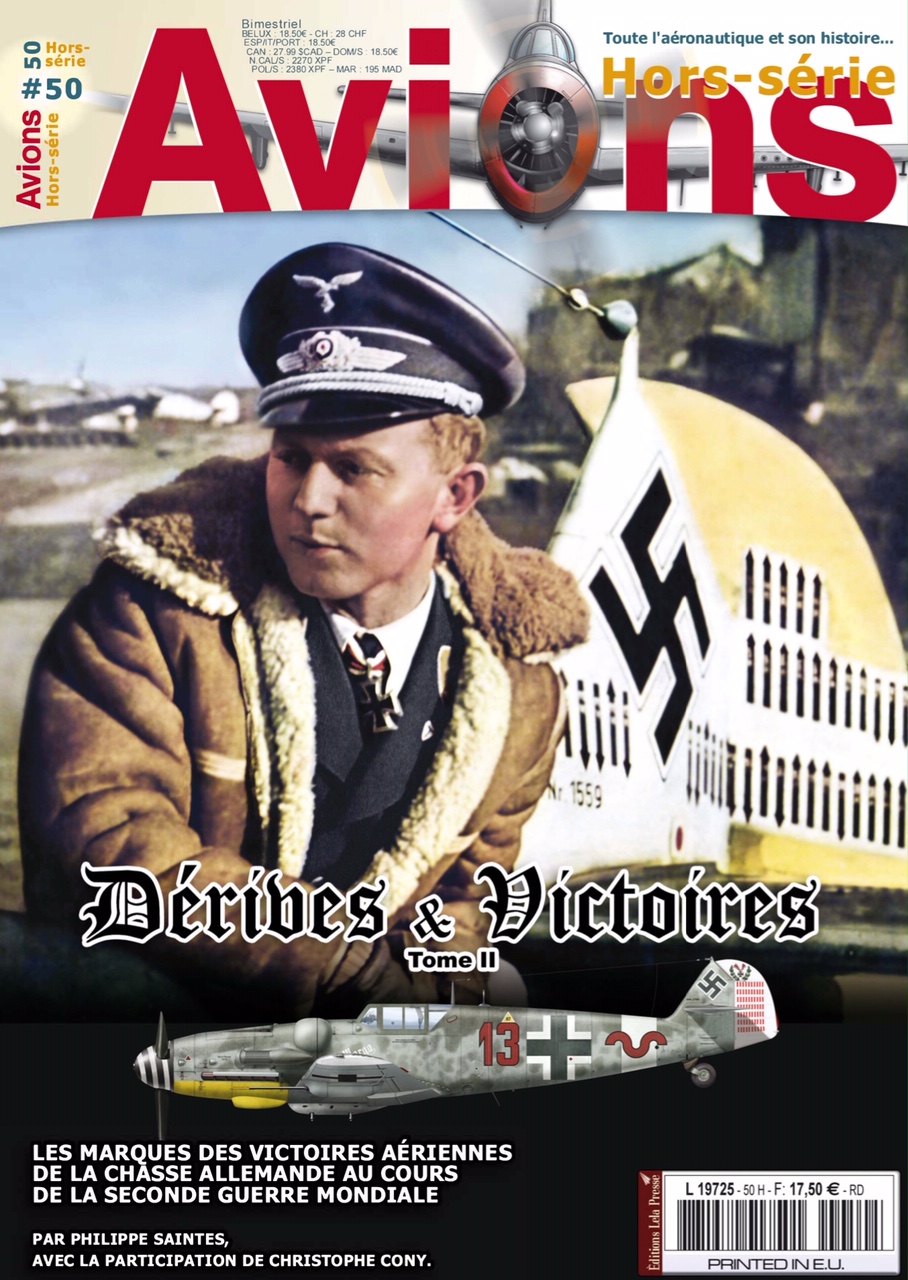
The latest monograph from Philippe Saintes is Part II of the 'Derives et Victoires' series published by Lela Presse - profile artworks, 96 pages, 185 photos - a bargain from the Lela Presse website where you can download a pdf extract of the title.
On a recent road trip to Belgium I secured a copy of a long sought after title " La chasse de jour allemande en Roumanie" (Luftwaffe Day fighters in Romania) which covers in depth the air battles for Romanian oil from the establishment of JG 4 to 'Tidal Wave' to the combats of April-July 1944 fought by JG 77 and JG 52 to the Russian arrival in Bucharest in August 1944..it is only a slim soft-back and 25 years old but is packed with first-person accounts and rare images..
..and a box full of Jägerblatt magazines - plenty of material for future blog posts!
..and, after his hassles with various publishers, Christer's latest volume in the Black Cross-Red Star series is entitled "Stalingrad to Kuban" ;
" ..masterfully combines the combat experiences of both Soviet and German aviators into a coherent narrative...an indispensable reference.." Highly recommended..
Tuesday, 30 October 2018
The story behind the Luftwaffe book(s) - a Luftwaffe blog interview with Jochen Prien
Hello Jochen, thank you for being willing to appear on the Luftwaffe blog and for answering my questions. Could you please relate a little about yourself as writer and
historian? How did you come to write the history of JG 53 ?
Well, there are two different questions there! What can I say about myself as a writer and historian ? That's a difficult one. I’m not an educated historian, just someone very much interested in recent German history, in particular that of the Luftwaffe. I have commented on my motivation in several earlier posts on TOCH and LRG – suffice it here to say that a main drive of my occupation with the Luftwaffe fighter force is the fact that I’m truly grateful to live in a time in which so far no one has fired a shot at me other than my father’s generation which was deprived of their youth and had to go through the war instead. Therefore I feel obliged to try to create a forum where the names of those which fell victim to the war are preserved. And one thing I can say for certain as a writer is that I want to come as near to the actual facts as possible; at the same time I want to overcome long living legends and most of all the remnants of Propaganda and Nazi ideology which is still evident in several publications dealing with the Luftwaffe up to this day.
As for JG 53 – well, I certainly did not wake up
one day being struck by the idea that I should write the unit history of JG 53.
In fact it was much rather a matter of coincidence. In 1985 I was asked to team
with Gero von Langsdorff, Hans Ring and Winfried Bock to research and write the
history of JG 3, this being a project of the verterans association of the
Udet Geschwader. It ended in dismal failure as the association and in paticular
its president proved to be totally incapable of any sort of reasonable
co-operation and support and, what was even worse, aiming at censoring the
manuscript to bring it in line with their perception of history. So, deeply
frustrated we quit this project.
While this was
still going on and with nothing at hand to spend time on the JG 3 project, I
continued my search for material for my collection. In mid 1986 I came into
contact with Julius – Jule – Meimberg
who invited me to his home asking me to show him what material I had on JGs 2
and 53. Back then it was still possible to stuff all of it in a laundry basket
and so I drove to Münster. I returned with all of his albums and documents but
had to leave my material with him as security. Two weeks later I swapped my
binders for his material. On this occasion he sort of casually enquired why I
shouldn’t write the unit history of JG 53 – he had an uncanny persuasiveness
and on the background of my JG 3 frustration he quickly talked me into his
project so that I accepted.
Next time we met –
around September 1986 - Jule had
gathered four more JG 53 veterans, Helmut Bennemann, former Kommodore, Alfred
Hammer, long time Staffelkapitän of 6./JG 53 and former Gruppenkommandeur of
IV./JG 53, Wolfgang Dreifke, former Geschwader-Adjutant and finally Walter
Rupp, flamboyant former Kapitän of 3rd Staffel. Together they signed a
recommendation addressed at all former members of JG 53 to help me research and
write the history of their Geschwader. This document over the next year opened
the vaults of several hundred former pilots and ground-crew men of JG 53,
leading to a steady flow of both documents and photos. The year 1988 was spent
with writing the manuscript, the first part of which was published in 1989 if I
remember it correctly. Unfortunately the printing and binding quality of Vol. 1
produced by Flugzeug Verlag was so bad that I decided to publish the remaining
two volumes myself with the help of Struve Druck, generously assisted by a loan
given by Jule and the other four
sponsors – they gave it with the provision that only as much had to be refunded
as the sales of the books allowed, the rest à
fond perdu. It was paid back in total.
My first
published article / book ? – that’s an easy one! In Luftfahrt International Issue 11/ 1980 I published an article
dealing with the red bands on the engine cowlings of JG 53’s Bf 109 Es
during the BoB entitled "Rote Ringe - Jagdgeschwader 53". Looking back at it now it was sort of poking in the mist yet it
alerted the late Michael Payne who became a very good friend for many years.
How did your interest in the Luftwaffe develop - your father won the Ritterkreuz but was not an aviator I believe?
My father was in
fact responsible for my interest in Luftwaffe matters in general and in the Bf
109 in particular, not because of his own war-time experience as a tank officer
but because he started to build scale models in the early fifties, lining them
up on a nylon thread above my bed. So when I went to bed and when I woke up as
a child there were always a string of aircraft models dangling from the ceiling
above me. This of course triggered my interest to build models on my own – and
the Bf 109 was the most appealing in my eyes ( and still is ).
How do you recall writing and researching
in the pre-internet pre-personal computer era? The jacket ‘blurb’ on the
original German language edition of both the JG 53 and JG 77 histories if
I remember correctly explained that the text was type-written and photo-statted
to produce the finished work?
It was totally
different in many ways. Research was done by going personally to as many
archives and museums as possible, in Germany and abroad, such as the
Studiengruppe Luftwaffe, the Bundesarchiv and the BA/Bildarchiv, the BA at
Kornelimünster, Sammlung Preussischer Kulturbesitz, IWM, ECPA to name just a
few. Archives in the US could only be approached by writing letters. The most
comprehensive means of information were micro-films with lots of original
Luftwaffe documents stored but it was quite a cumbersome procedure to exploit
the information. Most of the work was done by writing letters and using the
telephone. It was all much slower than today and the waiting for a return
letter was often enervating. There can be no doubt however that it was much
more difficult then to create a comprehensive representation of for instance a
unit history.
One thing however
was much better then – there were still many former pilots and ground-crew men
around who were willing to help and still had a good memory.
Yes, it is true
that all three volumes of JG 53 and the first two of JG 77 were written with a
simple NEC writing system with the text being stored on numerous floppy-discs. The
text was printed and the photos inserted by Struve Druck.
Just how much time is devoted to the writing and research
of your JfV series? how is the work load shared with your collaborators? There
are now some 18-20 volumes in this series..is the ‘end’ in sight or is it still
‘open-ended’?
Don’t ask me how
much time is devoted to writing and research – a lot! In our team I’m
responsible for the text and the photos, whereas Gerhard checks the loss lists
and Winfried contributes the information for the claims lists and re-checks the
loss lists and the text. Of course we constantly discuss many issues underway.
The end of the JFV
series is in sight. After Vol. 13/IV, V and VI containing the statistical parts
of the service over Germany and France in 1944 as well as Norway against the
Western allies there will be most likely
either one big or two medium volumes covering the Mediterrannean ToW in 1944.
The final major chunk dealing with 1944 will be the East, most likely two or
three volumes. That will leave us with 1945 – no idea yet how best to tackle
this.
Some of your work has been published in
English, but most of it has not - why is this ? Would you not achieve a
wider readership if you published in English for example?
Well, I’m a native
German dealing with a German topic so it is not entirely unusual that this is
done in German. But yes, I would be very happy if at least the JFV series could
be published in English but so far it has been impossible to find a publisher
for such an undertaking, even less so as there is no guarantee that the series
will actually ever be completed. Even the prospect of a substantial up-dating
of the manuscript and an equally substantial addition of new photo material has
so far not triggered any tangible interest.
What do you think of the Osprey ‘Aces’ series - more to the point would you ever consider writing a book for Osprey, as some otherwise serious researchers have started to do. And people like Erik Mombeeck have launched their own book series such as ‘Luftwaffe Gallery’. Would you ever consider releasing your research/collection in this more ‘accessible’ type of format?
Well, I'd certainly be prepared to offer my material gathered over the last 20 years for a revised English version of the JFV series but I’m not planning anything like Mombeek’s Luftwaffe Gallery.
I have never seen a copy of the Osprey “ Aces “ series so I cannot comment on that. Yet I cannot imagine to write something about aces as this is a subject I do positively dislike for several reasons.
That's an interesting comment. I suspect you dislike the fact that
many of the aces achievements may be taken out of context and inflated in
importance as they possibly were by wartime propaganda?
In my opinion there
is way too much emphasis being laid on the phenomenon of German fighter aces and
their scores in Luftwaffe publications, often not far away from wartime
propaganda; to me they were just a part of the overall picture and certainly
not the most important one. From a
distance of almost 80 years the number of claims filed should no longer be
sufficient reason to focus on this small group of pilots: it seems more
appropriate to acknowledge the fact that all pilots, the old hares like the young
newcomers, had but one life to lose and that the unnamed pilots that perished
in the war deserve the same space in the history of the German fighter arm as
do the so-called aces. At the end of the day the number of claims a fighter
pilot scored for me is not enough – at least even to this day - to elevate him
above the rest.
You also comment in your Gruppen histories from time to time on the German fighter aces 'naivety' and their naive 'world view' (cf. letter from Badum in JG 77
Teil II where he describes Russia as being 'dirty'). In your Intro to JG 27 you
of course also recognise that the ace pilots were part of the Wehrmacht which made
possible AH's policy of conquest ..among other things..
When I comment on
the naivety of the German fighter pilots in Hitler’s war on several occasions
this is in most cases not intended to be critical in the sense of an
accusation; nobody who was not around then or in any comparable situation since
and had to go through the same experience is entitled to criticize those young
men for their perception of the countries and the population they were sent to.
It’s just very striking in many cases to see just how much they were caught in
the results of their (school-) education, intensively formed by the Nazi
ideology, being led by a spirit of German superiority that left no space for
scepticism or even criticism with respect to the part Germany played in the war.
Another frequently encountered theme was the comparison between the social and
economical situation in several – predominantly eastern and south-eastern –
countries and the circumstances back home, almost inevitably leading to the
conclusion that Germany was the superior nation. In not really few cases this
comparison and the resulting high self-esteem led to the credo that Germany
through the Wehrmacht was in fact called upon to bring
order to the occupied countries. The tragedy was just how far the often –
really or just imagined - good intentions were from the reality of the Nazis' war aims. A very wide field indeed and certainly too much to be addressed here
comprehensively.
I read a while ago that you were updating
your Gruppe unit histories?
That‘s just a
side-line – it’s true that in the spare time between the completion of another
volume and the start of the next I have started to re-write the histories of
JGs 53 and 77 on the basis of the vast amount of new information which has
become available over the last 20 or so years. Work on JG 53 has reached the
end of 1940, that on JG 77 early October 1941. I cannot say whether these
efforts will ever lead to complete new unit histories – it’s just very
interesting and helpful to amalgamate the wealth of new information with the
old manuscript.
Jochen, I believe you are a partner in a law firm and work as a barrister. What
are you planning for your retirement and will you have more or less time for
research and writing ?
Retirement is not
yet an issue with three sons still to finish school or university; and honestly
I have no concrete plans other than – if possible – to retire in 2021.
We hear a lot about today’s generation having little or no interest in the events of 75 years ago that shaped our world -are your own sons interested in your work/ the subject area at all?’
My three sons, different as they are, are all interested in German history but not directly through my work and not in Luftwaffe matters in particular. They all made feeble attempts at modelling but this didn’t last long. But we can – and do – discuss historical issues for hours on end which is great fun and quite inspiring at times.
Which of your many publications are you most proud of ? Could you describe the most rewarding aspects of the book production process? And some of the frustrations?
I’m not
particularly proud of any of the books I have published – for me it’s not a
matter of pride. When I sometimes re-read some of the older volumes I arrive at
thinking that it wasn’t really bad but given time and the necessary means most
of it could have been done better.
The most rewarding
aspects certainly were the many postive, sometimes very personal reactions from
former pilots and ground-crew men who felt that the the unit histories had done
their service and their deprivations justice. This of course mainly applies to
the unit histories of JG 1 / 11, 53 and 77 and – to a lesser extent –
those of JGs 3 and 27. Work on the unit histories brought me in touch with a
number of very interesting, sometimes outstandig personalties, the most
prominent one being Julius Meimberg. Just as rewarding
was the fact that through my occupation with the Bf 109 and the Luftwaffe
fighter units I made friends with many very decent fellow historians all over
the world – if I started to name them here I fear that I might forget one and
therefore refrain from it. But they are many and I’m glad to have made their
acquaintance or even gained their friendship.
Frustrations – yes,
there are many but they don’t go deep and are not worth to go into detail here.
As my good friend John Beaman once put it – swatting gnats.
Thank you Jochen for responding to an approach from the Luftwaffe blog and on behalf of the air warfare enthusiast fraternity, thank you for your work!
"...You're welcome. One last thing .. the photo of myself was taken today (03 September 2018) on the North Sea coast on the island of Sylt where my wife and I spent a most enjoyable short weekend. And no, I have no photos either of Gerhard or Winfried – as far as I know Gerhard and Winfried have never met personally, the three of us have most definitely never met up together. So no photos of the crew - I'm not sure that they would be a sales incentive anyway!..."
Below; the latest volume in the huge ‘Luftwaffe fighter unit‘ series from Jochen Prien....Volume 13 part 3, nearly 700 A-4 pages covering Jan-Sept 1944, entitled "Operations in the West".
The Jagdfliegerverbände series and Jochen Prien's individual Gruppen histories are available via his website at http://jagdgeschwader.net
Paypal accepted and orders are expertly packaged and processed rapidly!

Also on this blog; more stories behind the Luftwaffe books!
author interviews with Eddie Creek
Robert Forsyth
Jean-Yves Lorant
John Vasco
Jan Forsgren
Alexander Steenbeck
Wednesday, 29 August 2018
notes on the 'cult of the fighter ace'; the example of JG 53 - by Jochen Prien
Doyen of Jagdwaffe unit histories Jochen Prien took the trouble to respond to a recent blog post on the 'cult of the fighter ace' in the Luftwaffe. The following is reproduced here with Jochen's permission.
" ..I have read your latest post dealing with the Luftwaffe’s policy of 'acedom' and over-claiming. This is of course an intricate topic that cannot possibly be dealt with in-depth in the blog format.Yet there are several statements that I would strongly object to. I have dealt with this in the unit history of JG 1/11, Vol. 1, p 621 pp, which still stands to this day. There are actually two issues – one is the Luftwaffe’s policy to elevate successful pilots to leading positions in the fighter units, making the number of claims the most important factor, and the other the question of the accuracy of the number of claims and the phenomenon of over-claiming. Both topics are of course related to each other. I can only touch the various aspects here in a very short way as a comprehensive comment would result in a book of its own.
The phenomenon of over-claiming is inevitable given the particular circumstances of aerial battles; it is less pronounced when the number of a/c involved in aerial combat is small, but it will be substantial when great numbers of a/c are involved in combat. This is clearly born out by the claims made by the Luftwaffe Sturmgruppen over the Reich in 1944, when the claims filed – and confirmed - far exceeded the actual US losses. However the majority of the claims were made in good faith – when a Gruppe of 30 or more Fw 190s opened fire on a B-17 or B-24 box simultaneously and the pilots saw comparatively large numbers of bombers explode or go down in flames it was only natural that many or most of the pilots thought that they had actually downed one of the bombers. This obviously resulted in substantial - albeit unintentional - over-claiming. There was a time – way back in the sixties/seventies of the last century – when the general attitude in German Luftwaffe history publications, fueled by experts like Toliver / Constable and the like, had it that the German system of claims verification and confirmation was perfect and the claims confirmed proven beyond doubt, whereas the USAAF and the RAF claims were confirmed independent of facts and vastly exaggerated, this being epitomized by the truly ridiculous 185 claims made by the RAF on 15 September 1940 and the constantly vastly inflated claims by the US bomber units. You can see this nonsense even today in some publications.
In fact Luftwaffe fighter claims were always prone to over-claiming. This was not pronounced during the Phoney War and the Western Campaign, but it was very much the case during the Battle of Britain when the fighting took place mostly over enemy territory or over the sea where the Claims Commission could not touch and count the wrecks. This applied in particular to the ZG claims but also to those of several fighter units. In 1941 and 1942 the claims made by JG 2 were greatly exaggerated with a high proportion of them made over the sea. If you want to tackle the issue of over-claiming you will find that this was not a phenomenon to be found in a consistent form in the fighter units; to the contrary the issue has to be addressed individually for every single unit. There were JGs that were prone to allow over-claiming whereas others tried to be as correct as possible with the claims they filed. Notorious over-claimers were for instance JGs 2 and 5 as well as all Sturmgruppen.
In your blog post you portray JG 53 as a unit with particularly high numbers of claims in the 1941 Campaign in the East. However the numbers of claims made by the Gruppen of this Geschwader between 22 June and 30 September 1941 do not stand out in any way compared with those of the other JGs deployed in the East – those claims in said period were as follows;
I./JG 3 – 273, II./JG 3 – 411, III./JG 3 – 367
I./JG 51 – 252, II./JG 51 – 321, III./JG 51 – 308, IV./JG 51 – 468
II./JG 52 – 248, III./JG 52 – 216
I./JG 54 – 212, II./JG 54 – 395, III./JG 54 – 223
II./JG 77 – 211 and III./JG 77 – 374..
Therefore it is simply not the case that the achievements of III./JG 53 have "become legendary" or that the claims made by III./JG 53 were the result of "a benevolent attitude of the higher echelons" nor was JG 53 the home of a particular bunch of "daredevils". The statement that HGr. Mitte had "abdicated its authority to adjudicate in the claims confirmation process" is wholly inaccurate as the Army Command organisation HGr. Mitte had nothing to do with the confirmation of Luftwaffe fighter claims. This was exclusively a Luftwaffe issue. By the same token there is little 'hard' evidence for the various general allegations that over-claiming was enhanced by the Luftwaffe hierarchy and propaganda services and to which false claims this should apply. As for the actual losses of the Russian Air Force – I have yet to see anything like a comprehensive presentation based on complete official documents that would reflect the true losses incurred in the fight against the Luftwaffe. I therefore refrain from commenting on this issue. However I can see no basis at all for reducing the claims of the Luftwaffe fighters to anything like 20 %. You can see from my publications – in particular Vol. 10 and 13 – that I explicitly point at the discrepancies between Luftwaffe claims and allied losses where possible; both in the aerial battles over the Reich and in France the Luftwaffe constantly over-claimed. Another question is to what extent over-claiming was made intentionally. There can be no dobt that this happened, as is evidenced by the often quoted Experten-Schwarm of 4./JG 27. There were certainly many other examples, a wide field....
...A few more remarks concerning JG 53 as they relate to your blog post: Herbert Kaminski was not shot down in aerial combat on 24 July 1942 but was severely injured in a landing accident owing to engine failure; he was by the way a Gruppenkommandeur not appointed by virtue of the number of his claims – 5 by the time he became GrKdr. of I./JG 53 – but for other exploits. This was not uncommon in JG 53 – for instance Lt. Alfred Hammer from 6./JG 53 was awarded the EK I without a single claim in the summer of 1942 only because of his successful escort sorties for air transport units to and from North Africa. (see below) Günther von Maltzahn made it a point that the successful execution of a task was more important than filing a claim for an e/ac shot down. I./JG 53 was quite active over Stalingrad in August and September 1942. The three pilots mentioned in your blog post – Peissert, Hagedorn and Zellot – all met their death in the fighting over Stalingrad in early September 1942 and not at some later point in time in the East. As for the claims made by I./JG 53 in Russia in the summer of 1942 – one thing would be to reliably name the true number of Russian losses to compare them with German claims, which so far has not been achieved, and the other would be to prove and show tangible facts that the German verification system was sloppy and eager to produce 'heroes' for the Propaganda. None of this has been presented so far, instead there is only the unfounded assertion that as little as 20 % of German claims were justified to come near the actual results. The magnanimous comment that the claims made must not necessarily have been the result of wilful falsification doesn’t make it any better – why over-claim on a 5 : 1 ratio in good faith ? To conclude - an opinion piece certainly, but I would respectfully suggest that you refrain from this sort of omniscient loud-speaker comment made from the safe distance of over 75 years and based on sources that are still far from complete...."
Jochen Prien
Alfred Hammer was born in Karlsruhe on 3 July 1921 and after gaining his Abitur joined the Luftwaffe, completing officer and pilot training at LKS 4 in Fürstenfeldbruck. After Jagdfliegerschule Werneuchen he was posted as Oberfähnrich to the Ergänzungsgruppe JG 53 in La Rochelle, France. In November 1941, Lt. Hammer moved with II./JG 53 to the Mediterranean theatre and subsequently flew some 280 sorties from Comiso, Sicily. On 14 May 1942, Hammer crash-landed his damaged Bf 109 F-4 (W.Nr. 7553) at Comiso following aerial combat over Malta with RAF Spitfires. Hammer recorded his first victory on 25 October during his 271st combat mission, claiming a Spitfire over Malta. Following several months off the flight roster with jaundice, Hammer recorded his second victory during operations over Tunisia on 4 March 1943, claiming 2/Lt Harry Gasaway's 82nd FG P-38 shot down on his 299th combat mission. During the final evacuation of Tunisia, Hammer flew out four of JG 53's ground crew in his Bf 109. On 10 July 1943, now operating from bases in Sicily, Hammer shot down a Spitfire for his sixth victory. However, he then suffered engine failure in his Bf 109 G-6 (W.Nr. 183 98) “White 14 + -“ and made a forced landing southwest of Gerbini. Leutnant Hammer was appointed Staffelkapitän of 6./JG 53 on 28 July 1943. On 20 August, II. and III./JG 53 were scrambled to intercept a formation of four-engine bombers with a strong fighter escort raiding Capua in Italy. In the subsequent combat, 14 USAAF P-38 twin-engine fighters were claimed by JG 53 pilots, including one by Hammer for his seventh victory. From Italy, where he had acquired the nickname 'Martello' (Italian for 'hammer'), 'Alfredo' moved to Vienna-Seyring and was promoted to Oberleutnant operating in the Reichsverteidigung. On 7 January 1944 II./JG 53 were scrambled to counter a large formation of bombers raiding Vienna.
At an altitude of 8,000m they intercepted 20 to 25 P-38 Lightnings. In the ensuing combat, which drifted south and ended at low-level over northern Yugoslavia, II./JG 53 claimed 15 P-38s shot down, including one by Hammer as his 10th victory. On 24 February, Hammer was wounded by defensive fire from USAAF four-engine bombers raiding the Steyr works at Linz. He was forced to land at Linz due to blood loss from his wounds and was hospitalised at Wels. Hammer was again wounded on 13 June 1944, operating over the Invasion front, in aerial combat with USAAF B-24 four-engine bombers and their P-51 fighter escort near Vannes in France. He baled out near Gail.
In late 1944 Hammer was promoted to Hauptmann and was appointed Gruppenkommandeur of IV./JG 53 based at Echterdingen. He led the unit until the end of the war, flying his last sortie on 20 April 1945, for a total of 463 sorties and 26 confirmed victories. He was decorated with the Frontflugspange in Gold, the Ehrenpokal and the Deutsches Kreuz in Gold. Postwar he returned to Karlsruhe and trained as a teacher and administrator, entering local government as a civil servant in 1957 (Landesbildstelle Baden in Karlsruhe). He retired in 1984 and passed away on 23 December 1997.
(additional information via Jägerblatt 1/1998)
" ..I have read your latest post dealing with the Luftwaffe’s policy of 'acedom' and over-claiming. This is of course an intricate topic that cannot possibly be dealt with in-depth in the blog format.Yet there are several statements that I would strongly object to. I have dealt with this in the unit history of JG 1/11, Vol. 1, p 621 pp, which still stands to this day. There are actually two issues – one is the Luftwaffe’s policy to elevate successful pilots to leading positions in the fighter units, making the number of claims the most important factor, and the other the question of the accuracy of the number of claims and the phenomenon of over-claiming. Both topics are of course related to each other. I can only touch the various aspects here in a very short way as a comprehensive comment would result in a book of its own.
The phenomenon of over-claiming is inevitable given the particular circumstances of aerial battles; it is less pronounced when the number of a/c involved in aerial combat is small, but it will be substantial when great numbers of a/c are involved in combat. This is clearly born out by the claims made by the Luftwaffe Sturmgruppen over the Reich in 1944, when the claims filed – and confirmed - far exceeded the actual US losses. However the majority of the claims were made in good faith – when a Gruppe of 30 or more Fw 190s opened fire on a B-17 or B-24 box simultaneously and the pilots saw comparatively large numbers of bombers explode or go down in flames it was only natural that many or most of the pilots thought that they had actually downed one of the bombers. This obviously resulted in substantial - albeit unintentional - over-claiming. There was a time – way back in the sixties/seventies of the last century – when the general attitude in German Luftwaffe history publications, fueled by experts like Toliver / Constable and the like, had it that the German system of claims verification and confirmation was perfect and the claims confirmed proven beyond doubt, whereas the USAAF and the RAF claims were confirmed independent of facts and vastly exaggerated, this being epitomized by the truly ridiculous 185 claims made by the RAF on 15 September 1940 and the constantly vastly inflated claims by the US bomber units. You can see this nonsense even today in some publications.
In fact Luftwaffe fighter claims were always prone to over-claiming. This was not pronounced during the Phoney War and the Western Campaign, but it was very much the case during the Battle of Britain when the fighting took place mostly over enemy territory or over the sea where the Claims Commission could not touch and count the wrecks. This applied in particular to the ZG claims but also to those of several fighter units. In 1941 and 1942 the claims made by JG 2 were greatly exaggerated with a high proportion of them made over the sea. If you want to tackle the issue of over-claiming you will find that this was not a phenomenon to be found in a consistent form in the fighter units; to the contrary the issue has to be addressed individually for every single unit. There were JGs that were prone to allow over-claiming whereas others tried to be as correct as possible with the claims they filed. Notorious over-claimers were for instance JGs 2 and 5 as well as all Sturmgruppen.
In your blog post you portray JG 53 as a unit with particularly high numbers of claims in the 1941 Campaign in the East. However the numbers of claims made by the Gruppen of this Geschwader between 22 June and 30 September 1941 do not stand out in any way compared with those of the other JGs deployed in the East – those claims in said period were as follows;
I./JG 3 – 273, II./JG 3 – 411, III./JG 3 – 367
I./JG 51 – 252, II./JG 51 – 321, III./JG 51 – 308, IV./JG 51 – 468
II./JG 52 – 248, III./JG 52 – 216
I./JG 54 – 212, II./JG 54 – 395, III./JG 54 – 223
II./JG 77 – 211 and III./JG 77 – 374..
Therefore it is simply not the case that the achievements of III./JG 53 have "become legendary" or that the claims made by III./JG 53 were the result of "a benevolent attitude of the higher echelons" nor was JG 53 the home of a particular bunch of "daredevils". The statement that HGr. Mitte had "abdicated its authority to adjudicate in the claims confirmation process" is wholly inaccurate as the Army Command organisation HGr. Mitte had nothing to do with the confirmation of Luftwaffe fighter claims. This was exclusively a Luftwaffe issue. By the same token there is little 'hard' evidence for the various general allegations that over-claiming was enhanced by the Luftwaffe hierarchy and propaganda services and to which false claims this should apply. As for the actual losses of the Russian Air Force – I have yet to see anything like a comprehensive presentation based on complete official documents that would reflect the true losses incurred in the fight against the Luftwaffe. I therefore refrain from commenting on this issue. However I can see no basis at all for reducing the claims of the Luftwaffe fighters to anything like 20 %. You can see from my publications – in particular Vol. 10 and 13 – that I explicitly point at the discrepancies between Luftwaffe claims and allied losses where possible; both in the aerial battles over the Reich and in France the Luftwaffe constantly over-claimed. Another question is to what extent over-claiming was made intentionally. There can be no dobt that this happened, as is evidenced by the often quoted Experten-Schwarm of 4./JG 27. There were certainly many other examples, a wide field....
...A few more remarks concerning JG 53 as they relate to your blog post: Herbert Kaminski was not shot down in aerial combat on 24 July 1942 but was severely injured in a landing accident owing to engine failure; he was by the way a Gruppenkommandeur not appointed by virtue of the number of his claims – 5 by the time he became GrKdr. of I./JG 53 – but for other exploits. This was not uncommon in JG 53 – for instance Lt. Alfred Hammer from 6./JG 53 was awarded the EK I without a single claim in the summer of 1942 only because of his successful escort sorties for air transport units to and from North Africa. (see below) Günther von Maltzahn made it a point that the successful execution of a task was more important than filing a claim for an e/ac shot down. I./JG 53 was quite active over Stalingrad in August and September 1942. The three pilots mentioned in your blog post – Peissert, Hagedorn and Zellot – all met their death in the fighting over Stalingrad in early September 1942 and not at some later point in time in the East. As for the claims made by I./JG 53 in Russia in the summer of 1942 – one thing would be to reliably name the true number of Russian losses to compare them with German claims, which so far has not been achieved, and the other would be to prove and show tangible facts that the German verification system was sloppy and eager to produce 'heroes' for the Propaganda. None of this has been presented so far, instead there is only the unfounded assertion that as little as 20 % of German claims were justified to come near the actual results. The magnanimous comment that the claims made must not necessarily have been the result of wilful falsification doesn’t make it any better – why over-claim on a 5 : 1 ratio in good faith ? To conclude - an opinion piece certainly, but I would respectfully suggest that you refrain from this sort of omniscient loud-speaker comment made from the safe distance of over 75 years and based on sources that are still far from complete...."
Jochen Prien
Alfred Hammer was born in Karlsruhe on 3 July 1921 and after gaining his Abitur joined the Luftwaffe, completing officer and pilot training at LKS 4 in Fürstenfeldbruck. After Jagdfliegerschule Werneuchen he was posted as Oberfähnrich to the Ergänzungsgruppe JG 53 in La Rochelle, France. In November 1941, Lt. Hammer moved with II./JG 53 to the Mediterranean theatre and subsequently flew some 280 sorties from Comiso, Sicily. On 14 May 1942, Hammer crash-landed his damaged Bf 109 F-4 (W.Nr. 7553) at Comiso following aerial combat over Malta with RAF Spitfires. Hammer recorded his first victory on 25 October during his 271st combat mission, claiming a Spitfire over Malta. Following several months off the flight roster with jaundice, Hammer recorded his second victory during operations over Tunisia on 4 March 1943, claiming 2/Lt Harry Gasaway's 82nd FG P-38 shot down on his 299th combat mission. During the final evacuation of Tunisia, Hammer flew out four of JG 53's ground crew in his Bf 109. On 10 July 1943, now operating from bases in Sicily, Hammer shot down a Spitfire for his sixth victory. However, he then suffered engine failure in his Bf 109 G-6 (W.Nr. 183 98) “White 14 + -“ and made a forced landing southwest of Gerbini. Leutnant Hammer was appointed Staffelkapitän of 6./JG 53 on 28 July 1943. On 20 August, II. and III./JG 53 were scrambled to intercept a formation of four-engine bombers with a strong fighter escort raiding Capua in Italy. In the subsequent combat, 14 USAAF P-38 twin-engine fighters were claimed by JG 53 pilots, including one by Hammer for his seventh victory. From Italy, where he had acquired the nickname 'Martello' (Italian for 'hammer'), 'Alfredo' moved to Vienna-Seyring and was promoted to Oberleutnant operating in the Reichsverteidigung. On 7 January 1944 II./JG 53 were scrambled to counter a large formation of bombers raiding Vienna.
At an altitude of 8,000m they intercepted 20 to 25 P-38 Lightnings. In the ensuing combat, which drifted south and ended at low-level over northern Yugoslavia, II./JG 53 claimed 15 P-38s shot down, including one by Hammer as his 10th victory. On 24 February, Hammer was wounded by defensive fire from USAAF four-engine bombers raiding the Steyr works at Linz. He was forced to land at Linz due to blood loss from his wounds and was hospitalised at Wels. Hammer was again wounded on 13 June 1944, operating over the Invasion front, in aerial combat with USAAF B-24 four-engine bombers and their P-51 fighter escort near Vannes in France. He baled out near Gail.
In late 1944 Hammer was promoted to Hauptmann and was appointed Gruppenkommandeur of IV./JG 53 based at Echterdingen. He led the unit until the end of the war, flying his last sortie on 20 April 1945, for a total of 463 sorties and 26 confirmed victories. He was decorated with the Frontflugspange in Gold, the Ehrenpokal and the Deutsches Kreuz in Gold. Postwar he returned to Karlsruhe and trained as a teacher and administrator, entering local government as a civil servant in 1957 (Landesbildstelle Baden in Karlsruhe). He retired in 1984 and passed away on 23 December 1997.
(additional information via Jägerblatt 1/1998)
Sunday, 29 April 2018
Jagdfliegerverbände Teil 13/ III & Lela Presse news, Focke Wulf Fw 200 Jean-Louis Roba, latest Luftwaffe books
Latest volume in the huge ‘Luftwaffe fighter unit‘ series from Jochen Prien....Volume 13 part 3, nearly 700 A-4 pages covering Jan-Sept 1944, entitled "Operations in the West". This massive tome covers all fighter units operating in the West up to 06 June 1944 ( pages 1 to 204) with the bulk of the book devoted to the period 6 June-30 September, " Abwehreinsatz gegen die Invasion ". Alongside the 4. and 5. JD fighters of JG 2 and 26, the daily chronology covers such lesser known Bf 109 and Fw 190-equipped units as NAG 13, JG 105, JG 107, JGr. Süd, JGr. 200, SAGr. 128, 5. (F)/123 and the Ju 88 Cs of ZG 1. The period covered in this latest tome is of course characterised by ever-growing and ultimately overwhelming Allied superiority, culminating in the D-Day landings - usually referred to as the 'invasion' - and the liberation of France. Taking one date at random - Thursday 2 March 1944 - there were countless RAF and USAF aircraft in the skies both of northern France (9th AF and 2nd TAF raids against airfields and V-1 installations), towns of western Germany (US 8th AF raid Frankfurt am Main) and southern France (F-5 recce sorties), countered by the Gruppen of JG 26 and JG 2. Losses among the Luftwaffe fighter units were enormous - 2 March 1944 saw the death in action of the Kommodore JG 2 Obslt. Egon Mayer - his successor Major Kurt Ubben would be KIA just over one month later. The strain of relentless combat in the face of overwhelming odds can be seen etched on the face of 34-year old Hptm. Wolfgang Neu (photo second from right top below), Staffelkapitän 4./JG 26, seen on his return from a sortie at the controls of his FW 190 A-7. He was Kapitän of 4./JG 26 from early 1944 until his death on 22 April 1944, shot down over the Eifel during combat. He had tallied 12 victories, including seven four-engine bombers. While Fw. Günther Jahn - top left, a member of Bühligen's Geschwaderstab - was KIA on 24 July as Staffelführer 10./JG 2 strafing Allied positions around Caen.One of the most successful pilots in the West during early 1944 was the Staffelkapitän of 5./JG 26 Ofw. Adolf Glunz - on 22 February he claimed three B-17s and a 78th FG P-47 as well as two further Herauschüsse. Most successful pilot during the 'Invasion' period was Hptm. Theo Weißenberger (Kommandeur I./JG 5) with 25 Luftsiege. He returned his 199th and 200th victories on 25 July - although as the authors point out on page 441, a good number of his 25 'invasion victories' cannot be confirmed from Allied records. The presence of such 'super' aces ( to coin a phrase) makes it possible (just) to argue that constant front-line action made the most of the limited resources available to the Jagdwaffe - by 1944 they were easily capable of anticipating every opponent's manoeuvre in the sky such was their level of experience. At the same time the average Allied fighter pilot would perhaps only fly or have flown 50-100 sorties before being rotated away from the front. ".. Just how good could they be ? " However the skill level of the pool of German pilots presented stark contrasts - so many good pilots were KIA in the first six months of 1944 in the West that most Gruppen were left with only a handful of aces and a small number of experienced but not yet 'expert' pilots, while the vast majority had just hours flying experience and were desperately pressed into service without sufficient training. Elsewhere coverage extends to all the other units that arrived in France to combat the 'Invasion' and is equally as comprehensive - and that includes 4./JG 52, 7./JG 51 and 9./JG 77..
It is difficult to do justice to a work of this nature in just a few lines of blog comment, that much is obvious and I apologise to the authors for my hopelessly inadequate appreciation. Suffice to say, the production values of this latest Prien/Stemmer/Bock volume are top-class, the text and detailed coverage is second-to-none and the photo content is as comprehensive as you would expect..quite stunning. Aside from one or two well-known images, it is obvious that a huge effort has been made to only use 'new' photos and highlights are many; the series of Hans-Ulrich Jung's 7./JG 3 Bf 109 G-6/AS and the Werfer-equipped Fw 190s of III./JG 2 are especially noteworthy.
Ordering via https://www.jagdgeschwader.net/
Eichenlaubträger Hauptmann Weißenberger, Gruppenkommandeur in einem Jagdgeschwader bei einer Nachbesprechung. Prop.-Kp. Lw.KBZ 15 Film-Nr.: 8279/10 Bildberichter: Schödl 4.10.44
Available at www.caraktere.com now is CJ Ehrengardt's Aérojournal 'special' on the Armée de l'Air May-June 1940. While in the immediate post-war period the defeat in May-June 1940 was largely and almost wholly attributed to the failure of the French Air Force - incapable of winning any sort of air superiority over the Luftwaffe's fighters or of holding up the Panzers with the Bre 691s of the ground-attack arm - the work of certain historians during the 1970s went too far in the other direction - the notion that the activities of the French air force inflicted losses that contributed to the victory of the RAF during the Battle of Britain - despite the fact that nearly 2,000 Armée de l'Air aircraft were abandoned on the ground to the Germans! As C-J Ehrengardt relates the reality lies somewhere between the two extremes..
Despite the cover composition - a JG 51 Emil downing a GC I/3 D.520 - the text does not focus on fighter combat, but is divided into three main subject areas;
1/ Autopsy of a débacle
2/ 'One way ticket to Hell' - the Breguets of the assault arm
3/ Armée de l'air training schools
Nicely complementing this treatment and also recently published by caraktere is CJE's 'Encyclopedia of French fighters 1939-42'..
Latest in the Batailles Aériennes quarterly series from Lela Presse is a new title starting a series of issues devoted to the Luftwaffe over Malta. Again, very nicely done and recommended. No idea who author 'Pol Glineur' is - could well be another of Jean-Louis Roba's pseudonyms..Go to the publisher's website here for a sample extract in pdf.
Also due imminently is Roba's new volume on the Fw 200. 320 pages, 660 photos, more info at avions-bateaux.com including a pdf sample extract here
Publisher's offer - orders placed before 23 May dispatched post free!
Latest Chris Goss title in the Frontline 'Air War Archive' series is this neat photo monograph devoted to the Dornier Do 17. While the type was the Luftwaffe's principal light bomber at the outbreak of war, helping to spearhead Germany's Blitzkrieg in Poland and then France and the Low Countries, heavy losses at the hands of Fighter Command in the Battle of Britain saw the type largely superseded by the Ju 88 so that by the summer of 1941 and the invasion of the Soviet Union, KG 2 was the only Dornier Do 17-equipped bomber unit. This book is a compilation of decent wartime images nicely reproduced over 136 pages in a slightly larger than A-5 softback format at a very reasonable price complementing the volumes already published in this series on the Bf 109, He 111 and Ju 88. The images are assembled under five headings, most notably ' Early development and pre-war deployment', 'The Attack on Poland' , 'War in the West', 'The Battle of Britain and the Blitz' and 'After the Blitz, 1941 and Beyond'. While there is a four-page text introduction detailing the major variants including the Kauz nightfighter versions (although only two photos of these particular rare birds), the photo captions comprise the bulk of the text, ranging from one or two lines to a good half-page. You probably won't be surprised to read that a lot of the images depict crashed and wrecked machines – but surprisingly perhaps such shots do show a fair amount of close-up detail, even where aircraft identity is not always confirmed. Coverage post-1941, when the type was serving in various secondary roles, amounts to just a handful of pages..
Subscribe to:
Comments (Atom)