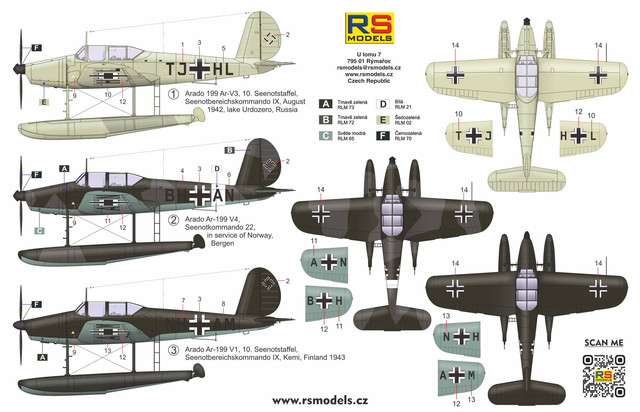
A little reference for a build of the RS Models Arado Ar 199 as recently featured in SAM (Scale Aircraft Modelling)
The Ar.199 was a development of the Ar.79 two-seat sports/trainer, 'crossed' with the Ar.196 float design conceived during 1938-9 for advanced training of seaplane flight crews. The cockpit featured twin tandem (side by side) pilot controls, and in the rear cockpit, equipment and space for a trainee/radio operator.
Unlike the wooden Ar 79, the new aircraft was all-metal and was suitable for ship-borne catapult launch. The first prototype (Ar.199V-1) flew in 1939, followed by the V-2 and V-3. All were powered by the 450 hp Argus As 410C engine with two bladed prop. Although a 'successful' design only around 30 aircraft of the type were built, most of them being constructed in Paris at the SIPA factory (see link below) .
Very little is known about the career of the Arado 199; most were dispersed piecemeal in schools or Seenot rescue units. Two of the prototypes, including the V4, were stationed in Bergen for some time, starting in late 1940. It is known that the V3 was lost on 14 August 1942 while attempting to rescue a shot-down Bf 110 crew in Finland; surprised by Soviet fighters, it was wrecked by their machine gun fire (full story below). Left to rot in its remote location it was still in situ as late as 1994, when the wreck was recovered and dispatched across the Atlantic. The V1 served with 10. Seenotstaffel and was photographed at Santahamina (Finland) in June 1943. It is also likely that A-0 0007, 0011 and 0026 joined it at the same time. Ar 199 coded 'KK+BT', served at the Seefliegerschule Bug in Rügen in May 1944. Finally, 'KK+BX' joined 5. Seenotstaffel in Tromsö in January 1944. An A-0 coded DM+ZE had to make an emergency landing near Tournai on 15 May 1943 and was destroyed there. A few days later, on its way from the SIPA factory to Travemünde, WNr. 0017 sustained slight damage during a forced landing in the Chartres area.
Two 'new' and rare views of a 'stranded' Arado Ar 199 - is this WNr. 0017? Further details unknown..
The third prototype (Ar.199 V-3, above) initially had the civil code D-ITLF (WNr. 3673). During the summer of 1942 and coded "TJ+HL" the machine served with 10. Seenotstaffel, the main base of which was the port of Tromsø, Norway. It was lost during August 1942 during a 'rescue attempt' . The story via 'Jet & Prop' 6/94, Girbig's Jagdgeschwader Eismeer and the sk16ru forum - translated and edited by FalkeEins.
On August 13, 1942 at 14:12 some fourteen Ju.88s were airborne from Banak airfield to raid the Varlamovo-1 airfield (as the Germans called Vaenga-1). Bombing at 15:47 from a height of 6500 m, they attacked the northern part of the airfield and observed "good hits on the edge of the airfield and aircraft dispersals." Some 13 SD 250 and 246 SD 50s were dropped. As defensive measures, the Junkers noted only well-aimed anti-aircraft guns in the area from Rost to Polyarny. They sustained no losses. Escorting the Ju 88s were six Bf 110s of the 'Dackelstaffel' 13.(Z)/JG 5 airborne from Kirkenes airfield at 15:02. One returned home due to technical problems. After completing their mission 3 "Messers" under the command of the future ace Weissenberger were caught up in combat with a group of Soviet aircraft, identified by the Germans as 8 "Tomahawks" some 10 km west of Murmansk at an altitude of 3000 m. The Germans filed a claim for one Soviet fighter, which was allegedly shot down by the gunner-radio operator Uffz. F.K Schröder. He did not have time to celebrate his victory: his Bf 110, flown by Lt. Hans-Bodo von Rabenau, received fatal hits. With one engine on fire and the other streaming glycol, the Bf 110 stood little chance of making it home.
Von Rabenau ordered the crew to jump. In addition to his BF there was a third 'crew' member on board, Kriegsberichter (war correspondent), Sonderführer Kuhnke. Schröder, wounded in his arm, was the first to leave the machine. He was followed by the "propagandist". Judging by his report, at that time the pilot was alive and well, and the plane was at an altitude of 1500 m. However, Rabenau did not bail out, but crashed and burned at the controls of his Bf 110 F-2 (WNr.4547, coded 'LN+MR') attempting a forced landing on the tundra. The crews of the other Bf 110s looked on as their comrade went down. They also saw the two parachutes. The location for these events was described as 40 km southwest of Murmansk. From Soviet accounts Rabenau and his crew fell victim to pilots of the 19th IAP.
As soon as it became clear that the Bf 110 had been downed and that the crew remained on enemy territory, the Germans began to conduct search sorties. For this purpose, Bf 109s were sent out along with Hs 126s from 1.(H)/32 which were airborne from Petsamo between 17:26-20:33. It was the Hs 126 that located the burned-out plane 6 km east of Lake Urd, but failed to spot any sign of the surviving crew. At 22:30, two Bf 110s flew to the scene - Weissenberger and Hauptmann Schmidt. They also found the downed 110, only its location was determined as "9 km east of the southern tip of Lake Urdozero." A kilometer away, Kuhnke was also found and the Bf 110 dropped flares and an emergency supply of food. The Soviets had noted the German search activity in the area of Lake Urdozero and suspected that a particularly important crew member had been shot down there - in their words " no ordinary 'Fritz' pilot would have been looked for as carefully nor for as long.."
Sorties continued through the Arctic 'night' - the Schmidt-Weissenberger Rotte escorted one "Storch" at 03:50 flown by Ofw.Rollnik from the "Zerstörerstaffel". Having found Kuhnke, the Fieseler attempted to land and pick him up, but the terrain was unsuitable - swamps and small lakes. So another "summer emergency kit" was dropped off to the 'propagandist', as well as directions on how to proceed. The Sonderführer was supposed to reach the southern tip of Lake Urd by 10:00 and wait there, marking himself with light signals and coloured smoke cannisters.
Since they were going to save Kuhnke from the shore of a large lake, the Germans decided to send a small seaplane in for him. At 13:07 the Ar.199 coded "TJ + HL" took off from Kirkenes with Ofw. G. Urtel at the controls and Hptm Schmidt's BF radio-operator as a 'guide' in the rear. The Arado was escorted by the same pair of Bf 110s. The German planes arrived at the rendezvous site with no problem but found no one there. However, after circling overhead, they nevertheless found the missing crew. Hptm.Schmidt spotted Kuhnke on the shore of the neighboring Lake Veznyavrsh (south of Lake Urd). Inexperienced in traveling through the tundra, the Sonderführer was apparently lost and was at the wrong lake. This 'mistake' would have sad consequences for them. Just as the Arado managed to put down and launch its inflatable dinghy to attempt to retrieve Kuhnke from the eastern shore, Soviet fighters intervened in the rescue operation.
As soon as the Germans appeared in the area of Lake Urd, pilots of the 19th GIAP and their colleagues from the 197th IAP were quickly in the air - two P-39s and two P-40s and six Hurricanes at around 14:00..
The descriptions on both sides look rather confusing. According to the Germans, two "MIGs" suddenly appeared and attacked the Arado already taxiing to take off and were able to damage it. The right float was shot through, which made it impossible to get airborne. Photographs of the wrecked Arado show that it is listing to the left, and it is the left float that is in the water. Immediately after their success, the Soviet machines themselves were hit by "three" Me-110s, claiming one downed - small consolation for the failure of the rescue mission.
The Germans continued sorties to the area of Lake Urd. From 15:00 to 22:00, 16 Bf 109s from II./JG 5 flew there from Petsamo and at 18:25-19:30 a pair of Bf 110s from Kirkenes. Four crew members people were found 10 km west of Lake Urd on the march towards the front. They were told to move in the direction of field patrol No. 11, from where, in turn, German soldiers were advancing towards them.
..When the seaplane took hits, the pilot Urtel was able to taxy it to the northern shore of the lake. Having taken out an emergency ration and a canister of water from an undamaged float, the Germans destroyed the dashboard and radio, and then went ashore. They also took with them a machine gun, 2 drums with cartridges and navigational instruments. According thier account Soviet aircraft soon arrived and began to strafe the Arado, however, they could not even set fire to it. The Germans at that time were hiding in the forest along the shoreline and escaped with only a slight fright. According to Soviet accounts, on the next day (August 15) and on the morning of August 16, an Sh-2 seaplane twice returned to the scene. As recorded in their report Soviet pilots found the enemy seaplane burned out and wrecked but also removed weapons and instruments from it. However, judging by the photo, the Arado, although crippled, does not show signs of a fire.
On August 15, Bf 109s and Bf 110s flew a number of sorties in search of comrades wandering through the tundra. The fugitives were again found walking in the right direction, there was no pursuit. A German patrol was located just 60 km from the 'place of death' of the Arado. Fortunately for the four pilots, Friedrich had just put it on his map recently. Therefore, laying the route was not difficult, and the main task was to cross the road from the Motovka camp to Ristikent. Here, too, the shot-down crew were lucky. The “road” marked on the map in reality turned out to be just a well-trodden path. It was hard enough overcoming the numerous swamps, while enduring the rain and the cold over night wind. Half-frozen they finally reached German lines on August 15.
It is worth mentioning that Schroeder, who was not discovered during the search operations, was also able to get to German-controlled territory alone, and on August 16 he almost reached Petsamo airfield itself. After treatment in the hospital, he did not return to Norway, but was assigned to V./KG 40.
The Arado remained for many years in the lake, its floats sinking deeper and deeper into the bottom sediments. The place was quite remote and no one touched the “exotic waterfowl” until a power line was pulled past. For the sake of interest, the workers tried to pull the plane ashore with the help of a tractor. At the same time, the struts of the floats broke, and one float remained in the water. In the intervening period the Arado lying on the shore was visited by curious hunters and fishermen. They left traces of their "curiosity" - a tail section with the swastika shot through, the cockpit smashed. When told that the Arado had been located H-H Schmidt was amazed that anything survived as the machine was regularly overflown by JG 5 and used for 'target' practise as the Germans sought to set it alight.
Also on this blog;
Arado Ar 199 manufactured in Paris by SIPA here