Showing posts with label Bf 110. Show all posts

Saturday, 4 October 2025

" Die England-Einsätze " - Oblt. Theo Rossiwall 5./ZG 26


Extracted from a period 'booklet' published in late 1941 ("our third Christmas at the front") for members of 5./ZG 26 and apparently written/compiled by the Staffelkapitän of 5./ZG 26 Hptm. Rossiwall and individually signed by him. I was given this on a trip to Belgium a few years ago. Rossiwall's introduction alludes to the fact that ZG 26 had by this stage of the war shot down over 700 enemy aircraft and destroyed around 1,000 on the ground and the last sentence of his diary text concludes " [..].. the end of the huge campaign in the East is slowly drawing near.."


Die England-Einsätze

 ".. the period of missions against England ('England-Einsätze'began in mid-August 1940. For obvious reasons I can't go into as much detail as I have done on the campaigns already concluded. Looking back on it though everyone says that it was the best time in terms of combat ("..so sagt jeder, dass es kämpferisch die schönste Zeit war..") We shifted from Crécy to St.Omer and found ourselves assigned the best accommodation in a small farmhouse with running water and electricity. We later moved to St. Aubin near Lisieux were we were put up in a villa with a bathroom and warm running water. In total we flew 45 missions over England, firstly against London and targets in the vicinity of the capital - usually from our Absprungshafen or 'jump-off' airfield at Théville - and then against towns along the south coast, penetrating inland as far as Yeovil and Bristol.  

The Staffel was extremely fortunate
(..' Die Staffel war ausgesprochen vom Glück begünstigt..'). We shot down twenty enemy aircraft - all fighters - for the loss of just a single crew. Although this one hit us hard - Ofw. Rochel and his BF Uffz. Schöffler failed to return from an 'enemy flight' on 2 September (Feindflug or sortie). It was not until 24 September that we were enormously relieved to hear that they were both uninjured in British captivity. Uffz. Franke with his radio operator Uffz. Hübner were assigned to 6. Staffel the unit they were flying with when they were shot down on 30 August. We learnt on 13 September that they too were in British hands..attempting to put down on one engine on 2 September Fw. Müller crashed from a height of 10 metres and flipped over on his back. He himself was able to return to the Staffel in December but his Funker Uffz. Gröhl was badly injured and as I write this is still undergoing hospital treatment. On 23 August we lost Oblt. Niebuhr who was posted to take charge of 4. Staffel. He took Uffz. Thiessen with him. On 31 August Uffz. Lohoff - BF in Uffz. Leinfelder's crew - was slightly injured and hospitalised in Brussels. On 29 September Oblt. Hubel took over the leadership of 4. Staffel with his BF Uffz. Schrodt following the death of  Oblt. Niebuhr ( shot down and KIA on 27 September in Bf 110 '3U+IM' with his BF Thiessen near Arne, Dorset) Oblt. Ihrcke was transferred to 6. Staffel... "


ZG 26 Kommodore was Oberst Huth up to 31 August 1940, succeeded from 01 September by Oberstleutnant Johannes Shalk. ZG 26’s I Gruppe was commanded by Hptm. Wilhelm Makrocki through the Battle of Britain. Awarded the RK in October 1940 he was shot down on 21 May 1941 off the coast of Crete during the operation to take the island - 'Merkur'. Hptm Ralph von Rettberg headed II Gruppe during the Battle of Britain. Rettberg was awarded the RK on the eve of Barbarossa on June 14, 1941.

In addition to these aces, ZG 26’s line-up included several among the Staffelkapitäne: Hptm Wilhelm Spies (RK also on 14 June, 1941) of 1./ZG 26 later Kommandeur I./ZG 26, Oberleutnant Johannes Kiel of 4./ ZG 26 and Oblt Theodore Rossiwall of 5./ZG 26 who had replaced Hptm. d'Elsa badly wounded on 18 May. 


Above; Hptm. Makrocki with RK awarded 6 October 1940. 

A 'souvenir' photo of flying personnel and ground-crew of I./ZG 26 taken in northern France (St. Omer) probably just prior to the Battle of Britain during June. Makrocki's Bf 110 with Kommandeur chevrons is the backdrop. 


Frankreich-West.- Zerstörergeschwader 26, Oberleutnant Theodor Rossiwall am Cockpit seiner Messerschmitt Me 110 (BA Bild 101I-341-0496-33)


Bottom left;  portrait in Rossiwall's booklet of Oblt. Sophus Baagoe who claimed two Spitfires off Dover on 14 July and two more on 18 August ('the hardest day') and made further Spitfire claims on 11,12 and 13 September with 8./ZG 26. At the time of his death - just prior to the landings on Crete - he was flying with 5./ZG 26 and with around 14 claims was one of the leading Zerstörer pilots. His BF Ofw. Daniel Becker is lower right.

Sunday, 24 August 2025

Bf 110 nightfighters in colour -Lt. Herbert Ludwig (Adrian Matthes 'Fliegerschicksale im Landkreis Nürnberger Land 1918-1949')


Lt. Herbert Ludwig was an instructor and one of the leading aces in II./NJG 101 and flew the Bf 110, Do 217 J/N as well as the Ju 88 G. This Bf 110 is coded '9W+BO' and has 10 Abschussbalken on the tail fin - 9 British roundels and 1 Soviet star - and was likely one of Ludwig's machines. Ludwig claimed two RAF Halifax bombers during Allied resupply ops flown over Warsaw in support of the Polish uprising in late August 1944.  Ludwig was officially credited with around 13 kills although in a March 1945 letter to his wife  he mentions that he was getting close to 20. On the night of 16-17 March, 1945, he downed two Lancasters over Nuremberg before his Ju 88 G-6 was set alight (also coded '9W+BO'). He and his crew bailed out with slight injuries. This colourful machine is Profile no. 109 in Claes Sundin's "Luftwaffe Night fighters Profile Book No. 5 ". The 81 'meander' squiggle over the standard greys would be a challenge for any modeller. Screen grabs from the Fritzlar colour footage. 


As a result of his injuries sustained that night over Nuremburg, Ludwig was unable to fly for several weeks. On 4 April 1945, II./NJG 101, which was based in Unterschlauersbach, was disbanded. The three best crews of II./NJG 101 were Ludwig with 13, Rasper with 11 and Dörscheln with 8 kills. These three crews were transferred to IV./NJG 6 (under Kommandeur Hptm. Martin Becker) in Ingolstadt. The remaining personnel of NJG 101 were transferred to ground combat units. From Ingolstadt and Schleissheim, Becker's Gruppe flew night ground-attack sorties against US columns. Ludwig and his crew failed to return from one of these dangerous low-level missions.

Adrian Matthes has researched and written about Ludwig and his crew and their last weeks and published his in-depth research in a book Fliegerschicksale im Landkreis Nürnberger Land 1918-1949 and on the net. Please visit his web-page at the following link.


Also on this blog;

Wednesday, 14 May 2025

Ofw. Walter Karbstein, 2./ZG 76


While researching his history of ZG 76, author Peter Kaššák came across a unique gun camera video from this unit. It was filmed by Ofw. Walter Karbstein of 2./ZG 76 on Sunday 2 April 1944. On this date, Bf 110 Gustavs of I. and III. Gruppe of ZG 76 were scrambled from Ansbach and Öttingen and participated alongside crews of II./ZG 1 in the defensive actions over the Reich as US bomber formations flew a major raid on targets in Austria and Yugoslavia, including the ball-bearing plant at Steyr. Some 28 Bf 110 Gs were airborne at 09:15 and, upon return at about midday, reported just one claim that would be confirmed - Walter Karbstein's attack on a lone B-17. Karbstein was in 2. Staffel, but flew his attack in cooperation with others. His victim was likely destroyed southwest of Linz at 5000 meters at about 11:15. Thanks to the Eric Zemper Collection of the 457th BG Association we can see this action on a short gun camera video clip - Karbstein's Bf 110 closes from astern on a lone B-17 which already appears to have had its port wing set on fire but continues to fly straight and level. Note the picture shake as the German pilot unleashes his salvos; 


 Just a short time after this action ZG 76 converted onto the Me 410 and battled against the 15th USAAF over the south of the Reich area. On one such sortie, flown on 27 June 1944, the Stab flight of Zerstörergeschwader 76 lost two machines - one of them was the Messerschmitt Me 410 B-2/U2 coded 'M8 + chevron 3', which crashed at Bánhida in Hungary. The crew, consisting of pilot Ofw. Walter Karbstein and his Bordfunker Uffz. Ernst Keller, were both killed. 

 A civilian photo of Walter Karbstein taken when he entered military service 


This material does not appear in the recent book published by Peter Kaššák and M. Žatkovič entitled 'Zerstörergeschwader 76 - History of the German Luftwaffe unit 1939 - 1945'. 

Since publication Peter's book has received excellent reviews from Luftwaffe and airwar history enthusiasts - " one of the best texts on a Luftwaffe unit of the past 10-20 years.." It is a high quality 'print-on-demand' title, available at the lulu.com book store and previously reviewed on this blog here. 

The Eric Zemper collection can be found at https://457thbombgroupassoc.org


Sunday, 6 October 2024

Hasso von Zieten and crew, II./NJG 101 -archive photo scan #34


Fw. Hasso von Zieten of II./NJG 101 (left) with his crew, BF (radio operator) Hubert Ungerbock and BM (flight mechanic) Fritz Hohensee in front of their Me 110 G nightfighter during conversion training in October 1944.


From Graz, Austria, Von Zieten was a Ju 52 transport pilot before being posted to 5./NJG 101 during April 1944 in Parndorf. From here Nachteinsätze were flown in the Bf 110 G and then the Ju 88 G even during their conversion training which lasted until the end of the year. Shortly before Christmas 1944 Von Zieten and crew were sent to Griesheim (Darmstadt) to fly a sortie during the Bodenplatte operation - possibly a night ground attack sortie on New Years Eve or as 'Lotse' (guide) for the fighter pilots on the morning of 1.1. 45 itself. At least two II./NJG 101 crews were shot down over Belgium. The fledgling nightfighters then returned to Parndorf before being posted to Unterschlauersbach (Nuremberg). From here II./NJG 101 - including the aces Herbert Ludwig, Hans Rasper, etc - continued to fly operational sorties until the end. Most of these were flown as Nachtschlachter against American road columns pressing into southern Germany. 

Hasso & Fritz survived the war. Hasso emigrated to Canada in 1952 and met Fritz again at the 40th Battle of Britain anniversary air show in Toronto, 1980. Von Zieten died in December 1986 aged 71. 

Friday, 2 August 2024

Bf 110 nightfighters in colour - exhaust flame dampers

Some examples of the heavy flame dampers on Nachtjagd Bf 110s for modellers. I recall reading somewhere that they may have been painted in a special heat resistant (black) paint (?) as at Hendon (below) but one modeller convinced me that there were examples of the flame dampers in light blue-grey with his take on a couple of Eduard Bf 110 builds. Some screen grabs from the Fritzlar colour footage below..


And from Petr Zaras, Schnaufer's Bf 110 G-4 in 72nd from the Eduard Profipack. The Hakenkreuz was presumably obliterated for FB..


Thursday, 18 July 2024

Oblt. Hans Kriegel, Lt. Felix Brandis, 'German eagle hunting the British lion' - ebay photo find #378


Note the 'Dita 13' on the nose above - usual marking of Oblt. Hans Kriegel, StaKa of 7./ZG 76 who was WIA in Bf 110 C-4 "2N+DR" in combat with a 252 Sqd Beaufighter on 28 June 1941. Kriegel was later Kommandeur IV./JG 5  (thanks to regular blog visitor Mr. Davis for spotting this one)


Emblem of 7./ZG 76 on the nose of the Bf 110 flown by Lt. Felix Brandis - image below shows him dismounting after his 3rd victory on June 1, 1941 and previously published in the JG 5 Special album ('Luftwaffe Gallery')


Peter Neuwerth's site has a page of photos of Kriegel's Bf 110s and Bf 109s here

Thursday, 21 March 2024

ZG 26 Bf 110 - archive photo scan #17


A 7.Staffel ZG 26 Bf 110 E/F possibly on Sicily or in North Africa. A good view of the penguin emblem with 'Sonnenschirm' parasol/sunshade over the Zerstörer vertical chevrons. Note too the white spinner tip, another 7.Staffel marking. The exhaust has a deflector plate to prevent intake ingestion of hot gases.

Tuesday, 5 September 2023

Unit history of III./ZG 26 reprinted (Lela Presse)


publishers blurb

" It may seem surprising in the context of a unit history to cover just a single Gruppe. However, III./ZG 26 - which started WW II as a Bf 109 unit - was 'detached' early on from its parent Geschwader and fought a very 'independent' war. Having received twin-engine Bf 110s during the Phoney War, the unit was largely deployed in the West and over England during 1940. Rested at the end of 1940, like all Zerstörer Gruppen, III./ZG 26 was sent to the Mediterranean in early 1941, where the unit's heavy fighters mainly supported the advance of the Afrika Korps while escorting shipping supplying the German Army in Africa. The Bf 110s also served as 'ad-hoc' transports ferrying in fuel in their 900 ltr drop tanks to be pumped out into jerry cans. In 1943, after the fall of Tunisia and facing the numerical superiority of the Allied air forces, III./ZG 26 returned to Germany and equipped with heavy weapons - including BR 21 rocket grenade launchers - was thrown into the bloody combats above the Reich. The Bf 110s were decimated and the unit was dissolved in mid-1944..."

Reader's review

".. a war diary of a unique Luftwaffe unit, III./26 saw action action from 1939 to 1944, when it was disbanded for lack of personnel, decimated above the dying Reich, its ME-110s by then obsolescent and out-classed by Allied long-range escort fighters. The talented (the word is weak when you know the talent of the author! ) Jean-Louis Roba has reconstructed, page by page and virtually day by day, the glory days and dark hours of a very special unit that flew for 90% of its time on an aircraft that was innovative and elegant but under-powered and under-equipped, which in no way detracted from the courage of its crews and technical personnel. On the contrary, because they were called upon to fight on almost every front. This is an excellent reference work, lavishly illustrated with a number of colour photos and written with great rigour. A book for enthusiasts of Second World War air history, but also for model makers eager to find new subjects .."

A 176-page book with 380 photos and 28 color profiles. French text. A 15-page pdf extract is available to view on the Lela Presse web site here

Also on this blog; The "Luchy" trial - III./ZG 26 pilot murder

Saturday, 28 January 2023

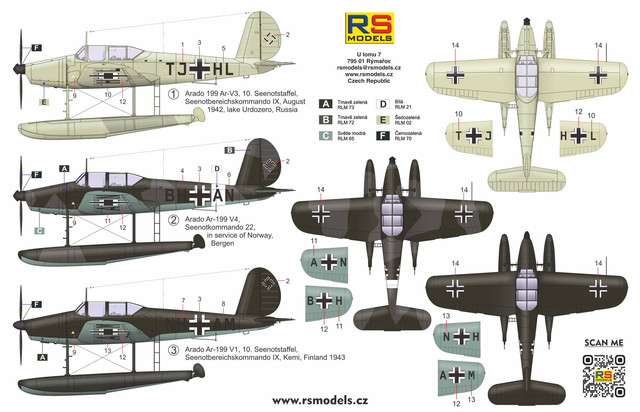
more on the Arado Ar 199s - 'TJ+HL' Ar 199 V-3 10. Seenotstaffel, Norway, August 1942.


A little reference for a build of the RS Models Arado Ar 199 as recently featured in SAM (Scale Aircraft Modelling)  


 The Ar.199 was a development of the Ar.79 two-seat sports/trainer, 'crossed' with the Ar.196 float design conceived during 1938-9 for advanced training of seaplane flight crews. The cockpit featured twin tandem (side by side) pilot controls, and in the rear cockpit, equipment and space for a trainee/radio operator. 

Unlike the wooden Ar 79, the new aircraft was all-metal and was suitable for ship-borne catapult launch. The first prototype (Ar.199V-1) flew in 1939, followed by the V-2 and V-3. All were powered by the 450 hp Argus As 410C engine with two bladed prop. Although a 'successful' design only around 30 aircraft of the type were built, most of them being constructed in Paris at the SIPA factory (see link below) .

 Very little is known about the career of the Arado 199; most were dispersed piecemeal in schools or Seenot rescue units. Two of the prototypes, including the V4, were stationed in Bergen for some time, starting in late 1940. It is known that the V3 was lost on 14 August 1942 while attempting to rescue a shot-down Bf 110 crew in Finland; surprised by Soviet fighters, it was wrecked by their machine gun fire (full story below). Left to rot in its remote location it was still in situ as late as 1994, when the wreck was recovered and dispatched across the Atlantic. The V1 served with 10. Seenotstaffel and was photographed at Santahamina (Finland) in June 1943. It is also likely that A-0 0007, 0011 and 0026 joined it at the same time.  Ar 199 coded 'KK+BT', served at the Seefliegerschule Bug in Rügen in May 1944. Finally, 'KK+BX' joined 5. Seenotstaffel in Tromsö in January 1944. An A-0 coded DM+ZE had to make an emergency landing near Tournai on 15 May 1943 and was destroyed there. A few days later, on its way from the SIPA factory to Travemünde, WNr. 0017 sustained slight damage  during a forced landing in the Chartres area.

Two 'new' and rare views of a 'stranded' Arado Ar 199 - is this WNr. 0017? Further details unknown..


The third prototype (Ar.199 V-3, above) initially had the civil code D-ITLF (WNr. 3673). During the summer of 1942 and coded "TJ+HL" the machine  served with 10. Seenotstaffel, the main base of which was the port of Tromsø, Norway. It was lost during August 1942 during a 'rescue attempt' . The story via 'Jet & Prop' 6/94, Girbig's Jagdgeschwader Eismeer and the sk16ru forum -  translated and edited by FalkeEins.

On August 13, 1942 at 14:12 some fourteen Ju.88s were airborne from Banak airfield to raid the Varlamovo-1 airfield (as the Germans called Vaenga-1). Bombing at 15:47 from a height of 6500 m, they attacked the northern part of the airfield and observed "good hits on the edge of the airfield and aircraft dispersals." Some 13 SD 250 and 246 SD 50s were dropped. As defensive measures, the Junkers noted only well-aimed anti-aircraft guns in the area from Rost to Polyarny. They sustained no losses. Escorting the Ju 88s were six Bf 110s of the 'Dackelstaffel' 13.(Z)/JG 5 airborne from Kirkenes airfield at 15:02. One returned home due to technical problems. After completing their mission 3 "Messers" under the command of the future ace Weissenberger were caught up in combat with a group of Soviet aircraft, identified by the Germans as 8 "Tomahawks" some 10 km west of Murmansk at  an altitude of 3000 m. The Germans filed a claim for one Soviet fighter, which was allegedly shot down by the gunner-radio operator Uffz. F.K Schröder. He did not have time to celebrate his victory: his Bf 110, flown by Lt. Hans-Bodo von Rabenau, received fatal hits. With one engine on fire and the other streaming glycol, the Bf 110 stood little chance of making it home.

Von Rabenau ordered the crew to jump. In addition to his BF there was a third 'crew' member on board, Kriegsberichter (war correspondent), Sonderführer Kuhnke. Schröder, wounded in his arm, was the first to leave the machine. He was followed by the "propagandist". Judging by his report, at that time the pilot was alive and well, and the plane was at an altitude of 1500 m. However, Rabenau did not bail out, but crashed and burned at the controls of his Bf 110 F-2  (WNr.4547, coded 'LN+MR') attempting a forced landing on the tundra. The crews of the other Bf 110s looked on as their comrade went down. They also saw the two parachutes. The location for these events was described as 40 km southwest of Murmansk. From Soviet accounts Rabenau and his crew fell victim to pilots of the 19th IAP.

As soon as it became clear that the Bf 110 had been downed and that the crew remained on enemy territory, the Germans began to conduct search sorties. For this purpose, Bf 109s were sent out along with Hs 126s from 1.(H)/32 which were airborne from Petsamo between 17:26-20:33. It was the Hs 126 that located the burned-out plane 6 km east of Lake Urd, but failed to spot any sign of the surviving crew. At 22:30, two Bf 110s flew to the scene - Weissenberger and Hauptmann Schmidt. They also found the downed 110, only its location was determined as "9 km east of the southern tip of Lake Urdozero." A kilometer away, Kuhnke was also found and the Bf 110 dropped flares and an emergency supply of food. The Soviets had noted the German search activity in the area of Lake Urdozero and suspected that a particularly important crew member had been shot down there - in their words " no ordinary 'Fritz' pilot would have been looked for as carefully nor for as long.."


Sorties continued through the Arctic 'night' - the Schmidt-Weissenberger Rotte escorted one "Storch" at 03:50 flown by Ofw.Rollnik from the "Zerstörerstaffel". Having found Kuhnke, the Fieseler attempted to land and pick him up, but the terrain was unsuitable - swamps and small lakes. So another "summer emergency kit" was dropped off to the 'propagandist', as well as directions on how to proceed. The Sonderführer was supposed to reach the southern tip of Lake Urd by 10:00 and wait there, marking himself with light signals and coloured smoke cannisters.

Since they were going to save Kuhnke from the shore of a large lake, the Germans decided to send a small seaplane in for him. At 13:07 the Ar.199 coded "TJ + HL" took off from Kirkenes with Ofw. G. Urtel at the controls and Hptm Schmidt's BF radio-operator as a 'guide' in the rear. The Arado was escorted by the same pair of Bf 110s. The German planes arrived at the rendezvous site with no problem but found no one there. However, after circling overhead, they nevertheless found the missing crew. Hptm.Schmidt spotted Kuhnke on the shore of the neighboring Lake Veznyavrsh (south of Lake Urd). Inexperienced in traveling through the tundra, the Sonderführer was apparently lost and was at the wrong lake. This 'mistake' would have sad consequences for them. Just as the Arado managed to put down and launch its inflatable dinghy to attempt to retrieve Kuhnke from the eastern shore, Soviet fighters intervened in the rescue operation.

As soon as the Germans appeared in the area of Lake Urd, pilots of the 19th GIAP and their colleagues from the 197th IAP were quickly in the air - two P-39s and two P-40s and six Hurricanes at around 14:00..

The descriptions on both sides look rather confusing. According to the Germans, two "MIGs" suddenly appeared and attacked the Arado already taxiing to take off and were able to damage it. The right float was shot through, which made it impossible to get airborne. Photographs of the wrecked Arado show that it is listing to the left, and it is the left float that is in the water. Immediately after their success, the Soviet machines themselves were hit by "three" Me-110s, claiming one downed - small consolation for the failure of the rescue mission.

The Germans continued sorties to the area of ​​Lake Urd. From 15:00 to 22:00, 16 Bf 109s from II./JG 5 flew there from Petsamo and at 18:25-19:30 a pair of Bf 110s from Kirkenes. Four crew members people were found 10 km west of Lake Urd on the march towards the front. They were told to move in the direction of field patrol No. 11, from where, in turn, German soldiers were advancing towards them.

..When the seaplane took hits, the pilot Urtel was able to taxy it to the northern shore of the lake. Having taken out an emergency ration and a canister of water from an undamaged float, the Germans destroyed the dashboard and radio, and then went ashore. They also took with them a machine gun, 2 drums with cartridges and navigational instruments. According thier account Soviet aircraft soon arrived and began to strafe the Arado, however, they could not even set fire to it. The Germans at that time were hiding in the forest along the shoreline and escaped with only a slight fright.  According to Soviet accounts, on the next day (August 15) and on the morning of August 16, an Sh-2 seaplane twice returned to the scene.  As recorded in their report Soviet pilots found the enemy seaplane burned out and wrecked but also removed weapons and instruments from it. However, judging by the photo, the Arado, although crippled, does not show signs of a fire.

On August 15, Bf 109s and Bf 110s flew a number of sorties in search of comrades wandering through the tundra. The fugitives were again found walking in the right direction, there was no pursuit. A German patrol was located just 60 km from the 'place of death' of the Arado. Fortunately for the four pilots, Friedrich had just put it on his map recently. Therefore, laying the route was not difficult, and the main task was to cross the road from the Motovka camp to Ristikent. Here, too, the shot-down crew were lucky. The “road” marked on the map in reality turned out to be just a well-trodden path.  It was hard enough overcoming the numerous swamps, while enduring the rain and the cold over night wind. Half-frozen they finally reached German lines on August 15.

It is worth mentioning that Schroeder, who was not discovered during the search operations, was also able to get to German-controlled territory alone, and on August 16 he almost reached Petsamo airfield itself. After treatment in the hospital, he did not return to Norway, but was assigned to V./KG 40.

The Arado remained for many years in the lake, its floats sinking deeper and deeper into the bottom sediments. The place was quite remote and no one touched the “exotic waterfowl” until a power line was pulled past. For the sake of interest, the workers tried to pull the plane ashore with the help of a tractor. At the same time, the struts of the floats broke, and one float remained in the water. In the intervening period the Arado lying on the shore was visited by curious hunters and fishermen. They left traces of their "curiosity" - a tail section with the swastika shot through, the cockpit smashed. When told that the Arado had been located H-H Schmidt was amazed that anything survived as the machine was regularly overflown by JG 5 and used for 'target' practise as the Germans sought to set it alight. 

Also on this blog;

Arado Ar 199 manufactured in Paris by SIPA here

Sunday, 22 January 2023

Hptm. Herbert Treppe 13.(Zerstörer)/JG 5


Born in Sprottau (now a town in western Poland) on January 30, 1914, Herbert Treppe studied at Breslau university, joining the Marineschule Mürvik in April 1935 where he learned to fly. He studied at the Luftkriegsschule Gatow 1935-36 (note two 's') and received his A/B licences at Celle in September 1936. His 'Lehrlingszeit' concluded with five months blind-flying at the Blindflugschule Wesendorf and subsequently he became an instructor in Brandis. Determined to join a front unit he was posted to KG 26 late in 1940 and according to one source flew in the 'Luftschlacht um England' (Battle of Britain). He flew both day-and-night sorties against land and shipping targets in England and Scotland. On one occasion he succesfully belly-landed his badly shot-up Heinkel He 111 with four wounded crew members in Beauvais after surviving a night-fighter attack.  On February 21, 1941 he was forced to ditch in the North Sea/Skagerrack and spent five hours in a dinghy in temperatures well below freezing before being found. He did not return to flying duties until October that year. After a spell as Ic to the Fliegerführer Nord he flew combat against England, Murmansk and in support of the German army in the Far North. He was appointed Staffelkapitän of 13.(Zerstörer)/JG 5 on June 1, 1943. He wrote an account of one of his first sorties leading the Staffel that summer, claiming two Bostons downed for a 'Doublette' -  as he put it, ".. not bad for a new boy". There are apparently no corresponding Boston losses in Soviet records.


13.(Z)/JG 5 re-equipped with the Bf 110 G early in 1943. Treppe flew Messerschmitt Bf 110 G-2  "1B+AX" (W. Nr. 120 037) out of Kirkenes during autumn 1943 as illustrated here by Kjetil Åkra in Eduard-Info 2015. 


The Zerstörer Staffel was re-named 10./ZG 26 in July 1944. Later in the year Treppe was named as Gruppenkommandeur of IV./ZG 26 (formed during the summer of 1944) and claimed an RAF Coastal Command Liberator on 28 September 1944 timed at 1245 hrs at only 5 metres altitude (over the sea). 

IV./ZG 26 became the new II./JG 5 in February 1945 with Treppe as Kommandeur. As related by Jan Bobek in Eduard-Info 2015-10 the newly reformed II. Gruppe was built up from elements of 9., 12., and 16./JG 5, and partly from the Stab IV./ZG 26 and 10./ZG 26. Interestingly the Messerschmitt Bf 110 Gs from the defunct Zerstörerstaffel were divided amongst the three Gruppen of JG 5 with single-engined fighters and were flown up to the end of the war. 

While the 'Luftwaffe Officer career summaries' page indicates that Treppe passed away in 1984, Jägerblatt published a 75th birthday profile in the December 1989 issue. At this time Treppe was 'Vorsitzender' of the 'Traditionsverband JG 5'.

Wednesday, 5 October 2022

..150th issue of leading German aviation magazine "Klassiker der Luftfahrt" - Luftwaffe in Greece


"...  In the winter of 1999, when the editorial teams of the aviation group of Motor Presse Stuttgart decided to put the history articles from FLUG REVUE into a special issue, probably no one realised that 23 years later this magazine would become a permanent fixture in the German market. Today you are holding the 150th issue of the magazine for aviation history in your hands. 150 issues of emotion, detailed aircraft reports, news, glimpses behind closed hangar doors and the best photography. The latest warbirds and historic aircraft, completed restorations, hitherto unknown photographs from the  WW II era, as well as reports and photos from events and airshows around the world. The classic of aviation reliably provides you with the latest news and historical background... in this issue [..] exciting and previously unpublished colour photos taken by a German soldier stationed near Athens. We publish these rare photographs in our gallery.." 

 Colour image on the front cover of the 150th issue of 'Klassiker der Luftfahrt' - Bf 110s of the Sonderkommando Junck (4./ZG 76) seen in Athens during a stop-over en route to Iraq..


Note the air intake and the enlarged 'tropicalised' radiators, indicating that the machines visible here are Bf 110 E sub-types.  Given the absence of white spinner and nose these machines may have not originally been on the strength of ZG 76 - the third machine from the camera does not have the Haifischmaul (shark mouth) either.  (Thanks to GP for the pointer!)

Also on this blog;

PDF extract of the latest issue of 'Klassiker der Luftfahrt' on the publisher's website here

Wednesday, 3 August 2022

Wartungsarbeit - Bf 110 G "2N + ??" (10.(N)/ZG 1 Lt. Josef Kociok)


 This interesting image shows (presumably) a maintenance task being undertaken on a Bf 110 - but what does it show ?  Attention seems to be focussed on the rear of the machine - master compass calibration or FuG instrument landing test perhaps? 

..No, none of these! Thank you to Alexander S for pointing out that the vehicle in the photo is an oxygen cart - the Sauerstoff-Umfüllgerät 10-50A could be mounted on its own twin-axle 'car' or on a 3-ton truck. The operator is at the Schaltafel or control panel at the rear of the unit which has been backed up to the aircraft.

The machine appears to be a "G" - note 'rounded' enclosed rear cockpit canopy and the MG Z mount apparently minus any armament. As the account below makes clear there would be little call for rearward-firing MGs on an Eastern Front Bf 110 night fighter, if that is what this is. Note the code '2N'  ahead of the Balkenkreuz -   according to Michael Holm's site 10./ZG 1 received the Bf 110 G-2 during the late spring of 1943 prior to the aircraft being 're-assigned' to the 'new'  4. and 5./NJG 200 during the summer of 1943.


More at the kfzderwehrmacht page here

Also on this blog;

Ofw. Josef Kociok 10.(N)/ ZG 1


An excerpt From "Night Witches", by Fergus Mason

" ... On May 9 Kociok shot down three U-2s from another regiment. Then on the night of May 15/16 he encountered the Night Witches. The 46th were out in force that night, to harry the Germans as they fell back on the Taman Peninsula. The deputy regimental commander, former airline pilot Senior Lieutenant Serafina Amosova, was leading a squadron in an attack on one target when the Germans tried to replicate the “Flak circus” tactic that had caused so many problems at Stalingrad. It was less successful this time; in retreat they found it harder to set up the elaborate traps, and the bombers were running at the target one after another. The guns weren’t well enough sited to catch them and the tracers were flying harmlessly wild. Then Amosova saw a trail of sparks race up into the sky and burst in a green flare. Instantly the guns stopped firing. Two miles away and 1,000 feet above, Josef Kociok was orbiting the target zone in a wide circle. Looking out the side window of his Bf 110 G-2 he searched for the tiny shapes of the Soviet bombers in the glow of the swinging searchlights. It was a confusing image, with bomb explosions and curving streams of tracer shells confusing his eyes. Still he watched patiently, until he saw what he was looking for: a line of moving specks, four of them a few hundred meters apart, all heading directly for the target. He opened the throttles and banked, swinging the big fighter round until he was directly ahead of the bombers, then chopped the power and pushed the stick forward. The Bf 110 tipped into a shallow dive. He lowered the flaps to keep the speed down as far as he dared – the Destroyer had a higher stalling speed than even the Bf 109 – and thumbed the transmit button on his radio. He gave the bearing of the incoming bombers then finished with, “Attacking now.” Seconds later the green flare popped open and the guns fell silent. He was clear to make his attack run. Weaving around in the decoy role off to one side of the defenses, Amosova saw the searchlights swing away from her towards the inbound group. It was hard to hold the Kukuruzniks in the beams but enough light was being thrown in their direction that they were suddenly clearly visible. There was no flak though, so they kept going, boring in on their target. The first of them was within yards of the drop point now, already starting to climb to avoid the blast of its own bombs. Then, to her horror, it seemed to stagger in the air as small explosions erupted all over the forward fuselage. Instantly it caught fire and spun out of control as the roar of powerful engines suddenly swelled out of the darkness. The Bf 110 was now hugging the ground, not much higher than the Soviet biplanes flew. As the first bomber blazed up like a candle Kociok pulled back on the stick to leapfrog the falling wreck, then dropped the nose again. The onrushing shape of the second Polikarpov swam into the glowing bars of his sight. His thumb stabbed down on the button, white flames erupted from the nose and the floor vibrated under his feet as the cannons thundered. The second U-2 was snatched aside by the stream of shells and bullets; it, too, erupted into flames and fell towards the steppe. Kociok was already lining up his guns on his next victim. Amosova could only watch in horror as the Messerschmitt skimmed along the line of bombers, blasting them one after another and sending all four crashing down in flames. Around her the other crews were already scattering and heading for home. There was no choice. A one-second burst from a Bf 110’s guns threw out over four pounds of metal and explosives, all travelling at more than twice the speed of sound. It was enough firepower to shatter a U-2 in an instant, and this pilot had the skill to pick off his targets with a single, lethal blast. If they tried to attack again they would be wiped out. Amosova forced her own plane a little lower, practically hiding behind hedges all the way back to the airfield. When Major Bershanskaya heard about the massacre she instantly grounded the regiment for the night; a third of a squadron had been destroyed in a minute, and she wasn’t willing to risk it happening again. Amosova, Popova and the others walked back to their billet in an old school building and sat, weeping, looking at a row of eight empty camp beds...."

(thanks Tim, what happened to the WIP on BM?)

Saturday, 2 April 2022

Bf 110 G night fighter walkaround at the RAF museum (Hendon, London) - comparison with Ju 88 G


There are still a few interesting Luftwaffe aircraft types on display at the RAF museum in Hendon, north London. This was my first visit to this fantastic museum since the dispersal of the very dark 'Battle of Britain' Hall - which is now Hangar 1 and the main entrance.  Whereas types such as the Bf 109 G, Me 262 and Ju 88 have been sent to the museum's Cosford site, Hendon's Messerschmitt Bf 110 G-4 (Werk Nr. 730301) is still on display and can be seen properly! I love the look of the night fighter and the camouflage scheme. The museum's example was surrendered to the Allies in May 1945 at Grove airfield (Denmark) and is probably the most complete Bf 110 anywhere. This particular machine served with I./NJG 3 (3.Staffel) and is fitted with the Lichtenstein SN-2 radar and FuG 220 antenna array. Note contrary to what can be read elsewhere (!) this machine is not fitted with "Schräge Musik" (the upward firing cannon used to attack bombers from below) The rear armament is the type's defensive MG 81 - however two round appertures in the rear canopy glazing are visible either side of the MG 81  - presumably for the SM weapons. This  former NJG 3 machine is also fitted with a ventral bomb rack - most nightfighters in the last months of the war were tasked with ground-attack sorties. I have posted a neat walk-around video at the bottom of this page.


Helmut Bunje provides an operational comparison of the Bf 110 as nightfighter with the Ju 88 in Boiten's 'Night Air War'. He flew both types and achieved downings in both. He achieved his first victory in his 4./NJG 6 Bf 110 G-4 over a Halifax on March 15, 1944. He was still flying with 4./NJG 6 when the Staffel converted to the Ju 88 G-1 and later the G-6 versions in August 1944. In December 1944 Bunje returned his 5th kill, this time over a Lancaster. On February 23, 1945 he claimed three Lancasters and his final two kills were over Lancasters on March 16, 1945 at 3800 metres and 4300 metres south and then north of Schwäbisch Hall. Post-war Bunje trained as an architect and led a successful practise in Hamburg. He passed away in July 2000.

Because the Bf 110 was used in larger numbers for far longer as a night fighter than the Ju 88 the Bf 110 returned a larger number of night victories than the Ju 88. The Bf 110 was smaller and much lighter than the Ju 88 and presumably more difficult to detect when approaching the bomber stream.  The Bf 110's manoeuvrability in an attack on a cork-screwing Lancaster would also be appreciably better.  The Bf 110 had sufficient range - but carried underwing tanks which were difficult to jettison in flight (or not at all according to some sources). The Ju 88 enjoyed better endurance and while it could carry drop tanks being a much bigger airframe all fuel could be carried internally. Speed, performance and armament were comparable but probably better in the Ju 88. Note the four cannon in the nose of the Bf 110. Lower gun ports for the MG 151 are visible while one barrel of a Mk 108 of the asymetrically aligned upper nose cannon is visible. In the Bf 110 the Schrägbewaffnung (slanting armament) where fitted was enclosed with the crew... 


Below; a view of the cockpit/canopy section showing the DF loop antenna and the radio mast. The latter was normally of wood but on this exhibit is a post-war replacement. The DF direction finder is centrally positioned while the mast is offset to port. Antenna extended to the rear tail fin(s) from the mast.  To the right of the MG 81 Zwilling (7.92 mm twin-barelled defensive weapon) a rounded aperture for one of two slanted cannon is visible. Note the Wellenmuster camouflage finish extends over the canopy framing. There are no handgrip panels/stencils in this view of the starboard side of the aircraft. Crew access was always via the port side. The large trailing edge slotted flap extends in a single piece out to the aileron. The red triangular 'Rotring' oil stencil is visible at the oil tank cover aft of the engine. The access panel for the starboard wing fuel tank is indicated by the yellow stencil..  


The Bf 110 was cheaper to build.  The Ju 88 was fitted out with a more modern radar suite -with Naxos and Flensburg- especially for evading Mosquitos and the Ju 88 crew had a decisive advantage with the additional crew member to carry out radar/radio tasks; 

Bunje; "in all important aspects the Ju88 - especially the Ju88 G-6 - was clearly superior to the the Bf 110 G-4.. particularly at altitude."

Bunje goes on to note that the endurance of the Bf 110 G was frequently below operational requirements and that the type was often  " too slow to catch and infiltrate the bomber stream..."  Interestingly he states that   "..jettisoning of the external tanks before combat could be a risky enterprise.." -  while a trigger release mechanism is visible aft of the tank, most sources state that the Bf 110's wing-mounted drop tanks could not be jettisoned in flight. 


Note the 'draggy' exhaust flame dampers that curve up over the wing, except for the starboard inner which vents below the wing to avoid exhaust gases being ingested in the supercharger intake mounted on the upper cowling. Note the VDM prop blades (minus the VDM emblem) have now been correctly repainted in the 'classic' RLM 70 black-green. Note the cooling scoops on either side of the nacelle. Directly below the supercharger intake is a 'window' for a prop pitch control and engine performance instruments. The supercharger intake for the port engine is situated in the port wing leading edge outboard of the engine. A 300 litre drop tank (79 gallons) was carried under each wing.


In general terms performance figures for the Ju88 G-1 were of course higher than those of the Bf 110 G-4. Aders quotes 335 mph at 6000 m (without flame dampers) and goes on to say that this was 31 mph faster than the Bf 110 G-4 since the larger internal fuel capacity avoided the need for the external tanks required by the Bf 110. The Ju88 G-1 used BMW 801 G/H engines 

 Bf 110 G-4 technical data follows;  in the night figher configuration, the flame dampers and ventral racks, in addition to the SN-2 antenna array, impose a considerable drag.


Engines 2 × Daimler-Benz DB 605 B-1 inverted-Vee, rated at 1475 hp each (and displayed alongside the airframe at Hendon)

Length 42 ft 9.75 inch including antenna
Height 13 ft 8.5 inch with the tail up
Empty: 9,920 lbs.

Loaded: 15,430 lbs
Wing Span 53 ft 3.25 inch
Wing Area 413.33 sq ft
Service ceiling 26245 ft
Maximum speed 342 mph at 22900 ft
Cruising speed 317 mph at 19685 ft
Initial climb rate 2,170 ft per min
Range 560 miles typical, 808 miles max
Armament could include the 7.92 mm MG 81z twin-barrel rearward-firing gun in the rear cockpit
but was primarily cannon;

* 2 × 30 mm MK 108  (nose fixed)
* 2 × 20 mm MG 151/20 (nose fixed)
* 2 × 20 mm MG 151/20 or MG FF fixed obliquely forward- and upward-firing in the rear fuselage in stead of the guns in the rear cockpit.

Below;  nose-mounted cannon  - lower oval ports for the Mauser MG 151 and detachable servicing panel. Note the apertures just aft of the lower radar antenna supports. These are the ejection chute openings for the 30mm spent shell cases. The starboard aperture is protected by a small sheet metal guard to prevent shell casings being ingested in the starboard engine - see first photo above for a better view. There was no requirement for this guard for the port engine. The installation of the upper 30 mm cannon was staggered, with the starboard muzzle protruding. Each 30 mm cannon was supplied with 120-135 rounds. They were charged and triggered by compressed air - note the access opening for the Preßluft bottle unit to the right of the lower MGs. The central opening provided air for the cockpit heater. According to some sources (Mackay) this intake fed cooling air into the nose cannon bay in the G-version .. 


Note the lower antennae of the SN-2 air intercept radar with FuG 220 'Hirschgeweih' (Stag antlers) array have been removed. The antennae and extension mounting rods are rounded in profile. 

Ju88 G-1

Engines 2 × BMW 801 D-2 radials of 1,700 hp each
Length (excluding radar) 47 ft 8.5 in, (including SN-2 aerials) 54 ft 1.5 in
Height 15 ft 11 in
Wing Span 65 ft 7.5 in
Wing Area 586.63sq ft
Weights: Empty Equipped 20,020 lb
Maximum Take-off 32,385 lb
Maximum speed 356 mph at 27,890 ft (8,500 m) with SN-2 but no upward-firing guns, 342 mph at same altitude with 'Schräge Musik' installation
Service ceiling 29,000 ft
Normal range 1,553 mls

Armament: Four fixed forward-firing 20mm MG 151 cannon in ventral tray with 200 rounds each and one flexible 13 mm MG 131 machine-gun at rear of cockpit. Optional 'Schräge Musik' installation in upper fuselage with two 20 mm MG151 cannon firing obliquely forward.

Below; former NJG 3 Bf 110 G-4 now sits opposite the Lancaster in Hangar 5 of the RAF Museum's Hendon site, Colindale, north London. 


George Hopp;

" ..The Bf 110 was just too small to carry all the electronics needed for a night fighter to safely exist in the skies over late-war Germany. Gotha had a merry dance in trying to pack into the nose of the Bf 110 the plumbing for the FuG 202, the FuG 220, and for the MK 108s. The crews actually breathed a sigh of relief when it was decided not to install the FuG 350 in the a/c because there was simply not enough room for it -- although 5 prototypes of the installation were installed. And, with the commencement of the Tame Sow type of night fighting in which fighters might have to roam over much of the Reich territories during RAF raids, it became obvious that the endurance of the Bf 110 was insufficient..."

Ultimately it is probably a little pointless to compare the Ju 88 G-6 and the Bf 110 G-4 - there would be no comparison. Although NJG 1 flew the Bf 110 G-4 until the end of the war so presumably favoured this type. The RLM made its own decision on the comparable quality of the two types. In the late summer of 1944, Bf 110 production was curtailed and in November 1944, the Bf 110 'programme' was terminated. This was largely the result of continuing problems with the DB 605 E -planned to replace the DB605 B in the Bf 110 - and the  superiority of the Ju 88.


BMW radial-powered Ju 88 G-1. 


Above;  Bf 110 G-4 '2Z+GB' of 2./NJG 6 flown by Kommodore Oblt. Martin 'Tino' Becker. Based at Neubiberg - from a sequence of photos taken on 18 July 1944. Note flash suppressors on the upper nose cannon.


Below - Bf 110 G-4 with an unusual 'reverse' mottle finish; the Farbton 76 appears haphazardly sprayed over the 74/75. In the second image note the non-standard nose cannon. 


Me 110 G-4 Nachtjäger mit der neusten Lichtenstein Radaranlage SN - 2 mit FUG 220 (Hirschgeweih).