Showing posts with label David E. Brown. Show all posts

Wednesday, 14 December 2016

new and forthcoming - Heimdal's "ACES" magazine, 'Luftwaffe Aircraft in Profile No.6' Claes Sundin, 'Feldflugplatz Brunnthal', Luftwaffe Gallery 5 and Erik Mombeek's history of JG 2 Band 5 1943


"Aces" is a quality new quarterly aviation title in French from the leading independent publisher Heimdal under the stewardship of Georges Bernage ("39-45 Magazine"). Editors-in-Chief are Many Souffan and Jean-Charles Stasi both well known for their diligently researched books and articles. At first sight "Aces" seems to be a difficult subject to write about - the careers of the leading 'Aces' have surely been dissected over and over. However 'Aces' has undertaken to bring new and undiscovered facts, photos and artworks about the leading aviators in the history of air combat - and their machines - to a wider audience under the by-line 'Get closer to the aces and their machines!'

 The evidence here is that they have largely succeeded. A fine glossy A-4 card-covered publication with spine, each issue will be around 100-pages (text in French) with quality production values. The six subject articles are given from 10 to 24 pages each. Note that the Marseille 'dossier' in issue no. 1 is spread over three features. One that immediately caught my eye in this first issue discusses the Free French pilots in 73 Sqd Hurricanes - the so-called Escadrille Francaise no. 1 -that operated over Tobruk with the British. In two separate combats with the Emils of JG 27 James Denis shot down HJ Marseille twice! The personal accounts from the French pilots furnish enough detail to enable the artists (Nico Gohin, Vincent Dhorne) to produce profile compositions of some of Marseille's Emils including his E-7 WNr. 5160 'yellow 7' in which he was shot down on 23 April 1941. A neat touch are the diary and logbook reproductions that accompany the article. The feature on Marseille himself covers his career with accounts from those who were there (Emil Clade, Werner Schroer) Apparently Marseille never claimed his 159th - full details in this issue. Photographic reproduction is excellent - and as usual, the French have exploited the ECPA-D archives which seem to be too expensive for everyone else - one superb shot of Marseille strapping in to his F-4 WNr 10 059 is reproduced across two pages. Worth mentioning again that 'Aces' is published by Heimdal - armour fans will know the quality of their work. While UK publishers seem to exist on a diet of nice, glossy restored warbirds, Spitfires and the like, far too parochial all round, it appears that only in France ( and to a lesser extent in Germany) do they do 'real' aviation writing and research. Another 'Aces' spread below - six pages on the Bf 109s in Africa in colour - inspiration for modellers! Elsewhere in issue one of 'Aces' Spitfire fans will lap up the in-depth feature on leading French ace Jean Maridor, the 91 Sqd ace based at Hawkinge who carved out a reputation as a V-1 'hunter' and there are twenty-two pages of P-47s and P-51s as Christophe Cony of 'Avions' magazine produces a detailed feature on Don Gentile - Thierry Dekker artwork!

 The title is currently on French news stands or the usual retailers. A 'launch price' subscription is available directly from the publisher Heimdal via abonnements.heimdal@wanadoo.fr which enables the subscriber to get the equivalent of one issue free on a one-year sub and two issues free on a two year subscription.


December 2016 sees the publication of a new profile book from Claes Sundin - Luftwaffe Profile book no. 6 'Golden Edition'. This is an updated, re-worked and improved edition of the now impossible-to-find so-called 'Yellow Book' which as Claes explained to me recently was really a 'proof-of-concept'  work, the book that proved to Claes that he could successfully self-publish. Of course he now has a loyal and ready audience demanding new subjects. So book 6 has more and previously unpublished artworks drawn and 'painted' to the latest standards - all single-engine aircraft on this occasion - and much more extensive artwork texts proofed and corrected by leading commentators such as David E. Brown. More info and ordering details at the link that follows..

new Luftwaffe profile book from Claes Sundin

 Norbert Loy and Matthias Hundt published a fascinating article in "Jet & Prop" issue 4/10 on the satellite field at Brunnthal built to accommodate Luftwaffe aircraft as an 'Ausweichs' or diversionary field close to Munich in southern Germany. Brunnthal offered an 'alternative' to the regular fields at München-Neubiberg and München-Riem. By the spring of 1945 these fields were on the end of almost constant Allied air attacks as the Americans pushed further and further into southern Germany. Many different Luftwaffe types operated there in some numbers -almost 60 machines by the time the Americans arrived there including examples of the Ju-87, Bf-109 G-4, Me 410, He 111 G, Ju-W 34hi, Ju 52/3, Ju-88 G-6, Ju 290 A, Si-104 A, Si204 D and of course the latest jets produced in 'forest factories' such as the Me 262 A. Now Loy and Hundt's research has been published in book form..

Brunnthal was a so-called 'Schattenplatz' or 'shadow' field. It was constructed between the town of Brunnthal and the Hofoldinger forest bounded on one side by the Munich-Salzburg Autobahn. There were two takeoff and landing strips constructed, although one of these was the A8 Autobahn itself. Aircraft including Me 262s were hidden along the forest perimeter in specially cut-out boxes and it is reported that animals were used to tow the aircraft into position on the airfield because of fuel shortages - not the usual oxen or horses, but two elephants from the Munich zoo. However the elephants didn't perform that war service for long - they were not susceptible to obeying commands and at least one aircraft lost its wings as the elephant stomped into the forest ! The authors have eye witness accounts from American veterans and the local populace so covering the story of  Brunnthal airfield in detail.

Wars end in Bavaria. Allied troops moving along the Munich-Salzberg Autobahn towards Salzberg pass abandoned Luftwaffe jets including this Me 262 'White F' coded 9K+FH on the strength of KG 51 and probably re-assigned to JV44


A few key-points regarding the book:
Approx. 392 pages hard cover
Size 23 cm x 27,5 cm
40 pictures in colour and 178 in black and white
ISBN 978-3-938845-64-6
price: 45,00 Euro + postage The book can be purchased from: www.verlag-scherzer.de
as well as Ebay and Amazon (Search: Norbert Loy: Der Feldflugplatz Brunnthal)


Also received here recently were two books from Eric Mombeek - not purchased by myself I have to say and I can hardly comment on them objectively since I helped out and have a credit. This is Luftwaffe Gallery no.5 (which with the two 'specials' devoted to JG 26 and JG 77) makes seven of these fine publications now published. Superlative artwork as usual by Thierry Dekker -contents includes articles on JG 2, JG 5 and Wekusta 2

As far as I am aware these are the first accounts in English from pilots and crews of this little-known weather reconnaissance unit. Wekusta 2 is notable for having deployed the He 177 in the long-range weather recce role. The full story of Wekusta 2 is told by Pierre Babin in his French-language book from Heimdal devoted to the unit reviewed in a previous 'new Luftwaffe books' blog piece, see link below..

Page samples of the latest 'Luftwaffe Gallery' and ordering on Erik's site here

More on Wekusta 2 on this blog
http://falkeeins.blogspot.co.uk/2011/07/wekusta-2-cloud-chasers-of-luftwaffe.html


"Am Himmel Frankreichs"  - In the skies of France - is the German edition of Eric Mombeek's superb JG 2 history. Possibly a better investment for many than the French edition - indeed the translator is a former Jagdflieger himself, Hans Berger. The text contains many of his notes and explanations which certainly adds to the value of the content. I reviewed the French edition covering the year 1943 on this blog here and included a translation of Georg-Peter Eder's account of the USAF raid on Rouen, 28 March 1943.

Saturday, 1 December 2012

Messerschmitt Me 262 production & Arado Ar 234 final operations from JaPo Publishing


Apologies for those blog readers who have been waiting to read a detailed review of JaPo's latest title - the story of Luftwaffe jet reconnaissance operations and aircraft over Czech territory in the final months of the war! This is a seriously impressive work, replete with top quality information and photos - the contents have taken a while to digest and assimilate! This then is the latest 160-page A-4 softback from JaPo devoted to the Luftwaffe over Czech territory at the end of the war and more specifically the relatively little-known history of the production and activities of the reconnaissance variant of the Me 262 jet that took place in Bohemia. Thanks to its superior speed the Me 262 was an idea platform for short-range recce missions and while resources were modest both in terms of pilots and aircraft deployed, the Me 262 reconnaissance force was active right up to the last days of the war, especially over Czech lands. Oblt. Herward Braunegg had been ordered to set up an experimental jet recce unit during the summer of 1944 at Lechfeld leading to the establishment of the first jet recce Gruppe in NAG 6. The first Me 262 recce machines were the interim Me 262A-1a/U3 Behelfsaufklärer, modified from the standard jet fighter, development of which took place at Messerschmitt's parent factory. The aircraft featured two Rb50/30 cameras in the nose, requiring the installation of small teardrop fairings over the gun access panels, the standard nose armament itself being deleted with a single Mk 108 cannon being retained in some instances and moved to a central position in the nose of the aircraft. Trials took place utilising machines assigned to EJG 2. The authors examine in detail the concept of the 'new' ME 262 recce design and then explore the attempts to conceive a reconnaissance variant based on the standard Me 262 fighter. Possibly the most fascinating section of the book is a description of Me 262 production and repair in the Protectorat detailing the activities of the two main constructors,  Heinkel's FWE (Flugzeugwerke Eger) at Cheb and LBB (Leichtbau Budweis). The research is outstanding, assiduously compiled from fragmentary documentary sources and rarely seen photos. There are extensive records of the aircraft repaired, produced and operated in the Protectorat, along with the variants and descriptions of camouflage and markings and operational service. According to documents from the Gen. Qu.  the Luftwaffe took possession of some 33 photo-reconnaissance Me 262As assigned to NAG 6 and NAG 1 which were subsequently re-assigned to III./EJG 2. The accounts of production in both Budweis and Cheb are as complete and as informative as the authors could make them - Allied bombing raids against Bohemian production plants are detailed and there are rare personal testimonies  of flight testing and operations from Czech technicians. Note that the book also includes analysis of standard Me 262 A-1a jet fighters assembled by the LBB with five pages devoted to 'Yellow 3' of 3./ JG 7. Reconnaissance Me 262s were even deployed in their place of origin.1./NAG 1 arrived at Cheb on 17 April 1945 but quickly tangled with 9th AF P-51s and P-47s. "White 5" of the Stab./ NAG 1 was shot down as it set up for a landing at Cheb and the pilot Ofw. Peter Wilke was killed. By late April 1945 those remaining jet Staffeln still operating had transferred to Prague-Ruzyne and were assimilated into the Gefechtsverband Hogeback. The battle for Prague raged until 7 May 1945 with the Me 262 recce Staffeln operating right to the end.  

A certain number of recce Me 262s with two-digit tactical markings were found at Lechfeld after the war and the JaPo authors ( Tomas Poruba, Ales Janda and David E. Brown) have undertaken a detailed analysis of fifteen individual aircraft - of FWE and LBB origin-  mostly on the strength of NAG 6, illustrated with superb profile artwork and photos. This section of the work provides new insights into the evolution of late war camouflage and unit markings for the Me 262. By way of example, no fewer than 10 pages are devoted to colour and B&W photographs of Me 262 A-1a/U3 'Red S'  WNR. 500???  (..identifying it as a FWE machine). This machine crash-landed on 1 April 1945 at Brandis  and was later extensively photographed wearing the markings of 'White 26' of III./EJG 2. The authors attempt a comprehensive history of this machine, assigned to Braunegg's NAG 6 and featuring what was effectively an unauthorised Mk 108 cannon repositioned in the nose. Thanks to its characteristic scribble-pattern camouflage pattern the aircraft could be identified among other wrecks at Lechfeld at war's end.


  'White 27', 'White 29', 'White 30', 'White 33' and 'White 34' receive similar coverage, with the history of each of these machines related through log-book entries and post-war flight test and accident reports from the pilots of the 54th Disarmament Squadron, dubbed 'Watson's Whizzers'. 'White 34' is of particular interest - it was the only aircraft from EJG 2 not found by the Americans at Lechfeld but on the edge of the four lane highway at Brunnthal. The U3 reconnaissance nose had been replaced on this machine with a standard A-1a fighter nose finished in Ikarol 201 Green. Beautifully clear photos of the Brunnthal wrecks also show that this machine featured an entire replacement wing which had been left unpainted - other sources merely mention 'replacement engine intake rings '.. While there remains the possibility that 'White 34' had been 'pieced together' by American technicians post-war the authors conclude on balance that the photographs of 'White 34' show the aircraft's original appearance while in Luftwaffe service making this a particularly motley-looking machine and one worthy of much closer consideration from Luftwaffe modellers! Two pages of artworks ensure that you get the best and most accurate interpretation possible of this fascinating machine..


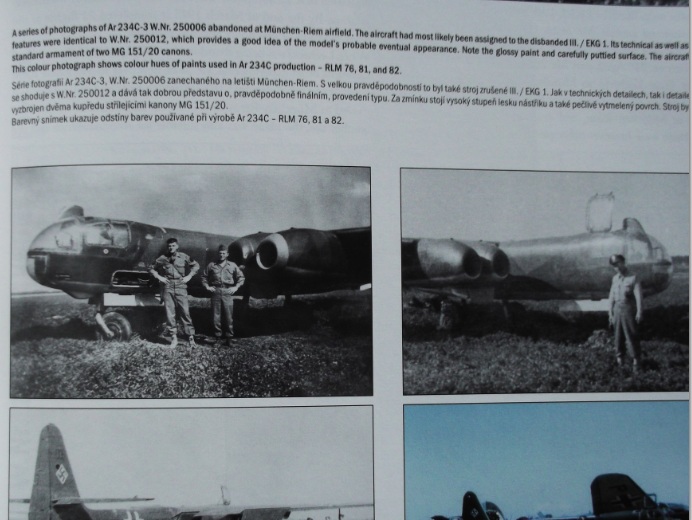
The second part of this very impressive work covers the final operations of Arado Ar 234 Bs and Cs over the Czech lands (partial page view above), detailing sorties flown by aircraft serving with 1.(F)/100 and III./EKG 1 from pilot log books and recollections. The rare Ar 234 C-3s abandoned at Prague-Ruzyne are covered in depth (some eleven pages) and other jet aircraft operating over Bohemia including the Me 262 V11 'V555' receive detailed treatment here (eight pages, partial page view below). 


This chapter also looks at the possibility that other jets and rockets, specifically the Me 163 and He 162, may have been deployed in the Protectorat. The final section of the book comprises ten pages devoted to Luftwaffe dispositions for the fighter protection of Me 262 air bases in Bohemia - this is material supplementary to the publisher's previous " Messerschmitt Me 262s of the KG and KG(J) units". There are several pages of detailed analysis and description of a rare Bf 109 K-4 of III./JG 27 deployed in the Luftwaffe's fighter umbrella over Bohemia.

To conclude, this is a title that the Luftwaffe blog recommends unreservedly especially for aficionados of Luftwaffe jet operations and production. It is replete with incredible details, difficult-to-find high quality information and very many photos (over 200) and documents, including flight log book facsimiles and WNr lists. The profile artworks are stunning. It is difficult not to agree with the publishers when they state that with this volume they have created the definitive account of Me 262 operations over Czech lands at war's end. A top quality work from JaPo!  Congratulations!  


Wednesday, 13 June 2012

R4M rocket-toting Fw 190 Dora - Doras and rockets at Schongau


Close-up views of a R4M rocket-toting Fw 190 Dora-9 filmed by a US 101 Div. cameraman in the winter of 1945-6 at Schongau according to the poster on youtube.. Still extracts from this footage were previously exploited in Vol II of the Eagle Editions Fw 190 Dora volume, although were first described in the David Wadman/Brown Experten Decals No.3 book published way back in 1995.

The film was shot on 02 May 1945 according to Crandall. The machine is identified in that publication as Fieseler-built Dora-9 'white 52', possibly 'chevron white 52' of 1./JG 101 and it is suggested that this unit/field served possibly as a satellite field/unit for the aircraft of the Verbandsführerschule General der Jagdflieger based 30 miles away at Bad Wörishofen.. The camouflage and markings infer an aircraft from the 600601-600680 Werknummer series. Note the lower cowling is painted in yellow. There are 13 white-tipped rockets on each wooden underwing rack.

The R4M was the only air-to-air rocket to see service with the Luftwaffe and its effectiveness was successfully demonstrated by the Me 262. Its warhead contained a high-explosive charge weighing some 440 grams  (R=Rakete, 4= kg weight, M=Minenkopf). During February 1945 an entire Staffel of Dora-9s had been assigned to test unit JGr. 10 at Parchim to trial the R4M rockets under operational conditions and when this unit was disbanded during April 1945 the surviving aircraft went to at least two other units, JG 26 and possibly JG 301 - although Crandall quotes Cescotti, TO of JG 301, who asserts that no such transfer to JG 301 was realised. Luftwaffe fighters arriving in Norway at the end of the war included a number of Doras belonging to II./JG 26 mounting R4M rockets.

Note too the "52" in small black figures (partly covered by snow) on the wing leading edge. Similar leading-edge markings were seen on aircraft serving with the Verbandsführerschule General der Jagdflieger. The pilots seat is on the ground behind the wing. The aircraft featured a blown canopy - the plexiglas is shattered here..note the absence of a spinner spiral, another feature of Verbandsführerschule aircraft.


Tuesday, 3 April 2012

Nowotny's Me 262 'white 8' - Kommando Nowotny and a Luftwaffe myth that refuses to die!

".. I've just picked up an Academy Me 262A-1a in 1/72 scale, one marking option of which is for "White 8" supposedly flown by Walter Nowotny. The colour calls give it as being RLM 81,82 over 76. It also shows it as having a Grunherz under the windscreen on the fuselage sides. The marking diagram, such that it is shows a mid fuselage demarcation between top & bottom colours, also on engine pods but several other model & marking sources give it as having a low demarcation. Is there any definitive answer on this ?...."


" ..I'm pretty disturbed that so many Me262 authors are still publishing incorrect captions and profiles, stating that a Me 262 from Kdo. Nowotny had a yellow fuselage band and the well-known “snake” or 'tadpole' camouflage pattern on the tail fin, when both are wrong! " (Olivier Menu posting in 2006 on TOCH forum,  "Me 262s of Kommando Nowotny" thread)

Even the replies to the original forum question cite the Me 262s from Kdo. Nowotny had a yellow fuselage band and the well-known “snake” or 'tadpole' camouflage pattern  response. This erroneous deduction-  most probably stems from analysis of stills drawn  from a well known film showing “white 1” advancing out of a row of Me 262s with “white 19” becoming first on the line. Then “green 3” W.Nr.110813 is seen passing in front of the camera. These machines are invariably identified as showing machines of Kdo. Nowotny - cf. profile artworks in Osprey and Kagero volumes. However further analysis points to another option - the above still and film extracts in fact depict Me 262s from the later III./EJG2 and not from Kdo. Nowotny as usually stated. There is a certain amount of evidence; the gun camera shots of F.Schall's  “white 1” W.Nr.110404 - the machine obviously lacks any yellow fuselage band while Manfred Boehme's JG 7 volume told us that W.Nr.110813 was produced in December 44 - following Kdo. Nowotny's disbandment on 19 November 1944… 


Finally in 1998 Axel Urbanke in his “Green Hearts First In Combat With The Dora 9” published a view of what we could definitively ID as a Kdo. Nowotwy aircraft, “white 2” W.Nr. 110389. This aircraft's identity "White 2" WNr. 110389 is known from the published loss listings in Manfred Jurleit's " Me 262 im Einsatz ".  This machine's previously applied yellow fuselage band, from EKdo 262, is clearly over-painted and the camouflage is dark. Thus since 1998 it has been accepted knowledge that the following Me 262 photos, F. Schall's “white 1”, Schneiders “white 3” W.Nr.110372 and Helmut Baudach's “white or yellow 6 or 8” were all three aircraft in  Kdo. Nowotny markings

Smith and Creek in Me 262 (Vol II)  and Dan O’Connell in his comprehensive “Messerschmitt Me 262 – The Production Log 1941-1945” should have effectively put an end to all these erroneous captions and so-called 'artist' profiles when they explained that the “snake” or "tadpole" tail fins were actually wooden experimental fins, produced in December 44, sometimes retrofitted on earlier Me 262s thus confirming why some Me 262s produced before Kdo. Nowotny was disbanded could be seen with this "snake" tailplane in December 44 or later, as the well known W.Nr.170003 V7 pictured in colour.


Can we specifically ID Nowotny's machine? Probably not, but it may be the Me 262 above. The following from a chat I had with David E. Brown of Experten decals back in the days when I was really interested in Luftwaffe colours. David wrote that he was of the opinion that the machine pictured here - from the old Werner Held "Reichsverteidigung" book - could very possibly have been Nowotny's 'white 8' (see extreme right of pic)  Of all the known photos of Ekdo. 262, Kdo. Nowotny and III./EJG 2 Me 262s, this is the only 'white 8' for starters. We can rule out Kdo. Schenk/ KG 51 as they used letters on the forward fuselage. And if 'white 8' here is Nowotny's machine WNr. 110400 then we know of  three machines from this unit from photos including the pic from Urbanke's book above all from the same WNr. block (110386 to 110410)- all wearing different schemes but featuring a pretty dark camo finish, the plain white number on the forward fuselage, no yellow rear fuselage band (although not visible on 'white 8' ) and no 'tadpole' or 'snake' markings on the tail ( which - to repeat- were not a feature of Kommando Nowotny machines as stated above). In David's view this aircraft was finished most probably in overall 83 over which a "wispy" application of 76 had been applied at unit level. Note the man on the wing is wearing shorts - which points to an early time frame (July- September) in Me 262 operations. The only 262 units operating during this period were Ekdo. 262, Kdo Nowotny and Kdo Schenk/ KG 51 - KG 51 used letters, Ekdo 262 used white numbers outlined in black. And while the Werknummer is not visible here, note that part of the Stammkennzeichen aft of the Balkenkreuz is. To conclude 'white 8' here reveals a number of the attributes of the known aircraft assigned to Kdo. Nowotny - plain white numbers, no yellow band (possibly), no tadpole tail markings and photographed early-ish in 1944 - which automatically rules out a number of units.  And in any case, as David E. Brown concluded, " there is no mention in the loss listings of a Me 262 with a 'white 8'  - except for Nowotny's.."

Thursday, 22 September 2011

latest Luftwaffe/Axis titles, JAPO Me 262s of KG and KG(J) units, JG 4 Vol II off to the printers, Vol V of Stipdonk/Meyer, work on the latest Luftwaffe Gallery...

Only a handful of updates so far this month  - and with good reason as I've been incredibly busy helping M. Erik Mombeeck prepare volume II of the Jagdgeschwader 4 history for the printers - we should meet our deadline of 30 September ! This volume covers the period from Market-Garden to the final air battles over Berlin and I hope you'll forgive me if I state that this is probably one of the most riveting late-war Jagdgeschwader histories to yet appear in English - a must for all Jagdwaffe fans. With the dissolution of I./JG 4 during March 1945 and the remustering of pilots as infantry there are even personal accounts of the ground fighting as well as plenty of perilous ground-strafing missions and Mistel and "Kamikaze" escort sorties.
The first volume of Erik Mombeeck's two part history of JG 4 cover the unit’s establishment, deployments and combat actions through to Autumn 1944 and is 'reviewed' with a lengthy text extract on this blog at the following link.

http://falkeeins.blogspot.com/2011/09/latest-luftwaffeaxis-titles-jg-4-vol-ii.html


Elsewhere I have also completed my work on Band V of the Stipdonk/Meyer photographic series - some 500 captions into English. However I believe this volume is only appearing in conjunction with the first volume of a new photo series devoted to the Jagdgeschwader so is not exactly imminent. In fact Band V was almost not going to appear at all since VDM declined to pay for the translation of the captions - I stepped in to produce them 'unpaid' to 'unblock' the situation. In addition I have been hard at work on the personal accounts that will feature in the next issue of 'Luftwaffe Gallery' - which will be a 'special' . Now as I've mentioned this translation effort is - for want of a better word - 'unpaid' and very time-comsuming, which makes it difficult to keep up with blog matters....oh and I have a three-page feature on French Desert Storm Jaguars in the current issue of Airfix Model World (personal account by capitaine Alain Mahagne) !

I have managed to read a couple of new books though;

First up the new Pen and Sword title on the "Vichy Air Force at war" by Sutherland and Canwell.
These two authors have produced a huge body of work - some 200 books published - but sheer volume means that quality and quality control don't really get a look-in. Firstly the authors do not appear to have consulted any French-language sources (just one in the bibliography) nor speak French. No serious author would write " the l'Etat..." or even " a single raid did for all of the aircraft of GAO2/551.." There are no personal accounts whatsoever here - it would have been easy enough to source some exciting accounts from Jean Gisclon's "Chasseurs au groupe la Fayette" - Gisclon saw combat over Mers-el-Kebir in 1940 and Casablanca in 1942 with GC 2/5 and wrote about it in detail. Lela Presse in France have produced a range of exciting monographs on the period, including a 400-page history of the Curtiss Hawk in French service, none of which have been consulted. Nor does the Sutherland and Canwell work feature an index or any footnotes whatsoever. Chapter 1 deals adequately enough with the Battle of France but 'historians' and amateurs have generally made such a mess of this period that statements like "The French faced the invasion with 4,360 combat aircraft" need referencing and qualifying. The venerable Potez 25 biplane might have been an extremely potent aircraft in 1925 but it certainly wasn't in 1940 when dropping bombs on Gibraltar (not that the authors even mention this..)
Ehrengardt's two volume 'L'aviation de Vichy au combat' covering fighting in North Africa, Syria, Iraq and Madagascar should at the very least have been consulted. Rather, chapters such as those devoted to operations over Syria are largely based on English-language sources such as Heringtons "Australia in the war of 39-45" - entire page-long quotes in fact. Shores ' Dust Clouds in the Middle East .." must have been used, but doesn't appear in the bibilography. Finally it is worth pointing out that this book is also a pretty slim volume. Chapter 9 - the 'throwaway' last chapter of the book which features potted bios of French pilots who achieved various feats outside of the Vichy Air Force ie Normandie Niemen veterans etc - starts on page 139 and runs to P150. Total page count is 172. Chapter 8 is six-page long 'focus' on those Frenchmen who may or may not have flown with the Luftwaffe including Rene Darbois who flew Bf 109 fighters with JG 4 in Italy - nothing to do with the Vichy air force. As mentioned the photo insert pages are dark and murky. There are some appendices featuring two pages of victory credits and a quick 2-page treatment of the Vichy air Force in Indochina, the subject of new 400-page hardback book from Lela Presse - which just about sums up this rather poor Pen and Sword volume.
 
Next up is the latest Osprey Duel title entitled " La-7 vs Fw 190" ...Neat idea to get a Russian viewpoint on the two types but be aware that Khazanov is the author responsible for the " Erich Hartmann -352 victories or 80 " revisionist approach to the Eastern Front air war. Usual highly competent computer artwork from Hector & Laurier and yet another re-telling of the development history and chronology of the Fw 190 - including photos of early variants in the factory - which along with the more interesting La-7 chronology takes up some 33 pages of this 80 page work. Some curious translation as expected - first time I've seen the Fw 190 described as a "cavalier's horse" - the phrase in German used to describe the Fw 190 is "Arbeitspferd" or 'workhorse' ! The account of the air war on the Eastern Front itself occupies only some 10 pages before we arrive at May 1945! The authors then write, "  the heavier armed, and armoured, versions of the Fw 190A-6, A-7 and A-8 were used almost exclusively by Defence of the Reich units in the west (although IV./JG 3 used its anti-bomber Fw 190A-8/R8s in strafing attacks on Soviet troops as the latter advanced on Berlin), and are therefore not detailed in this volume.." Of course not, there simply isn't the space! But by late January 1945, when the Soviets arrival at the Oder meant that there were more pressing concerns than shooting down USAF bombers, ALL three of the Sturmgruppen were deployed to the Eastern Front along with the Fw 190s of JG 11..and as a result of works by Mombeeck and Lorant there is now plenty of info out there on the deployment and activities of these late-war Fw 190s on the Eastern Front. The chapter devoted to training and conversion from the Bf 109 to the Fw 190 was frankly not of interest. Photographic content is best described as indifferent. Some personal accounts -previously seen- and also a look at the introduction of the Dora on the Eastern Front including the usual picture of  " a smart, newly built Fw 190D-9 Wk-Nr. 210051 with a straight-topped cockpit cover ". I think that's a reference to the Dora's flat canopy. The 'meat' of this small book - if you can call it that - is the chapter entitled "Combat" (P58-72 but including full page profiles of Kozedub and Nowotny along with the two-page battle scene 'painting'). The bibliography ("Further Reading") again features mostly Osprey titles (from the Aces series) and always strikes me as being particularly pointless in these Osprey works. As it is, lots of text seems to me to have been drawn from these very books by the authors of this volume! As usual difficult to sum up - recommended with reservations, especially if your library is devoid of works on the La-7 or Fw 190.


Just time to mention here the latest JAPO 'Luftwaffe over Czech territory' title devoted to the Me 262 jets of KG and KG(J) units ahead of a more comprehensive review. A much heftier work of some 180 pages (A-4 softback) than previous titles in this series and featuring as co-author the talents of David E. Brown, the leading researcher on Luftwaffe camouflage and markings, this work should prove absolutely indispensable for late-war Luftwaffe and Me 262 enthusiasts. Needless to say I have been poring over it daily since it arrived and am very much enjoying what is a fine work. Among other subjects, it features a 20-page colour 'walkaround' section, a detailed history of IX Fliegerkorps jet deployment and combat operations over Bohemia, with a day-by-day reconstruction of events from mid-April 1945 to war's end over 55 pages, along with detailed features on all eleven identified KG and KG(J) jets with sumptuous artworks and a decal sheet covering the featured aircraft for scale modellers. Superb!


Tuesday, 6 September 2011

Review of 'Captured Eagles' - Roger S Gaemperle's Vintage Eagle Publishing


My copy of 'Captured Eagles' arrived! What an exciting publication this is! Quite stunning. We've all seen plenty of photographs of German types taken by Allied servicemen as they moved ever deeper into Germany during the last months of the war, but quite simply this new collection is superlative - with the promise of more to come. What distinguishes this book from similar titles is the range, extent and quality of the new images, all but three of which are previously unpublished anywhere. In addition the majority of the images in this Volume 1 are beautifully clear and reproduction is of the highest quality. Similar in feel to " LO+ST ", 'Captured Eagles' easily surpasses that volume in terms of quality of image reproduction, image size, page format and layout and of course in terms of the extensive supplementary details presented in the lengthy English-language captions.

Between its glossy card covers 'Captured Eagles' features more than 85 previously unpublished photos of captured German aircraft taken by US, British or Australian soldiers during 1944/45 over some 72 large A4 format pages with just three images previously seen. Eight original colour profile artworks were created for this volume by Simon Schatz ( known for his work for Classic Publications among others; 'Dornier Do 335' ´He 162 Spatz´ etc). Without wishing to give too much away, various aircraft types are featured such as Bf 109 G/K, Fw 190 A/D, Ju 88 A/G/T, Ju 188, Me 410, Me 262, He 162, Ju 290, He 111, He 219, and more. These are presented in chapters according to mission/type, ie 'reconnaissance', 'destroyer', 'jets', 'mistel' etc. And while there are one or two 'wrecks' most of the aircraft featured here are 'complete' examples. Illustrations of anciliary equipment (control columns, service hatches) and depictions of emblem badges are sprinkled throughout the text. Also featured are log-book extracts and even a personal account or two..

Each photo and caption are numbered to facilitate reading and subsequent further discussion on the author's website (address below) Highlights include a previously unknown Fw 190 D-13 and the first photographic proof that the Ju 88 G-7 actually entered production at the end of the war! One of my particular favourites is a lovely new image of the 7./JG301 Dora 'Yellow 15' which is soooo clear and its caption so detailed that it makes all previous published captions redundant at a stroke! But just about every photo here gets the treatment  - well researched, described in detail -some captions five or six paragraphs long- and superbly presented on a single page. No photos across the binding here.

For the modelling fraternity decal sheets for both 1/48 and 1/32 are also available separately in a twelve-page booklet that features four very attractive aircraft illustrated in full colour (1x Bf 109 G-10, 2x Fw 190 A-8, 1x He 162 A). Stencils are provided as dry transfer decals (printed by Hobbydecals) and markings as wet transfer decals (printed by Cartograf). The quality of these exciting sets is further assured by the contributions of  noted researcher David E. Brown and the profile artist Simon Schatz.

By profession an engineer and currently active as a consultant in the power generation business, Roger Gaemperle has created one of the most professional Luftwaffe photo-album books I have ever seen and he thoroughly deserves to be supported in his exciting new venture. A second book is already in the planning stages with rare photos of a Ju 388 prototype, a JG 300 Bf 109 G-10 with Reichsverteidigung bands and much more. In fact it is no exaggeration to state that you miss this one at your peril!

Much more at the Vintage Eagle Publishing web site

http://www.vintageeagle.com/

Thursday, 19 May 2011

Late-war variant Fw 190 Dora with Ta 152 tail (Eduard kit Fw 190 D-9 Late ProfiPACK)


Eduard's latest release features another boxing of their very nice 1/48 scale Dora kit - a late-war variant fitted with the wider broad chord Ta 152 empennage. The kit itself is nicely reviewed on britmodeller here. The article excerpt below neatly illustrates the two types of Dora tail alongside each other (Fw 190/Ta 152 Aircraft in Detail by Neil Page in SAM 27/12) and the lower photo depicts the Eduard tails as published on their Facebook page.


 Like other German late-war fighter aircraft, production of the Fw 190 Dora variants was largely dispersed with major aircraft components being brought together and mated up at a final assembly location. The majority of these components were painted to varying degrees prior to delivery resulting in the 'pieced together' appearance of many Fw 190 Dora camouflage schemes. Various attempts were made to 'standardise' the production effort - one such was the planned introduction on the later Dora variants of the broad chord tail built for the Ta 152. And while these airframes may appear to be 'hybrids' the so-called Einheitsheck or 'uniform tail' ( see Rodeike) was designed, firstly, to be constructed from non-strategic materials (wood) and, secondly, to fit all the later planned Doras (D-12, D-13, D-14 up to the D-15). However the fascination with the variant resides in the fact that only two examples have been documented photographically, whether as new or replacement items is unknown. From Jim Crow's collection, the first photograph to appear ( in Monogram Close-up No. 10, but subsequently in multiple sources, including Hildebrandt 'Broken Eagles', Aero Detail Fw 190 D, German Aircraft Interiors by Merrick, 'Greenhearts'  by Urbanke and so on and so forth.. )  showed the wrecked and burnt-out tail fin of WNr. 500645 (clearly visible). According to authors Smith and Creek the photo appeared to depict     "... the remains of what might be a Fw 190 D-15. WNr. 500645 would suggest the type is a Fw 190 D-9 but the revised fin seems incompatible with this series. However the new fin was to be standard on the Fw 190 D-15.."  German authors Griehl and Dressel also agree in their Fw 190/Ta 152 book published in 1997 that this is   "... the wreck of a Fw 190 D-15 discovered close to the Czech border. Despite the Werknummer the empennage differs considerably from that of a Dora-9 ". Dietmar Herrmann in his 'Focke Wulf Ta 152' volume identifies the broad chord tail fin of WNr. 500645 as belonging to " Ta 152 C WNr 500645 "  - with no further commentary. Peter Rodeike - author of the Focke Wulf 190 'bible' - goes further in his Jagdflugzeug 190 book (P.404); " the so-called Einheitsheck or 'uniform tail' was planned for the Dora from the spring of 1945 and designed for series production of the Ta 152..it can be seen that the yellow/white/yellow fuselage tail bands of JG 2 are also visible .." W.Nr. 500645 was most recently illustrated as 'black 6' from III./JG 2  (Crandall Fw 190 Dora, Vol I) although this profile is speculative and apparently not based on any documentary evidence- although now featured on a least one after-market decal sheet and as an option in this Eduard boxing. The single 'known' photograph was allegedly published in a Dutch monograph in the 1970's but surprisingly not a single example has yet surfaced anywhere (?)

 
Urbanke's 'Greenhearts' volume was perhaps the first to publish pictures of what was identified as 'brown 4' of 7./JG 26, WNr. 500647 and photographed by a Canadian soldier at Hustedt airfield near Celle. Again the photographs appear to show a Dora-9 fitted with the wide tail and given that the two Werknummern are so close together, this according to author and publisher " demonstrates that a small number of of Fw 190 Doras were constructed with the Ta 152 tail ".


This aircraft is the box-top subject of the new Eduard Dora - 'brown 4' WNr. 500647 of JG 26. A third photograph of this machine was published in Hideki Noro's 'LO+ST' photo album of captured and abandoned Luftwaffe aircraft - interestingly this 'new' photo, along with the previously published pics of this aircraft, again fails to show a complete view of the tail unit, leading some to suggest in a debate on one forum that 500647 does " not have a Ta 152 tail..." (see P282 Crandall Vol II -while the broader tail fin appears to be present the top of the fin itself is nonetheless cropped out so it is not possible to confirm absolutely the absence of the typical pointed Dora aerial mast ). However it is now generally assumed that other Doras in the WNr. 500600 range were fitted with the same broad Ta 152 tail and are mostly covered here on Eduard's decal options.

There are a number of 'blanks' in the history of the Dora - such as the 'operations' of Kampfgeschwader units re-organised and re-equipped with fighters in the last months of the war. These so-called Kampfgeschwader (Jagd) or KG (J) units - the designation reflecting their conversion to the fighter or Jagd role - presumably did only relatively limited flying due to difficulties in obaining fuel. In SAM 27/12 Dora/Ta 152 'Aircraft in Profile' (February 2006) article a third candidate Dora with Ta 152 tail was illustrated speculatively - a 9./KG(J) 27 machine 'yellow 6' featuring green/white rear fuselage band checks. Noted Luftwaffe colours researcher David E. Brown first wrote about KG(J) Doras, specifically "ge.6 + I" of 9./KG(J) 27, way back in July 2000 - 11 years ago. His commentary and a profile by Claes Sundin were posted on Claes' website at that time. As recently as 2008 the existence of these Doras was being questioned by one prominent Dora Experte - however with the passage of time more KG(J) 27 aircraft have surfaced, the majority wearing the green/white Karobands, which rather vindicates David E. Brown's research. Interestingly - giving previously expressed doubts - a KG(J) 27 green/white tailband on a Dora fuselage is shown on page 337 / Vol. 2 of the Crandall Dora book. Also worth pointing out that the white/green fuselage checks have been seen photographically on this unit's Antons, which presumably accounts for this shift - although no artwork. Some 'speculative' machines are more valid than others it would appear.
  
'Yellow 6' was identified from loss reports as WNr. 500641, subsequently revised as WNr. 500648, just one number above the JG 26 machine. III./KG 27(J) lost two Doras in action on 1 April 1945, one of which was the aforementioned 'yellow 6'. And although the profile is speculative, this aircraft was likely finished in the typical Mimetall scheme - fuselage sides in the green-blue variation of 76, fuselage spine and engine cowling in 81 Braunviolett, fuselage underside natural metal from the wheel well back to the fuselage insert, wing leading edges and the front underwing panel probably 75 Mittelgrau with the control surfaces in 76. Note that these later Doras were more often than not fitted with the re-designed centreline weapons rack - the ETC 504 was a simplified carrier featuring a much smaller mounting and fairing.


Sunday, 3 April 2011

Fw 190 Doras of IV./JG 3 and JV 44

Interesting discussion at britmodeller.com today on the Doras of IV./JG 3. I reproduced the picture under discussion in a Fw 190 Dora feature that I prepared for Scale Aircraft Modelling in 2003. Author/researcher/archivist Jean-Yves Lorant was kind enough to send me a selection of his photos for my article including a nice copy of 'Blue 2' below. Even at high-res though this is still a pretty poor quality shot.


My caption in the SAM Fw 190 Dora feature


"...'Blue 1' and 'Blue 2' taken on charge by Gruppenkommandeur Oskar Romm for the Stabsschwarm of IV./JG 3 . This view illustrates the 'pieced together' appearance of many D-9 camouflage schemes resulting from dispersed late-war production - pre-painted engine assemblies, wings and tail units were mated to fuselages at a central assembly plant. Note the partially over-sprayed natural metal rear fuselage extension plug fitted on ‘Blue 1’. Both these aircraft have the early 'flat' or ‘Anton’ style canopy..."

 
Note the parachute placed on the horizontal stabiliser and the unpainted rearmost segment of the wing root on both aircraft. Concerning the fuselage colours Focke-Wulf maintained use of 76 on Doras right to the end. The mystery grey-green shade used extensively on some machines chiefly concerned aircraft constructed by Mimetall Erfurt (MME), in the 50xxxx serial sequences. 'Blue 2' (identified by some as a 600 series machine from Fieseler) has had a fairly liberal overspray of RLM75 around the extension plug (unlike 'Blue 1') and ahead of the Balkenkreuz a chevron and bar over-painted.

I had always thought that 'Blue 2' was for a long time 'Green 2' being an aircraft originally assigned to the Gruppenstab of IV./JG 3 (Prien 'IV./JG 3 - Chronik einer Jagdgruppe' ). I think Squadron with their 'Walkaround' title were the first to suggest it had 'blue' numbers which I found rather surprising at the time, but which seems to have become the accepted wisdom ever since. Note the caption for the same picture in Vol 3 of 'Luftwaffe Camouflage and Markings' by Smith & Gallaspey suggests another option referring to the ..

"....two nearest aircraft, red 1 and red 2 (probably flown by the Staffelkapitän and his wingman) which may have belonged to 15. /JG 3 which was led by Oblt. Oskar Romm between January and February 1945. Traces of a white rear fuselage band on red 1, possibly the defence of the Reich band allocated to JG 3.."


And not forgetting Japo with their psuedo-scientific approach - their ID is a Focke-Wulf Cottbus machine in the 21xxxx serial range, and the fuselage Kennzeichen are black. (Eric Larger RIP)

Note the aircraft in the top left of the picture was apparently first identified as either a D-11/13 circa 1986 by David E.Brown. He had made this determination from a much better copy of the photo than is usually published according to Dave Wadman in the same britmodeller thread. Some maintain that David E. Brown never received due credit for his early Dora research, especially with regard to JV 44 machines. Now I am the first to recognise that David E. Brown is probably the leading Luftwaffe colours researcher, still publishing and writing long after his early 'Experten Decals' project. While pursuing this debate, it would not be out of place to mention that the first published JV 44 photos and commentary appeared in Jean-Yves Lorant's 'Le Focke Wulf 190'. This 400-page book was published in collaboration with J-B Frappé by Docavia in 1981. At the time Lorant was still in his teens! This was some time before the Brown and Wadman Experten Decals project, but since he wrote it all up in French, Jean-Yves has never received due credit. Rather bizarrely perhaps though, at the time the lower surface colours of JV 44 were originally thought to be dark grey with white stripes. It wasn't until a 1989 interview with Crandall that JV 44 pilot Faber confirmed to the English-speaking world that the lower surfaces of his a/c were painted red with white stripes. Some Experten continued to argue that at least one JV 44 machine 'Black 1' (sic) had black lower surfaces, rather than red - as maintained in a 1995 article published in Jet & Prop (95/3) entitled 'Die bunten Langnasen der Papageien Staffel'  - 'The multi-coloured long-noses of the Parrot Staffel' - although it was hardly likely, as one JV 44 veteran allegedly pointed out, that Luftwaffe birds would have been painted with black and white stripes if operating over the Reich.