Showing posts with label Bf 109 G-6/AS. Show all posts

Monday, 10 November 2025

JG 27 Bf 109 G-6/AS - archive photo scan series #45


A line-up of Bf 109 G-6/AS fighters of 5./JG 27 seen in early summer 1944 at Fels am Wagram. ‘Black 14’ has the WNr. 412x29 (‘x’ is probably an '8' or even a '3'). The finish comprises an unusual 'snake' mottle along the fuselage sides extending to below the exhaust stacks. Note the curved 'shield' above the exhaust stack on the port side of the engine - designed primarily to prevent hot gases from being ingested into the supercharger intake, a feature of most Gustavs. Click on the image to view large..'Black 14' is illustrated by Claes Sundin in his 'Luftwaffe Fighter aircraft - Profile book no. 12'


Leaving Wiesbaden at the end of May 1944 for Unterschlauersbach (near Munich)  II./JG 27 was briefly subordinated to the JG z.b.V before going to Eisenstadt for rest and refit on 3 June. Just three days later D-Day brought this period to a swift end and the Gruppe was sent to Fels am Wagram as part of a Sammelgruppe for Western front fighter and fighter pilot replacements. A host of new machines was assigned to the Gruppe including their first G-6/AS fighters, with which they were due to be re-equipped. This period came to an end on 1 July. Assigned to 8 JD the Gruppe was scrambled against 15th AF raids heading for the south of the Reich and Hungary on no fewer than 13 occasions during the month and on a further four days was directed against 8th AF incursions over the Reich. During July the Gruppe claimed five bombers shot down for the loss of 33 Bf 109s - 19 pilots were killed and 7 wounded. A further (approx) 20 Messerschmitts were lost in accidents! 

" ..after one month of operations following refit [during the summer of 1944], combat readiness [of II./JG 27] had already shrunk to Staffel strength level.." 

(adapted from Jochen Prien's JfV Teil 13/V p283-284)

Thursday, 1 August 2024

Bf 109 G-6/AS Hptm. Horst Carganico Kommandeur I./JG 5 'Mickey Maus' - archive photo scan #27


A 'new' view - at least not published by Mombeeck in his JG 5 history or elsewhere - of Hptm. Horst Carganico's Kommandeur I./JG 5 machine, an overall blue-grey 76 Bf 109 G-6/AS, seen at Herzogenaurach during May 1944. (incorrectly listed as a G-5/U2 on p243 of 'Eismeerjaeger'). Note the refined cowl bulge, tall tail, Erla Haube, short antenna mast and enlarged supercharger intake. Although not visible here - apart from an 'ear' above the officer's cap, middle - markings included Carganico's large 'Mickey Maus' on the port fuselage side. Artworks show the lower engine cowl in yellow although that now looks unlikely. Carganico had claimed some 60 victories by the time he was KIA on 27 May 1944 attempting a crash-landing after clipping high tension wires following combat with US fighters - 27 May 1944 was a 'black day' for I./JG 5 who lost 13 Gustavs (at least seven or eight G-6/AS machines) shot down in high altitude combat over the Franco-German border (south-west of Strasbourg) out of 19 machines scrambled. One of the first downed was 'black 7' of the Stab flown by Hptm. Heinz Deuschle, Carganico's wingman and the officer partially visible behind Carganico in the image below, seen exchanging words with Carganico's mother.


Sunday, 28 June 2020

'Yellow 14' Bf 109 G-6/AS of III./ JG 1 -Wochenschau 28 June 1944


These Bf 109 G-6/AS fighters of  III./ JG 1 were featured on the Wochenschau footage shown in German cinemas on 28 June 1944. Taxiing out -most probably at Paderborn - is 'Yellow 14' with 'Yellow 9' behind to the right of the image. Finish is the usual three greys with red RVT band around the rear fuselage. Note the over-painted remnants of a Stammkennzeichen under the Kennziffer fuselage numeral. Note too the unusual position of the short III. Gruppe bar. Just visible under the fuselage is the FuG 16 ZY aerial..


Artwork is from the 'Reich Defence' boxing of the AZ model G-6/AS


The first reported loss of the new G-6/AS variant in III./ JG 1 occurred on 8 May1944 - Fw. Felix Karenitz of 8.Staffel by shot down by P-47s. He baled out but failed to operate the ripcord of his chute. Below; a close-up from the same Wochenschau footage showing Ofw. Friedrich Zander of 7./ JG 1 in the cockpit of his G-6/AS..


Friday, 5 June 2020

AZ Bf 109 G-6/AS Hptm. Horst Carganico Kommandeur I./JG 5 'Mickey Maus' in 72nd scale


Continuing with the small-scale Bf 109 theme and built from the AZ Bf 109 72nd scale kit, this is my representation of Hptm. Horst Carganico's G-6/AS from May 1944, displaying the personal 'Mickey Maus' and 60-kill rudder scoreboard of the Kommandeur I./JG 5 as photographed at Herzogenaurach during May 1944.

 As a far better modeler than me put it, " I keep going back to the 1:72nd scale AZ Bf 109s ...and then reality hits home.." Now - based on just one build so far - I decided that I quite like AZ Model's Bf 109 G-6 series - 'Model of the Year 2015' in the small scale category in the German 'Modellfan' magazine. I've just added a couple of G-6/AS variants to the stash and bought both the 'Limited Edition' JG 300 boxes.


But I'd forgotten how tricky these kits are - not much fits well unfortunately. Especially where the cockpit is concerned - a large chunk of that need sanding down to get it between the fuselage halves. The G-6/AS variant featured a refined cowl, tall tail and enlarged supercharger - Peter Schmoll refers to the variant as being 'Beulenfrei'. Hence the parts in the box are the same as those featured in AZ Model's Bf 109 G-10 boxes. However for a G-6/AS as depicted in this box the chin bulges will need to be sanded off - AZ don't tell you this anywhere.

Decals are taken from an old Encore Models Gustav sheet and performed just fine considering that they must be at least 15-20 years old - the coloring of the 'Mickey' emblem is probably not 100% accurate (note the red shorts..) and there is no actual image of Carganico's rudder scoreboard although he had some 60 victories by the time he was shot down and killed over southern Germany during May 1944. Perhaps his machine did not carry any other markings but on the starboard fuselage side I have used standard command chevrons. Note AZ do not give the modeler a spinner spiral ! These have to be sourced separately or else purchased on a separate sheet from AZ  ( thanks Jan .. no I haven't forgotten!)


Horst Carganico flew in Norway and Finland from the first days of the invasion in April 1940 until March 1944. He then departed the Eismeer front and II./JG 5, being appointed Kommandeur I./JG 5 in the Reichsverteidigung. By then his Mickey Mouse personal emblem was well known. In official German papers his aircraft was listed as "Mickey Maus".  Erik Mombeeck's 'Luftwaffe Gallery' JG 5 'Special Album' features an interesting photo of this machine. It is apparent that the aircraft was painted in light blue-grey overall (standard G-6/AS Höhenjäger finish) The picture is partially double-exposed, showing part of the wing - confirming the wing cross (black, filled, and not white outline as per my model..)  and the single-colour finish of the wing. On May 27, 1944, aged 26 years old, Carganico was killed in this machine crashing after colliding with power cables while attempting to make an emergency landing following combat with P-51s - no fewer than 13 of the nineteen I./JG 5 Bf 109s deployed against an 8th AF raid against rail hubs and infrastructure in eastern France and s-w Germany were lost that day. Carganico's body was repatriated back home to Berlin and he was buried on June 6, 1944. His father, Generalmajor Victor Carganico died exactly one year later - May 27, 1945 -  shot by Soviet troops.

According to some sources, Carganico's machine may have been a  a G-5/U2. This is essentially the same as a G-6/AS, only with GM-1 or MW-50 booster injection installed. The Erla canopy means that the G-5 pressurised cockpit features were of course absent. The cowling was 'bulge-free', like the G-10 and K-4. Standard 160/660 wheels, small 'tear-drop' wing bulges, low tail wheel and tall tail.


extract from Luftwaffe Gallery 'Fighters of the Midnight Sun' still available from http://www.luftwaffe.be/luftwaffe-gallery/


Tuesday, 18 June 2019

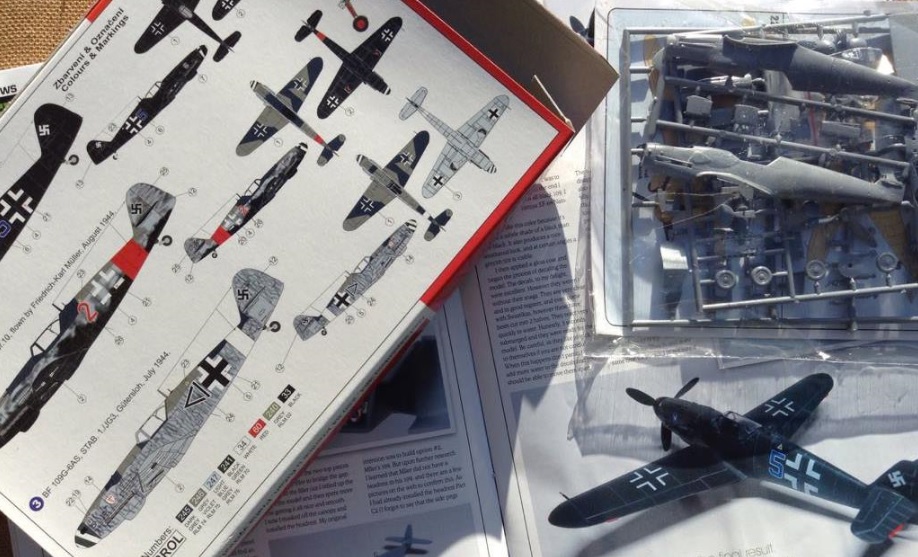
NEW! Eduard ProfiPACK 48th scale Bf 109 G-6/AS - Luftwaffe models


two of the five marking options in this new release

- G-6/AS of Hptm. Horst Carganico, Kommandeur of I./JG 5, Herzogenaurach, May 1944


G-6/AS 'Moskito hunter' of 1./NJGr 10 flown by Friedrich-Karl Müller during July-August 1944 "Red 2" (WNr. unknown).


Eduard August distributors leaflet is available to download here

Markings research for 'Red 2' by 'FalkeEins -the Luftwaffe blog' - see my articles in Model Aircraft Monthly June-July 2014

Also on this blog;

Hellblau-über-alles - overall RLM 76 Bf 109 G-6/AS Höhenjäger fighters of I./JG 3  here

Friday, 23 December 2016

Hellblau-über-alles - overall RLM 76 Bf 109 G-6/AS Höhenjäger fighters of I./JG 3


I./ JG 3 received its first up-rated G-6/AS ('S' for Sonder or 'special') machines during May 1944 (cf. Prien 'Messerschmitt Bf 109 im Einsatz bei Stab und I./ JG 3', page 400). These first Erla-refurbished/built aircraft were manufactured at the Erla VII plant in Antwerpen and powered by the DB 605 AS engine, a stop-gap development which featured a larger blower taken from the DB 603. The bigger intake required a larger port-side engine bearer arm which in turn resulted in the new refined cowl shape, the so-called asymmetrical 'Ballungen' ahead of the cockpit as Jochen Prien refers to them.  'Ballungen' is a curious Messerschmitt term - for which I can find no translation- for the 'refined' G-6/AS cowlings. The G-6 MG cowl 'bulges' were dispensed with. It would appear that the sub-type was developed - aside from on-going issues with the DB 605 D engine - to fulfill a high-altitude interceptor role, the so-called "Höhenjäger".

The Bf 109 G-6/AS that served with III./ JG 1 and I./ JG 3 in the "Höhenjäger" role in early 1944  (high altitude fighter) were notable for being finished in an overall 76 scheme, the so-called Höhenanstrich. Elsewhere Ken Merrick has explained that Messerschmitt  -as a general rule - painted its airframes with an overall undercoat of 02 followed by a single protective coat of the lower surface colour, which may explain this so-called 'new' finish adopted by some units. At the same time other Defence of the Reich units were already experimenting with low-visibility schemes; JG 11 had even taken to dispensing with the Balken- and Hakenkreuze. That being so, the AS machines of both JG 1 and JG 3 featured standard black Balkenkreuze on the wing upper surfaces- not the white outline type so often seen. The yellow (cowl) ID markings were dispensed with. (cf. Prien, page 402-403) The AS series were also manufactured at other plants including Mtt Regensburg, although it would appear that there is no precise WNr. record. With MW 50 power boost the AS-engine was designated ASM.

Staffelkapitän 2./ JG 3 in early 1944 was Walter Bohatsch although through the spring of 1944 he flew infrequently. Based in Burg bei Magdeburg, 2./ JG 3 was deployed on high cover duties for the Sturm Fw 190s of the Sturmstaffel 1 and IV./ JG 3.

Bohatsch flew a Bf 109 G-6/AS 'Black 7', possibly the machine in the picture below..see page 404 of Prien's 'I./ JG 3 im Einsatz'


One of his  Staffel comrades was Uffz. Horst Petzschler below. 'Black 14' is WNr. 412 179. Note that unlike the camouflaged I./JG 3 machines during this period the "76" machines did not have a white fuselage band. This image is reproduced on page 405 of Prien's 'I./JG 3 im Einsatz' - the winged-U emblem is just visible on the engine cowl. This machine was lost on 28 May 1944 when Fw. Büssow was KIA near Belzig. Note the Erla-Haube (canopy) and the tall tail, standard on the G-6/AS.


Below; Bf 109 G-6/AS W.Nr. unknown "Schwarze 27", 2./JG 3


Seen near Cormeilles-en-Vexin, Summer 1944. Source: Collection Col. Reginald Franklin Conroy Vance, via Tom Barnes, Flickr.com.

H Models Decals have a small sheet of black Kennziffer for these high altitude day fighter interceptor machines in their "Nachtjagdgruppe" series - well that's H Models Decals for you!


More overall blue Bf 109 schemes by H-Models Decals here
http://falkeeins.blogspot.co.uk/2016/11/new-h-models-decals-wilde-sau-jg-300.html

Thursday, 28 January 2016

AZ Model Bf 109 G-6/AS 'Special Markings' build review


I was interested to read Patrick Mizgala's build review of the new AZ Bf 109 G-6/AS 'special markings' release over two pages in the current issue of Scale Aircraft Modeller International (SAM Publications). Now I quite like AZ Model's Bf 109 G-6 series - 'Model of the Year 2015' in the small scale category in the German 'Modellfan' magazine. Unfortunately Patrick missed a number of points concerning the subject aircraft in this release clearly explained elsewhere on this blog. Firstly, the G-6/AS variant featured a refined cowl, tall tail and enlarged supercharger. Hence the parts in the box are the same as those featured in AZ Model's Bf 109 G-10 boxes. However for a G-6/AS as depicted in this box the chin bulges will need to be sanded off. Mizgala referred on a number of occasions to the box top presentation of Bf 109 G-6/AS 'Red 2'; this is the 1./NJGr 10 Moskito hunter flown by Friedrich-Karl Müller during July-August 1944. Note the spelling of the name - written incorrectly all through his article. Apparently while doing his research Patrick discovered a picture on the internet that shows Müller's aircraft with no head armour. I'm assuming that this was the photo via Jean-Yves Lorant already posted on my blog - see link below. I published three pictures of Müller's 'Red 2' in SAM Publications own "Model Aircraft" in a 'wilde Sau und Moskito-Jagd' feature back in June and July 2014, exclusive to SAM - with some superb profile artwork by Anders Hjortsberg. The absence of head armour was a particular feature of Mosquito-chasing high performance Bf 109s. It was a shame that Mizgala appeared to be unaware of any of this. I'm assuming too that this is where AZ got their inspiration for the kit from! The all-black Bf 109 G-6/AS that Patrick did eventually build from the box (Dieterle's 'Green 5' of 2./Erg.JG 2) is also covered in-depth on this blog. Note that unfortunately AZ's research for this release has been particularly sloppy; wheel hubs were not red for a start and they have even got the colour of the Staffel number wrong on the decal sheet; it is blue in the kit and should of course have been green. One other point to note about the decal sheet - no spinner spirals. The modeller has to purchase those separately. I have to thank Czech modeller Jan Pavlik for sending me a sheet of these - they were out of stock at Hannants.  Cheers mate!

To conclude, a couple of links on this blog covering both the aircraft and the issues mentioned ..

Bf 109 G-6/AS 'Red 2', 1./NJGr 10 Moskito hunter flown by Friedrich-Karl Müller during July-August 1944 - pictures and artwork here.

'Green 5', the overall black Bf 109 G-6/AS of 2./Erg.JG 2, the Ergänzungsnachtjagdstaffel (night fighter replacement training unit) featured on this blog here


Monday, 11 August 2014

Bf 109 G-6/AS or G-14/AS W.Nr unknown "Grüne 5", Oblt. Manfred Dieterle, 2./Erg. JG 2


Below; a nice print from my collection depicting Bf 109 G-6/AS or G-14/AS 'Green 5' of I./EJG 2, the Ergänzungsnachtjagdstaffel  (night fighter replacement training unit), in overall (semi-) gloss back finish. Pilots for this special Moskito hunting Staffel were drawn from the ranks of the Ergänzungsnachtjagdstaffel instructors and tasked specifically with 'Moskito-Jagd'. 

Established in March 1944 at Ludwigslust under Staffelkapitän  Hptm. Heinrich Spitzer, this unit was augmented to two Staffeln in July 1944 and initially trained pilots for single-seat night fighters.

 "Grüne 5", along with two sister ships "Grüne 6" and "Grüne 7", were briefly deployed as night fighters as described by Joachim Geier in the German-language "Jet & Prop" magazine issue 3/03.

Geier's article " Die schwarze "Grüne 5" der 2./Erg.JG2 "  (front page below) was the first to publish views of these machines. Geier's photos were taken from the album of Staffel erster Wart Gerhard Hübner. Note that Geier in his feature states that "Grüne 5" was more likely to have been a G-14/AS than the far less numerous G-6/AS sub-type and points primarily to the absence of lower cowl bulges as a basis for this conclusion. (Note too that Crandall suggested elsewhere that the codes may have been red!)

Note the owl unit emblem on the engine cowl and, unusually for a Luftwaffe fighter, the white or yellow propeller tips. Note that the gear legs - as recalled by erster Wart Hübner - were also painted black! The wheel hubs are also black as well, rather than red as often illustrated..Click on the image for a quality screen-size view.


 On the pilot roster was former I./ JG 300 wilde Sau ace Manfred Dieterle. Dieterle was posted as Staffelkapitän 2./EJG 2 on 21 November 1944. He mostly flew G-6/AS machines on 'Moskito' hunting duties, although this was less of a priority as the end approached. In his own words;

 "My last battles of the war were night ground attack missions, bombing convoys, bridges and anti-aircraft positions in the north. We had about 80 pilots and 56 Me 109 G-6s. My last flight was on 3 May 1945."

According to the original Jet & Prop photo caption the view above apparently depicts Dieterle in the cockpit with erster Wart Gerhard Hübner leaning against the wing leading edge and was taken at Hagenow, south of Schwerin, during the winter of 1944/45. 

The lower surfaces of the three Erg. JG 2 Bf 109s here were black. However "Grüne 6" and "Grüne 7" featured 'standard' upper surface colours with some areas of their airframes, such as the yellow lower cowl, in a cross-hatched black over-spray, while "Grüne 5" was sprayed black overall.

"Grüne 6" with  erster Wart Gerhard Hübner on the cockpit sill (via Joachim Geier)


According to Hübner, Dieterle had initially requested that his machine "Grüne 5" be stripped of all camouflage paint for an extra turn of speed for Mosquito chasing duties, and a Probeflug - check flight- was flown in the bare metal finish. However the airframe was finally painted a glossy black finish that was highly polished. Two of the three Bf 109s were eventually lost;  "Grüne 7" with Ofw. Steinhagen at the controls had to make an emergency landing in the vicinity of Magdeburg.

The front page of Geier's article below, shows the over-sprayed lower cowl of 'Green 6' framing 'Green 5' in the background..


More rare images of "Grüne 5" depict the aircraft 'captured' at Gardelegen having been left there in the spring of 1945 with mechanical problems. Note the 'extended' flame damping exhaust shield in the view below, evidently a field mod made subsequent to the photo above..


Modellers looking for decals for this machine should check out John McIllmurray's new AIMs decal sheet "Monotone Me's". Likewise modellers should consider purchasing a digital copy of Roger S. Gaemperle's superlative "Captured Eagles" which features two pages of previously unpublished coverage of this Ergänzungsnachtjagdstaffel Gustav including new photos and detailed text...