Showing posts with label JG 26. Show all posts

Tuesday, 16 September 2025

Karl-Heinz Ossenkopf I./JG 26 Dora-9 pilot, April 1945


 Both 'Avions' and 'Aeroplane' are running the same feature in their current issues - Holger Ziehm's interview with K-H Ossenkopf. Ziehm is a former Bundesluftwaffe F-4 pilot while Ossenkop arrived at the front following the D-Day landings and saw combat with the latest and best Allied fighters at the controls of his I./JG 26 Fw 190 D-9. He even managed several victories until he was shot down and hospitalised by an RAF 80 Sqd Tempest on 17 April 1945. 

Both the 'Avions' and 'Aeroplane' magazines feature Fw 190 D-9s on their covers and fairly random and well-known images of Doras inside to illustrate their lay-outs. The less said about the 'Aeroplane' cover illustration the better. As Keith put it;

"..why am I looking at a hideous Typhoon/Tempest mash-up? Why has the production team let this through the net? The fuselage is flat sided behind the cockpit which is wrong and the wings are definitely Typhoon, why? It seems such a shame to tarnish what is still a leading publication for aviation history.."

Not to mention the poor translation; ".. D-9 in the end times." (!!)

Meanwhile Graham Boak noted on britmodeller;

" I looked at the Fw 190 (on the cover of 'Aeroplane') and noticed that it had a decent representation of a late-war finish, and I hauled out my JAPO books to check. However the pilot's favourite "Black 8" was a very early one, but written off in a forced landing. He replaced it with another Black 8, no details given, but when shot down was flying a (presumably) 'Black 2' (ie, a replacement 2. Staffel machine) The artwork shows a Black 8..."..

The 'Avions' cover on the other hand features an Eric Schwartz profile described as depicting K-H Ossenkop's regular machine during the period February-March 1945, a 'black 8' W.Nr 210968 of 2./JG 26. 

Ossenkop describes the events of 17 April 1945 when he was shot down over Lake Schwerin. 

" ..my wingman Uffz. Karl Fröb was sticking close to me. My 'black 8' was not available that morning so I had been assigned 'white 2', a replacement crate, but something of a lame duck. [..] I closed on the Spitfire, one of the latest, most powerful models, most probably with a well-trained and experienced pilot at the controls. He hadn't seen me. I checked my rear, then opened up. Pieces of debris flew off the enemy aircraft, he rolled over and dove. I could see a banner of smoke streaming from him so knew that he was probably on fire. I had no time to watch his fate - enemy fighters were now on our tails. We dove into the mist just above the surface of the  lake. Visibility was poor but at least we had escaped the Spitfires. Then, in a split second, I saw a fountain of water erupt from the lake. My inexperienced wingman [Fröb] had just gone straight in!..."

Attempting then to rejoin Oblt. Dortenmann who was leading a formation over Lubeck, Ossenkop ran into some aggressively flown 80 Sqn Tempests. It would be his last action of the war. Ossenkop was forced to bail out and was injured colliding with the tail of his Dora. So according to Ziehm, Ossenkop was shot down in 'white 2' (sic!) on 17/4/45. 'Black 8' WNr. 210968, the pilot's usual a/c, was u/s.. but was nonetheless lost on that same sortie with Uffz. Karl Fröb at the controls! Elsewhere Caldwell doesn't have any details on Ossenkop's loss at all, while he confirms that Fröb, flying as Ossenkop's wingman, was downed in 'black 8' - which Ossenkop himself states was u/s. Something doesn't add up!  Answers on a post card please..


Thursday, 13 March 2025

Hptm. Rolf Pingel's Emil - Gruppenkommandeur I./JG 26, November 1940


Hasegawa Me 109 E - is there an easier build out there? Not sure I'm 100 % convinced by the shape of the nose. Decals from Kagero. Pingel's Emil was photographed at Audembert on the Channel coast as the ace returned from a sortie on a grey, drab day during November 1940. The rudder 'scoreboard' shows 17 Abschussbalken. The fuselage sides are now heavily over-painted, although the machine still has large areas of yellow.  I used Xtracolor enamels. Note the campaign flags along the cockpit sill. 


Pictures of Pingel's Emil have previously appeared in a Kagero monograph and were originally sourced from the Deutsches Technik museum in Berlin. Note he is wearing his RK awarded on 14 September for 15 victories.


also on this blog;

Hptm. Helmut Bennemann's Emil I./JG 52


Tuesday, 24 December 2024

Hptm. Rolf Hermichen, 3./JG 26 Fw 190 A-5 'yellow 5' - and a new magazine from Eduard, " Eduard Modeller's Den "


I recently responded to a request for images of the Fw 190 A-5 'yellow 5' flown by 3./JG 26 StaKa Oblt. Rolf Hermichen as featured by Eduard as a markings option in their Fw 190 A-5 kit. 

Seen here perched on the tailplane of his I./JG 26 Fw 190 A-5 'yellow 5'. Hermichen was a successful Bf 110 Zerstörer pilot in the Westfeldzug and went East with 6./SKG 210 before joining I./JG 26. Hermichen led 3./JG 26 on the Eastern Front from late January 1943 out of Dno and Riebiltzi, the Gruppe having 'swapped' sectors with III./JG 54 - and adopted their Wintertarnung camouflage finish for their new Fw 190s. Full story in the April 2003 issue of the now defunct Belgian magazine 'Histoire de Guerre'. Covered by Eduard in their boxing of the Fw 190 A-5. Another photo below..


And while on the subject of Eduard, here's a heads-up for a new 'paid-for' magazine that Eduard are producing called "Eduard Modeller's Den".  This first 'Zero' issue features a lengthy piece by Dan Caldwell on the Schweinfurt-Regensburg raid from the Luftwaffe perspective, illustrated with archive photos and plenty of Eduard artwork. Produced under the direction of the two Jans - Zdiarsky and Bobek - the first issue is available to download for free. As I understand it, the "Eduard Modeller's Den" will be a more 'serious' publication than the regular Eduard 'newsletter' and feature a wide range and diversity of topics, but with less emphasis on the advertising of Eduard and their products. Subsequent issues are 'paid-for' but the small fee will enable the reader to exchange 'coupons' for discounts at the Eduard e-store. Good luck with this new venture guys!

https://emd.eduard.com/en

Sunday, 1 December 2024

Oblt. Kurt Ruppert, Staka 9./JG 26 - Bundesarchiv photo report #8


Photographed in late August 1942, this is Oblt. Kurt Ruppert's Fw 190 A-3 WNr. 551 'gelbe 1+I' of 9./JG 26.  I'm assuming that is Ruppert seated on the cockpit being saluted by his comrades. There are 17-18 victory Balken on the rudder. Ruppert had returned his 15th in July and then claimed 3 Spitfires shot down on 19 August 1942 as he led his 9.Staffel over Dieppe flying out of Moorsele, Belgium. Note the high contrast finish and the very light yellow of the aircraft Kennung -  the 'darker' camo colour is either a 'grey-green' or 'green-grey' 74, almost certainly the Graugrün variation of '74'. See the link below for more on this. Claes Sundin's 'Profile book No. 10' has more on Ruppert and artwork. Strangely the only 'Ruppert' to appear in  'Buch 1, Flugzeugführer des Jagdgeschwaders 1939-Mitte 1944' is Ofw. Hans Ruppert. (109 Feindflüge, 2 victories) who, like his namesake, died bailing out of his burning machine. Kurt Ruppert was KIA during June 1943 as Kommandeur III./JG 26 with 21 victories. (thanks to Rudi Kneipp for help with this post)


Ruppert flew with;
3./JG 26 from at least the beginning of 1940 to 11.11.1940, 
9./JG 26 from 12.11.1940 - 06.04.1943 
9./JG 26 Staffelkapitän from 02.05.1942 (http://wp1097868.server-he.de/geschwader/jg26.html) from 01.09.1942 Hauptmann and T.O. (Technischer Offizier?) 
III./JG 26 Gruppenkommandeur m.d.F.b. (mit der Führung beauftragt, ie, he was only a interim commander) from 07.04.1943 - 13.06.1943

Also on this blog;

Thursday, 3 October 2024

Fw 190 in JG 26 - archive photo scan #32


An early JG 26 Fw 190 - an enlargement from a Nicolas Grebert image previously published in the author's " La Jagdgeschwader 26 - Histoire de quelques aérodromes de la Luftwaffe dans le nord de la France.." Note the aircraft shelter in the background. If this is Wissant/Audembert, about 23 km south of Calais, then the remnants of these are still visible from the road that runs alongside the field. 

Click on the image to view large..


Thursday, 19 September 2024

JG 53 Friedrich, JG 26 Fw 190 -archive photo scan #31


'white 8' of II./JG 53 with yellow cowl and spinner somewhere in Holland prior to Barbarossa. Note rough over-painting of the yellow areas. A single click on the images for a wide view.


Fw 190 A-5 of the Stab./JG 26 being prepared for a sortie in its 'shelter'. Electric starter cart plugged in.


Wednesday, 17 July 2024

Bf 109 aces - Hptm. Paul Schauder JG 26


Born in Munich on 27 April 1921, Paul Schauder was studying architecture when he was called up for the army. Like many of his comrades, he wanted to become an aviator. After training as a fighter pilot he was posted to 3./JG 26 at the beginning of 1941. He took advantage of the RAF's so-called 'Non-stop Offensive' of 1941 to open and then build up his score (9 victories). In December 1942 he was promoted to Kapitän of 11./JG 26. His command lasted only a month, however, as he was called up to the Stab II./JG 26 before taking over command of 9./JG 26 in May 1942. On the 23rd of that month, III./JG 26 shifted to northern Germany, where Schauder shot down his first first B-17. Back in the Netherlands and then to France, Schauder scored another victory over the RAF before seeing his 9./JG 26 renamed 10th Staffel. 1944 saw him fighting over France and, in the weeks following the landings in June 1944, he was one of the pilots to be credited with three air victories over Normandy, including a 354th FG P-51 on 17 July. Having taken temporary command of III./JG 26 at the end of 1944, Hptm Schauder was officially promoted to Kommandeur, claimed his 21st and last victory over Germany on 21 April 1945, a 3 Sqd Tempest near Perleberg. On 1 May 1945, he was shot down and captured. According to one source, he was a victim of anti-aircraft fire; he also claimed to have hit a P-38. In June 1945, he took advantage of a passing truck loaded with liberated POWs to clamber into the vehicle. Having ‘escaped’ in this way, he was soon reunited with his family. After the war, he resumed his pre-war activity but eventually joined the Bundesluftwaffe. Paul Schauder died in his home town on 22 January 2004.

Lt.Paul Schauder (3./JG 26) supervises the application of a victory bar on the rudder of his Friedrich.


There are currently 182 Bf 109 ace biographies on this blog, most featuring rare photos and personal accounts.

Thursday, 29 February 2024

retrieving a belly-landed JG 26 Emil - archive photo scan #15 (and 6 Million page views on the blog!)


FalkeEins- the Luftwaffe blog, now 1,360 published posts and sometime yesterday the blog received its 6 millionth 'hit' - that's now over 6 million page views for this blog. Thanks to all supporters. Go here if you want to read more on this. 


below; wreck recovery of a crash-landed Emil somewhere in Belgium at II./JG 26. Will it fit on the back of that truck?

Negative scan from Otto Stammberger's album.


Tuesday, 30 January 2024

Ofw. Heinz Humburg JG 26/ JG 7


Several images from an expired ebay auction from the estate of ex-III./JG 26 pilot Ofw. Heinz Humburg. Note the Spanish Cross with swords on his tunic, lower left. Humburg did not fly as a pilot in  Spain contrary to what is implied elsewhere. This biography attempts to correct further inaccurate accounts online.


Humburg was born in October 1915 and trained as a sheet metal worker after leaving school. He joined the Luftwaffe in 1936 but was not accepted for pilot training. He went to Spain and flew his first combat sorties during 1937 as a Bordmechaniker. On his return from Spain he was accepted for pilot training which he concluded at Jagdschule Werneuchen following the outbreak of  WW II. He arrived at JG 26 on 18 May 1940 from Erg.Jgr.Merseburg according to the JG 26 pilot listing (RL 10 /265). He was posted to 9. Staffel of JG 26 Schlageter and according to the 'Kracker archive' he downed a Spitfire, east of Dover on 15 August, 1940.  This is probably not correct  - he was awarded an EK II during September 1940 and then according to the same source (RL 10/265)  was sent back to flight school for further training and did not rejoin the Geschwader until 1 September 1943. This followed a spell with Luftdienstkdo. 2 / III. at Venlo, an airfield which was undergoing major expansion during late 1940-early 1941 as home to the premier Nachtjagd Gruppe I./NJG 1. According to his obituary in Jägerblatt issue 3/90 he was "..subsequently shot down three times and on three occasions was forced to bail out of his 'Gustav'.."


Again, according to Kracker, Humburg was WIA on 16 December, 1943 when he ran out of fuel and crashed in "White 1" at Hoya Weser, injuring himself. According to the JG 26 pilot listing in RL 10/265, he was hospitalised in early January 1944 following illness. Assigned to the Frontfliegersammelgruppe Quedlinburg -  which is where all pilots suitable for front-line service (often after hospital stays) were 'collected' (but not necessarily in the 'physical' sense') and then re-assigned to the respective front-line units - he was sent back to III./JG 26 in mid-February 1944. He made some 77 Feindflüge (combat sorties), earning the Frontflugspange in Silber (awarded 28 September 1944) and returned four 'confirmed' victories in JG 26; two P-47s, a P-51 (27 September at Arnhem) and a B-17 between August and September, 1944. Additional claims according to Perry include a P-47 at Yerville on 7 June, 1944 and a P-47 at Rugles on 17 July, 1944 (Perry Claims). His 7th, an "e/a" in February, 1945, no date given.

In November 1944 he was trained on the Me 262 at Lechfeld and was posted to III./EJG 2 and then JG 7 in March 1945. He died on 5 May 1990.

Also on this blog; 

Thursday, 23 March 2023

Oberfähnrich Wolfgang Rose 4./JG 26 - 'Ehrenbuch JG 26'


   The JG 26 'Ehrenbuch' is a large volume containing brief biographical details and portraits of every pilot who flew with JG 26. Read in conjunction with the "Gedenkblätter für die gefallenen Angehörigen des Geschwaders" ('memorial cards' for the fallen members of the Geschwader   - genitive case ending on Geschwader, not a plural!) it is possible to build up a picture of these young Nachwuchs ('new growth') who flew and fought for literally only a handful of sorties before being shot down and killed.
 
Born on 28 September 1924 in Stollberg (district Erzgebirgskreis, southwest of Chemnitz), Wolfgang Rose arrived at JG 26 on 30 April 1944 aged 19 years old. He had entered the Luftwaffe in November 1942 directly from school and became an Oberfähnrich on 1 March 1944. A tall thin lad, well-liked, he was a keen airman and as might be expected 'einsatzfreudig'  or 'keen to see action'. He was posted from his operational training unit 4./ Jagdgruppe West to 4. Staffel and flew just 7 combat sorties (Feindflüge) before he was shot down and killed on 27 June 1944. The Ehrenbuch gives a very short account of his death - his Staffel was landing after a sortie when they were surprised by Allied fighters.  At the controls of his Fw 190 A-7 'black 15' (WNr. 431159) Rose had already set up to land but 'saw the danger' and attempted to pull up and go around. He failed to detect the P-47 or P-51 that slipped in behind him. He was hit and shot down. He crashed to his death 1 km east of  Ennencourt and was buried at the German cemetery in Beauvais. Rose was credited with a single Abschuss - a so-called  'wirksamer Beschuss'  ('effective fire'). A note in his memorial card attests to his 'strong' ideological and political outlook ('seine weltanschauliche und politische Einstellung war gefestigt '). His rank of Ofhr. has been crossed out and 'Leutnant' added - presumably posthumously along with the award of the EK I in December 1944.

An interesting account from a JG 26 Nachwuchs who survived is Heinz Gomann's " Und über uns der Himmel - Fliegergeschichten vom Jagdgeschwader 26 " - flying stories from JG 26. (Vowinckel Verlag, 1996).  Gomann provides an apt description of the non-existent combat value of an inexperienced fighter pilot during his first missions at this stage of the war;

"..The Staffel takes off to counter incoming Spitfires. I stay close to my Rottenführer. Suddenly everything starts to turn like crazy. I have no idea why. After landing, they tell me that we were caught up in dogfights with the Spitfires. I didn't see any. Apparently that's what happens to everyone at the beginning (...)…"


Also on this blog;

Friday, 21 October 2022

Uffz. Walter Lühs, 9./JG 26 - service record and death in combat


Fw 190 A-4 'Yellow 14' flown by Uffz. Walter Lühs of 9./JG 26, late 1942-early 1943, probably Flugplatz Maldegem, Belgium (East Flanders).


Born on March 27, 1920 in Schwerin/Meckl, Walter Lühs was a 23-year old III./JG 26 Fw 190 pilot. According to his service record (reproduced below from his Ehrenbuch entry at Freiburg) he started training during the summer of 1939 and arrived at his first combat unit, III./JG 26 on the Channel coast, three years later in September 1942. Note (above) the EK II on his tunic - probably awarded following his first (and only) victory - he downed a four-engine bomber early in his career as a fighter pilot..."..durch seine fliegerisches Können und seine Einsatzfreudigkeit gelang es ihm schon bei den ersten Einsätzen ein viermotoriges Kampfflugzeug abzuschießen.." He flew 21 combat sorties in total. 


Flying from an airfield in Belgium, he failed to return along with his Rottenführer from a combat sortie against four-engine bombers over the North Sea ("norddeutsche Küstengebiet") on June 25, 1943. 


".. as unit leader ...[Einheitsführer]...it is my sad duty to inform you that you son failed to return from a combat sortie on 25 June. On this date we flew a mission to intercept four-engine bombers. In the course of the  air battle our Staffel was forced to disperse and therefore I am unable to give any further details as to the exact  fate of your son although through radio communication it has been established that he was with his Rotte leader up to the last moments. Both failed to return from the mission. As combat took place out over the sea the air-sea rescue services were immediately notified on our return to base, although their efforts did not meet with success. These events have hit us all very hard. Be assured of our Staffel's deepest sympathies...Your son was a much-loved comrade..[..] and an enthusiastic pilot. In the time he was a member of the Staffel his grit and fighting spirit earned him the admiration and appreciation of all the unit's pilots......"   


Sunday, 6 March 2022

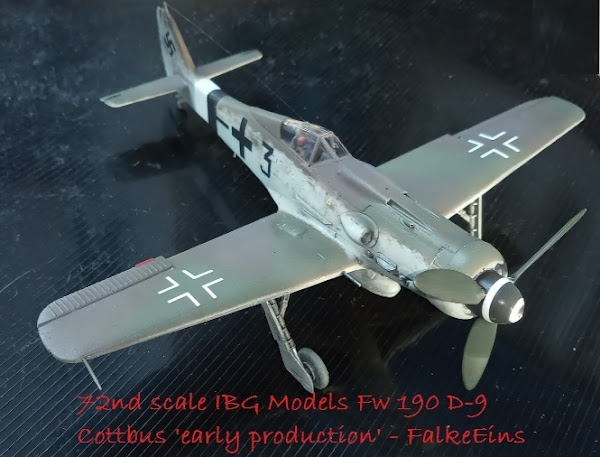
Building the new IBG Models Fw 190 Dora 9 (Early Production Cottbus) - new Luftwaffe models


Finished my first of the lovely 72nd scale IBG Doras (Cottbus 'early'). Totally hassle-free build, loads of detail and neat options! 

Finished in one of the kit markings options, Fw 190 D-9 "black 3" WNr 210239 flown by Uffz. Fritz Hanusch, 6./JG 26, shot down on 7 March 1945 by the 366th FG and crash landed at Börsiker, Wesel. 


 Part 1 of my build is here

 Part 2 of my build is here


Sunday, 9 February 2020

"Doppelabschuss!" Auf dem Feldflugplatz eines Jagdgeschwaders......more Messerschmitt Bf 109s - ebay photo find #326


Press photo of Oblt. Johannes Steinhoff at the controls of his 10.(N)/JG 26 Dora


"Doppelabschuss!"  Auf dem Feldflugplatz eines Jagdgeschwaders......


Ofw. Max Martin 8./JG 26


  Bf 109 E ‘black 5’ flown by Leutnant Gustav Langanke of 5./JG 27


Messerschmitt Bf 109 G-6 Major "Tutti" Müller Stab JG 3 Mai 1944. Left, Dahl


Bf 109 G-2 of I./JG 54 in winter 1942-43.


Bf 109 E-3/N flown by Hptm Herwig Knüppel Kommandeur II./JG 26 Westfeldzug 1940. As an Oberleutnant, Knüppel was one of the first German fighter pilots in Spain (departed Germany on July 31, 1936). Knüppel was killed near Valenciennes on May 19, 1940 in WNr. 1452 while leading II. /JG 26. He had 3 victories to his credit (in addition to his 8 in Spain).


Wednesday, 25 September 2019

Kommodore JG 26 Galland's first Friedrich - ebay photo find #320

60 victory Abschussbilanz on the rudder of Galland's Bf 109 F-2 WNr. 6714. His victories 59 and 60 were returned on 15 April 1941 in this machine. Via Oliver Rogge


on offer here

Below; More 5. Staffel JG 26 Emils with diving raven emblem. More on this blog

 https://falkeeins.blogspot.com/2018/02/diving-raven-emblem-on-emils-of-5-jg-26.html


Below; note the diving raven emblem just visible under the cockpit of this 5./JG 26 Emil with scoreboard of Staka Lt. Wolfgang Kosse. See JFV 4/I p.317.