Showing posts with label Luftwaffe in France. Show all posts

Monday, 24 March 2025

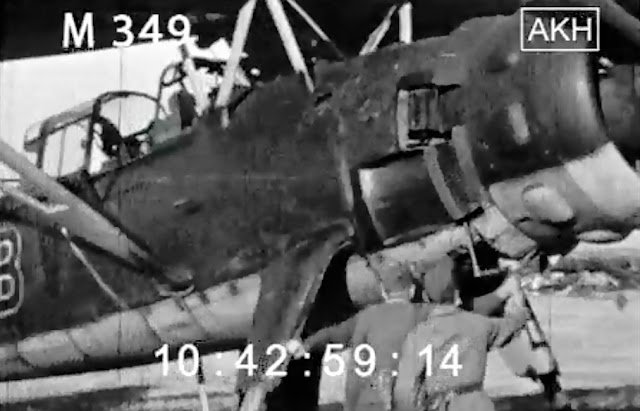
Hs 126 and DFS 230 Agentur Karl Höffkes film archive


Del has been trawling through the footage made available via the Agentur Karl Höffkes film archive (AKH) and has come across some DFS 230 colour footage;

 " ...from the Agentur Karl Höffkes film archive - home movie taken by a Luftwaffe officer while training on the DFS 230.." 


This footage almost certainly looks to have been filmed in the south of France presumably during the summer of 1943, prior to Gran Sasso. Either Valence Chabeuil or Lézignan-Corbières. It features a Staffel of Luftlandegeschwader 1 equipped with DFS 230 gliders and Henschel Hs 126 and Avia B.534 tugs training for a new mission... Hauptmann Joseph Karl, Gruppenkommandeur of III./LLG.1 is seen in the footage. 

On 19 August 1943, 12./LLG1 was transferred to Ottana (Sardinia), then on 11 September 1943 to Pratica di Mare (south of Rome). Its mission in Italy was the transport of 1./FJR.7 (Fallschirmjäger-Regiment) to Gran Sasso for the ‘liberation’ of Mussolini. I have extracted a couple of time codes which correspond to the stills below... 

 10:40:11  arrival by train at a town in France, possibly Valence. Does anyone recognise it? 
 10:43:00  engine start Hs 126 tugs of LLG 1 on the airfield.
 10:43:27  pilot in cockpit of DFS 230. Note MG 34 with muzzle flash guard  attached to the fuselage and MG 15 mounted above the cockpit
 10:42:47  a group of officers chatting. In the white cap the Kommandeur of III./LLG 1  (I think..). Another officer in white cap shows off his "Kreta" cuff band for the camera.
 10:48:13  colour section - a DFS 230 with nose-mounted braking rockets, also shown in close-up
 10:49:10   DFS 230 comes into land and the glider's braking rockets are fired. This section concludes with a few shots of the DFS 230 passengers disembarking...  

 At this point I would provide a link to view reel M349 ..but since preparing this post I can no longer find the film... 

 As always these stills are reproduced here with the kind permission of Karl Höffkes


Thursday, 27 February 2025

8th AF raid on Avord airfield, 5 February 1944, Fw 200 C-4 of 8./KG 40


The airfield at Avord, ten miles east of Bourges in the Cher departement (Loire valley region), was one of the biggest military airfields in France even prior to the German invasion. From July 1940 it was continuously occupied by Gruppen of Luftwaffe bombers but escaped attack until February 5, 1944 when it was hit by the 8th AF flying mission no.210. A US reconnaissance mission carried out one month prior to the raid took photographs showing an Fw 200 on the northern ‘dispersal’, and a further five Fw 200s facing the hangars along the Avord-Farges road and a He 177 taking off. In front of the southern hangars, there was one Fw 200, two He 177s, two He 111s and a single Caudron C 445. Finally, three Fw 200s were stationed in the western part of the airfield. According to US intelligence, through 1943 the prinicpal activity was crew training. The attack on Avord on February 5, 1944, targeted along with Châteauroux and Tours, was flown by 8th AF B-17s and B-24s escorted by 20th and 55th FG P-38's (two kills) and several P-47 FGs (4 kills). By the time the American bombers reached Avord, the alerted Germans were apparently attempting to 'scramble' the aircraft occupying the taxi-ways. At 11.09 am, the first bombs fell on the base. A tail gunner recounted: ‘I saw a German bomber taking off, but four P-38 fighters swooped down on it and knocked it out’. Several hangars received direct hits and were seriously damaged. The surrounding area was not spared: 16 houses in the hamlet of ‘Les Vignes’ were hit by bombs and partially destroyed. Fw 200 C-4 of 8./KG 40 (W.Nr. 0170) was one of two machines to get airborne as the raid started but was caught and shot down along the Crosses-Saint-Just road, Annoix, some 10 km south of Bourges-Avord as seen here in the P-47 gun-camera stills. KG 40 pilot Hptm Anton Leder along with four other members of the crew was KIA. The Fw 200 came down in the marshes between Fenestrelay and Bourges. There were three survivors. Research by 'archaeologist'.


Saturday, 22 February 2025

Fw. Kurt Knappe - first Abschuss in the West


An 'unexpurgated' view of Fw. Kurt Knappe's rudder scoreboard on his Fw 190 A-4 WNr. 2413 from the ECPA-D file DAA 2693 - recently posted elsewhere without commentary. Knappe arrived in the West at III./JG 2 with 51 Eastern Front 'red star' victory markings on his rudder. This image was taken on the occasion of his first 'kill' in the West - his 52nd - marked with what appears to be an RAF 'roundel' visible here (bottom row) but which is in fact an American 'star'. This first victory with 7. Staffel was achieved on 30 December 1942 -a USAF B-17- shot down over the sea during a 1st Bomb Wing raid comprising some 40 B-17s on the U-boat pens at Lorient. B-17 'kills' were soon represented with a double-bar with US star superimposed on JG 2 rudder scoreboards. Knappe was posted to the West in late 1942 along with another JG 51 ace - Erich Hohagen - to 'beef up' 7./JG 2 who had lost Oblt. Egon Mayer following Mayer's appointment as Kommandeur of III./JG 2. Mayer replaced 'Assi' Hahn who departed for JG 54 in the East on 1 November 1942.


The 8th USAF's raid on the U-boat pens at Lorient on Wednesday 30 December 1942 - the 27th mission of this fledgling force- was significant in the story of the Fw 190-equipped III./ JG 2. Kommandeur Mayer and his Stab along with nine Fw 190s from 7. Staffel were airborne from Vannes to counter the incursion. Mayer was determined to carry out a new tactic that he had been considering over the previous weeks - the frontal attack, hitting the B-17s where their defensive fire was at its weakest. Flying alongside Knappe that morning was another ace encountering four-engine bombers for the first time - Lt. Georg-Peter Eder.
 

Friday, 24 January 2025

JG 2 Friedrich 'Notlandung Cherbourg' - ebay photo find #384


..and the seller also states 'Wick 1940'.  So probably not Cherbourg either - III./JG 2 was mostly based at St.Pol/Brias during the summer and autumn of 1941.

This yellow-nosed  7.Staffel JG 2 Bf 109 F-2 'white 10' with (barely visible and rare for a Friedrich) 'top hat' or Zylinderhut emblem on the cowl appears to have made a wheels-up landing and slid off the end of the field during the late summer of 1941 - or perhaps the gear has collapsed after the machine has run over the slight embankment around the perimeter. Certainly the prop does not appear to have been damaged. Subsequent images show the aircraft back on its gear and being pushed around the perimeter road. The focus of attention though in the picture below is not on the aircraft but on something in the road behind it - has the aircraft hit something? There certainly seems to be some damage on the spinner. Note (presumably) the pilot near the tailplane (in life jacket) and the onlooker behind him wearing a black beret. 7. Staffel gave up their Friedrichs in May 1942 to convert to the Fw 190. Kapitän during this period was Oblt. Egon Mayer.


also on this blog

III./JG 2 convert onto the Fw 190 May-June 1942 - 7. Staffel Kapitän Oblt. Egon Mayer.

Tuesday, 29 October 2024

Dewoitine D.520s and Arados in JG 105, Chartres


A line-up of D.520s with a single Ar 96 of JG 105 in early 1944. The story of JFS 5/JG 105 from June 1941 to June 1944 is told in Avions issue No. 253 (July/August 2023). 

The numbers of machines and pilots lost during 1944 is notable, no doubt the result of short-cuts in training programmes, the employment of non-German types, Allied bombing raids on French airfields and RAF fighter sweeps. During February 1944 there was an accident or incident every day of the month  - on 6 February a strafing attack destroyed two  D.520s and on the 9th a D.520 was shot down by 166 Sqn Typhoons**. During March 1944 Chartres was bombed on the 2nd (six D.520s damaged or destroyed), raided by RAF Typhoons of 174 Sqn on the 16th and bombed again on 27 March (five D.520s destroyed). During April 1944 there were over 60 accidents and incidents with an important bombing raid on April 10. In total, some 51 aircraft were damaged or written off during the month. The last mention of a D.520 in JG 105 was 20 April 1944 - by now spare parts were likely at a premium and none of the D.520s went back to Germany with the unit, a transfer that got underway on 7 June.

Click on the image for a wide-screen view.


A closer view of the two D.520s nearest the camera 'yellow 77' and 'yellow 76'. The spires of the cathedral in Chartres can be seen in the background.


**

"..During a 'Ranger' to the Chartres area on 9 February, Plt Off D. Erasmus of 266 Sqn claimed a Bf 109 shot down. This was in fact a Dewoitine D.520, an ex-Armée de l´Air fighter taken over by the Luftwaffe and used by JG 105, which was based at Chartres. D.520 No 483 was shot down and Uffz. Woll was killed. Four days later (on 13 February 1944) Sqn Ldr G.B. Warnes of 263 Squadron, also a Typhoon unit, claimed another Bf 109 in the same area. Again this was a D.520 of JG 105 - No 664 in which Uffz. Bartl was killed. It is interesting to note that at this time the Luftwaffe operated four such Jagdgeschwader in France, which would continue to operate until August 1944 (sic), when there was a general withdrawal back to Germany. The other units were JG 101 at Pau, JG 103 at Chateauroux and JG 107 at Nancy."

 In '2nd TAF' by Shores and Thomas

Thursday, 3 October 2024

Fw 190 in JG 26 - archive photo scan #32


An early JG 26 Fw 190 - an enlargement from a Nicolas Grebert image previously published in the author's " La Jagdgeschwader 26 - Histoire de quelques aérodromes de la Luftwaffe dans le nord de la France.." Note the aircraft shelter in the background. If this is Wissant/Audembert, about 23 km south of Calais, then the remnants of these are still visible from the road that runs alongside the field. 

Click on the image to view large..


Monday, 9 September 2024

Le Fana latest issue Sept 2024 - Luftwaffe pilot training in south-western France (excavating an Emil)


by Gilles Collaveri

"...31 January 1944, Pau, south-west France. Friedrich Kisslinger climbed into the cockpit of a Messerschmitt 109 E coded ‘red 5', an E-3 built by Erla in April 1940, from a batch of 500 constructed between August 1939 and April 1940. According to German archives, it had already been damaged twice, the first time on 29 August 1942, when it sustained 35% damages in northern France, and a second time on 25 March 1943, again at 35%, at La Rochelle Laleu airport [when a plane was damaged, the Luftwaffe recorded the degree of destruction. Thus 100% meant total loss]. Friedrich Kisslinger was 21 years old and had followed the standard curriculum by learning to fly gliders before arriving in Pau. On 31 January he got airborne. Once at altitude, he somehow lost control of his aircraft and was unable to stabilise it. When he finally bailed out he was too low. He was killed on impact with the ground, and his plane crashed nearby. How did the young Friedrich Kisslinger find himself in 1944 in south-west France? Quite simply because in 1943 and 1944, Tarbes, Pau and Toulouse were three major Luftwaffe training bases. These airfields were far from the front line and enjoyed decent weather, ideal for training young pilots. Jagdgeschwader 101 and the Jagdgruppe Ost, Süd and West were based here. Formed at the end of 1942, JG 101 was based in Pau, Tarbes and Ossun, while JGr. West and Ost were based in Cazaux, Biarritz, Toulouse, Mont de-Marsan and Landes-de-Bussac. These training units sometimes opposed Allied raids. On 5 March 1944, for example, Chuck Yeager's P-51 B was shot down by Irmfried Klötz, a young pilot from JGr. West flying the Fw 190..." 

So-called 'Idiotenbock' Emil trainer with 'fixed' landing gear and wing-tip 'stabilisers'  -   from reading the piece it is not clear if they were flown like this - that seems unlikely. These 'skids' were more likely designed as an aid to 'rough-field' taxiing. 


 After a long investigation and thanks to local eye witness accounts, Gilles Collaveri's association "Aérocherche" located the field where Friedrich Kisslinger's Me 109 crashed. Parts of the aircraft were uncovered, albeit damaged where the field had been ploughed. Nonetheless, one oil temperature gauge plate had miraculously remained intact because it was folded in half, protecting the inscriptions. It confirmed that the 'aviation archaeologists' of  'Aerocherche' were looking at the remains of an Emil. Numerous parts gradually came to light: equipment components, a fragment of an instrument panel counter, ammunition cases of different calibre: cannon and machine guns. Some of them still showed traces of green camouflage paint. In the spirit of respect and remembrance the pilot's family was located near Munich, more specifically the pilot's nephew, who shared the same first and last name as his uncle. He expressed a strong desire to visit the site of his uncle's crash. More than 70 years after the accident, Friedrich Kisslinger arrived from Germany with his son to visit the crash site of his uncle's Me 109 ‘red 5’. 

See Friedrich Kisslinger's visit towards the end of Gilles 20-minute film on Vimeo here

Parts of this article were previously posted on line at the Aérocherche FB page here


Wednesday, 7 August 2024

Ju 88 1(F)./123 Brittany, 1941 -archive photo scan #29


Luftwaffe Helferinnen welcome back a crew from 1.(F)/123 somewhere in Brittany, possibly Morlaix or Brest, following a 'milestone' sortie somewhere over England and the Channel during 1941.


Saturday, 8 June 2024

Stukageschwader 77 - archive photo scan #21


..a Kette of 1. Staffel of St.G 77 seen over northern France (Caen, Normandy) during late August 1940. New crews being trained in formation flying according to the period caption - 'Staffelausbildung mit neuen Besatzungen..'


Sunday, 12 November 2023

II./JG 77 Emils in Brest - archive photo scan (5). A new JG 77 monograph due soon!


..these photos simply labelled "Brest".  II./JG 77 departed Scandinavia** for France in early November 1940. Machine with Kommandeur chevrons and 'Seeadler' emblem probably belonged to Hptm. Karl Hentschel. Click on the image to view large!


A detailed account of II./JG 77 actions against RAF Bomber and Coastal Commands during the summer of 1940 appears in this blogger's "Luftwaffe Fighters -Combat on all Fronts" Volume I, published by Mortons)

Coming soon from the publishers of AÉROJOURNAL - due on 12 January 2024 is a 'special' (HS N° 47) devoted to JG 77 available to preorder now here


"..Heinz Bär, Joahnnes Steinhoff, Siegfried Freytag, Kurt Ubben, Wolf-Dietrich Huy, Gordon Gollob, Joachim Müncheberg or Armin Köhler - a number of illustrious Experten passed through JG 77, the Luftwaffe fighter arm's "ace of hearts" Geschwader, whose Gruppen quickly distinguished themselves at the start of the Second World War: I. /JG 77 in the Polish campaign and II./JG 77 protecting the Bay of Germany from RAF bomber raids. This was followed by the Western campaign for the former, the Norwegian campaign and protection of the fjords for the latter, and the unprecedented creation of III./JG 77 in July 1940 from the planned carrier fighter Gruppe that was to have manned the 'Graf Zeppelin', which was never completed. After the hard-fought Battle of Britain and victory in the Balkans and Crete, the three Gruppen of JG 77 were scattered across all fronts, in the Soviet Union of course, but above all in the Mediterranean. Hard-fought campaigns over Malta, North Africa and Italy were the Geschwader's 'finest hour' but which relentlessly wore down its fighting strength. In 1944, elements of the Geschwader took part in the Battle of Normandy and the defense of the Reich, with JG 77's last bloody feats of arms coming in the Ardennes and the "Bodenplatte" operation in December 1944-January 1945. This exceptional special issue is the complete history of this JG, which claimed some 4,000 victories between 1939 and 1945..."

Sunday, 29 October 2023

Death of the Kommandeur - Maj. Helmut Fuhrhop I./KG 6 (Junkers Ju 188 E)


Above; I./KG 6 Ju 188 E medium bombers were based in Chièvres, south of Brussels for the Steinbock raids over England during the first quarter of 1944.


Just after mid-day on the afternoon of 29 February 1944 (1944 was a leap year) two Junkers Ju 188 Es took off from Melsbroek, north of Brussels, and headed for Dreux, 50 miles east of Paris. They were part of a force scheduled to fly another 'Steinbock' bombing mission over southern England later that day which was transferring to Dreux in small groups. One of the Ju 188s (coded '3E+AB') was flown by the Kommandeur of I./KG 6, Maj Helmut Fuhrhop. An Eastern Front veteran with KG 51, Fuhrhop was an experienced career aviator and RK-holder credited with sinking at least 30,000 GRT of shipping in 250 missions. He had also flown over one hundred sorties at the controls of a Legion Condor K 88 He 111 (Taghon p.49) and was an obsessive athlete who made his crews run around the airfield almost daily! (Taghon, p.166) At the controls of the second machine was Uffz. Wilhelm Mayer of 1. Staffel. Both machines carried five aircrew and a handful of groundcrew, while Fuhrhop had his two dogs, Chica and Ciro, on board. Meanwhile, seven Hawker Typhoon Mk.1b aircraft of 609 Squadron were getting airborne from Manston (Kent) to carry out a fighter sweep in the sector Le Culot-Florennes-Cambrai across Belgium/northern France. Led by Sqn Ldr Johnny Wells the group comprised, in addition to the Englishman, one Australian, one Canadian and four Belgian pilots. They had already strafed barges and tugs when they sighted the two Ju 188s flying south-west past Cambrai at about 1,000 ft. One of the Belgian pilots flying that day, Fg. Off. Charles Demoulin, later recalled; 
 “..We were at 150 ft and had our hands full keeping station in the flurries of snow that alternated moments of zero visibility with sudden clear breaks. Suddenly, two shadows loomed out of the gloom, flitting across our heading, just feet above us, to then rapidly disappear to our left into skeins of broken cloud. But not quick enough to prevent me from identifying them. They were Ju 188s, night fighters (sic!) and medium bombers.."

“ All three of us (the two other Typhoon pilots were Flt Lt Lawrence Smith and Fg. Off. Georges Jaspis) banked into a sharp turn at the same time and at some risk of collision since the other Typhoons did likewise. The chase was on ('C'est l'hallali'!). Throttles wide open and engine screaming we went flat out after the Ju 188s and within a matter of moments come across them in a clear patch of sky.

“In front of me, a multi-coloured ribbon streamed towards my Typhoon and I could see the gunner of the second bomber bracketing my Typhoon with tracer. A little right rudder to correct and the turret fell silent as the body of the gunner slumped in his seat. At that moment the gunner of the first Junkers opened up - his rounds flashed just past my cockpit. Left rudder and gun-button depressed I rapidly shifted target - there were flashes on the grey fuselage and an explosion and the port engine of the Junkers burst into flames. ”


Below; I./KG 6 Ju 188 E "3E+KL" on a transfer flight - these machines were seen only rarely in the air during daylight hours during 1944, usually during transfer flights..


The combat was a slaughter and both bombers were sent down in flames. Meyer crashed at Bohain-en-Vermandois while Fuhrhop’s aeroplane came down three miles further south at Seboncourt, some 20 miles south-east of Cambrai. Everybody on board was killed, including Fuhrhop's long-time observer Ofw. Alfred Schuber.  According to one account, Fuhrhop's wrist watch was stopped at 13:13. The Adjutant of I./KG 6, Oblt. Roters, identified the recovered bodies wrapped in parachutes the following day laid out in a nearby monastery. Fuhrhop's wife and her sister attended the funeral in Mons. Fuhrhop's replacement as Kommandeur I./KG 6 was Hptm. and RK-holder Hans Thurner.

Below; Fuhrhop's widow and her sister in black at the Kommandeur's funeral. To the right in the front row  are, from the left, the Kommodore, Maj. Hermann Hogeback, the Kommandeur II./KG 6, Hptm. Hans Mader and  Fuhrhop's successor, Hptm. Hans Thurner..


Extracted and adapted from Peter Taghon's superb 328-page large-format French-language history " La Kampfgeschwader 6"  published by Lela Presse. Published in June 2021, an 18-page PDF extract of Peter's book is available on the publisher's web site here

Saturday, 21 October 2023

Paris, Buc or Le Bourget , summer 1941, Fw 190 'Fronterprobung' flight tests in II./JG 26 Otto Behrens - archive photo scan (4)


Above; Göring and staff examine the Fw 190 A-1 'brown 4' probably in Buc, Paris during August 1941. Göring - in pale blue uniform - is visible next to the port wing MG.

A fantastic contribution from Peter K. (Larry) who has forwarded photos from his grandfather's album - Peter's grandfather was (Oblt. later  Maj.) Otto Behrens, the man largely credited with getting the early teething problems wrung out of the Fw 190 and thus getting it into service. The unit charged with the introduction into Luftwaffe service of Kurt Tank's new BMW-radial engined fighter was an 'Erprobungskommando' (test detachment) under Behrens which started its work in Rechlin and then moved to Paris during 1941 to carry out operational trials (Fronterprobung). 

While the Behrens family who own the album are not entirely sure of the date and location of these images, one member of the General Staff who features on them - 'Hajo' Herrmann- recalls in his memoir (see chapter 8) that in July 1941 he was transferred to Paris and during that summer accompanied Göring to visit the latest 'innovations' on the airfield at Buc, 18 kms south-west of Paris (see third photo below, Herrmann at second left). 

Karl Borris (TO II./JG 26) writes that II./JG 26 moved to Le Bourget in August 1941 to convert onto the Fw 190 A-1 (Rodeike, 'Jagdflugzeug 190' p28) The Fliegerstabsingenieur (Technical Officer of JG 26) Ernst Battmer describes Otto Behrens was the man largely responsible for getting the Fw 190 into service - "..no praise is too high for his work" (Rodeike 'Jagdflugzeug 190' p33). The period of 'Fronterprobung' or operational testing in Paris was a disaster due to the constant engine over-heating issues - " die Fronterprobung wuchs sich zu einer Katastrophe aus.." Practically every flight ended up with some sort of engine damage and very often the engine over-heated just taxying out, causing any test flight to be scrubbed. ('..der Motor wurde bereits sauer beim Warmlaufen oder beim Rollen zum Start und die Maschine mit Kolbenfressern blieb stehen..') It was Behrens who forced through the changes required as Focke Wulf claimed that the BMW engine 'tauge nichts' (literally, was not worth a damn..) while BMW stressed that Fw had not allowed for enough cooling air flow to the big radial in the original design of the aircraft. The lack of cooperation between the two companies forced Behrens to knock heads together - probably not too onerous a task with the head of the Luftwaffe taking a keen interest in the new fighter. Rechlin had already test flown the Fw 190 against all leading Allied fighter aircraft then in service ..and it had not out-performed Messerschmitt's Friedrich in comparison testing. (see link below)


Above; far right alongside Göring at Buc airfield was the corpulent commander of Luftflotte 3 Sperrle. 

Following the death of Schneider in December 1941 Behrens resumed his former position as 6./JG 26 Staffelkapitän. During 1942 he transferred to the Kommando der Erprobungsstellen der Luftwaffe based in Rechlin. Here he was promoted to Hauptmann on 1 January 1943 and to Major on 1 June 1944. He ended the war as Kommandeur der Erprobungsstelle Rechlin.

He later went to Argentina - with Tank and Galland - and flew as test pilot in Tank's Ta 183 derivative the Pulqui. He was killed on 9 October 1952 in a crash while testing the Pulqui.

Otto Behrens (facing camera) with Göring during August 1941 (probably) at Buc airfield, Paris


Also on this blog;


Tuesday, 25 April 2023

No 1 Squadron Hurricanes in France 1939-40 - Sqn Leader 'Bull' Halahan and 'blue 109s'


During late 1939 No. 1 Squadron was commanded by Squadron Leader Patrick J. H. ‘Bull’ Halahan. While airmen from all over the Empire served in 1 Sqd,  the Irish squadron leader earned a certain notoriety. Patrick Halahan, a Dubliner, nicknamed ‘Bull’ - apparently because of his sturdy broad-shouldered physique - had what might then have been referred to as a 'strong character'. He spoke with a thick Irish accent and according to one account, " his language was colorful and down-to-earth. " As part of 67 Wing, 1 Squadron was sent to France during October 1939 along with No. 73 squadron as part of the air component of the BEF (British Expeditionary Force) assigned to escort and protect the BEF's Fairey Battle bomber and recce machines. No. 1 Squadron was to settle in at the airfield at Vassincourt (Champagne-Ardennes region), while No. 73 Squadron under Squadron Leader Brian W. ‘Red’ Knox was stationed at Rouvres. The field at Vassincourt was perched above the small village of Neuville where No 1 squadron’s pilots were quartered in private lodgings. It was, according to the pilots, a ‘real hole’. Squadron Leader Halahan soon had good cause to call upon the services of the new French interpreter assigned to the unit - a certain Jean Demozay. With Jean’s help the pilots were able to establish their ‘mess’ in the local town hall, rather than utilize the ancient and run down buildings on the airfield. This was the first real contact between the two men and their paths would subsequently cross on several more occasions.

'Bull' was soon embroiled in struggles with RAF command. This became evident when he insisted on back armour being installed in the Hurricane. The authorities believed this would disrupt the aircraft's centre of gravity, but Halahan took the armour from a Fairey Battle bomber and had it installed. It was soon apparent that it did not affect the Hurricane’s handling. He demanded – against regulations – that the convergence distance for the eight machine guns be reduced to short range, which increased the effectiveness of the Hurricanes. 


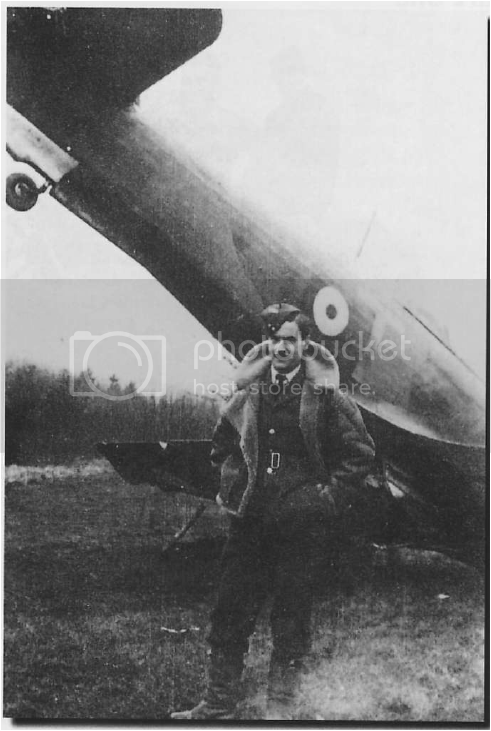
Pilots of No 1 Squadron at Vassincourt show off one of their Hurricanes to Mr Mahmoud Abu Fath, a member of the Egyptian Parliament, January 1940. Looking at the camera is Flying Officer Billy Drake, who became a 20-kill ace and survived the war.


Below; Thierry Dekker artwork of No. 1 Sqd Hurricane Mk 1. s/n L1679 'JX-G' of F/O Paul Richey, Vassincourt, May 1940. Note the French-style rudder stripes. Note the aircraft is fitted with a reflector gun sight. The photo also appears to show aluminium or blue lower surfaces (rear fuselage) - as Richey put it in his account ; " all German aircraft were difficult for us to see from below as they were painted duck-egg blue. Our  [..aircraft ] stood out like chequer-boards. Not without a struggle 'Bull' had our machines painted blue underneath, a colour subsequently adopted for all RAF fighters..."


As noted by Richey in his memoir 'Fighter Pilot' 'Bull' also filed a report regarding the lower surface colours of RAF fighters which was forwarded to AASF HQ and dated May 7, 1940 and had originated from test flying a captured Bf 109 against Hurricanes on May 2, 1940 at Orleans. S/Ldr Halahan wrote:

" ..during these tests one point became abundantly clear, namely that the 109, due to its better under camouflage, was very much more difficult to spot from underneath than was the Hurricane. This gives the 109 a definite tactical advantage, namely when they are below us they can spot us at long distance, which we when below them find most difficult. As in all our combats initial surprise is the ideal at which we aim, I strongly recommend the undersides of Hurricanes be painted a duck egg blue, the roundels remaining the same, as it is the contrast between the black and the white only which is noticeable from below.."


Above, Bull Halahan (CO) and Johnny Walker in front of 'L', still apparently with black/white undersides


Below; P/O Peter 'Boy' Mould of 1 Sqd is often credited with scoring the first RAF victory over France on Oct 30, 1939 in Hurricane L1842 coded 'T'. In fact he did not - a JGr. 152 Bf 109 D flown by Gfr. Joseph Scherm was shot down by return fire when attacking a Battle of No. 103 Sqd on September 27. Three weeks later a Hurricane coded 'T' was lost after a mid-air collision with a French H-75A. The Hurricane was flown by Sgt A.V. Clowes (of JX-B with wasp fame) and the photo shows Clowes alongside the machine - note the 'T'  - the serial 'JX' appears to have been overpainted, as was common practice at the time. While codes change in service of course this may well have been Mould's aircraft.


Loss report for P/O Mould, flying a replacement Hurri, coded "T" on May 10, 1940
Type: Hurricane Mk 1
Serial number: P2649, JX-T
Operation: Patrol
Damaged: 10/05/1940
P/O W.O. Mould - unhurt
Took off from Vassincourt. Hit by return fire from Do 17 engaged east of Rouvres 05.00 hrs. Returned with slight damage and punctured tyre. Aircraft damaged but repairable.


Another Irish pilot to benefit from Halahan’s leadership in 1 Sqd was John Ignatius Kilmartin from Dundalk, County Louth. ‘Killy’ claimed several aircraft destroyed during the Battle of France, including a Messerschmitt Bf 109 on 12 May 1940.  (claimed as a Heinkel He 112). On that same day, his leader, ‘Bull’ Halahan shot down a ‘real’ Bf 109 before being brought down himself. Luckily, he was unhurt and managed to return to his unit. He continued to lead them to numerous victories in the air until the exhausted Squadron was granted a return to Britain on 24 May. Both pilots became instructors at No. 5 Operational Training Unit at RAF Aston Down. Halahan became its commander, but Kilmartin was sent to RAF Tangmere to participate in the Battle of Britain, shooting down two aircraft in the first three days. 

Surprisingly the experienced Halahan was not involved in the Battle of Britain. In April 1941 he led a formation of 24 Hurricanes, taking off from the aircraft carrier HMS Ark Royal and flying to the besieged Malta, enabling the island to hold off Italian-German air attacks. However, in June 1941, he took responsibility for a riotous drinking spree of some of his men and was transferred to the Middle East. With his career stalled, he retired from the RAF in 1943. This, together with his absence from the Battle of Britain, may be the reason why he is largely forgotten. 

The memoirs of Richey and Drake, two direct witnesses suggest other reasons. For example, Halahan is described as  having a certain contempt for the French ally and made no secret of it according to the Francophile Richey. Drake describes him as an unwelcoming fellow who did not wish to have any ongoing contact with his men. He lived in a chateau or, although married, indulged in adultery with local girls (his Francophobia was therefore 'two-speed'). It is perhaps for his 'harsh' temperament ('Bull') and his various misdemeanours that led to his eclipse rather than for his 'non-participation' in the Battle of Britain.... 

Kilmartin had a much longer career, flying Typhoons and Thunderbolts and taking command of several units from Scotland to Sierra Leone and from Middle Wallop to Sumatra. After the war, Kilmartin stayed in the RAF and held several positions in NATO until 8th July 1958, when he retired as a Wing Commander.


Also on this blog;


Thursday, 23 March 2023

Oberfähnrich Wolfgang Rose 4./JG 26 - 'Ehrenbuch JG 26'


   The JG 26 'Ehrenbuch' is a large volume containing brief biographical details and portraits of every pilot who flew with JG 26. Read in conjunction with the "Gedenkblätter für die gefallenen Angehörigen des Geschwaders" ('memorial cards' for the fallen members of the Geschwader   - genitive case ending on Geschwader, not a plural!) it is possible to build up a picture of these young Nachwuchs ('new growth') who flew and fought for literally only a handful of sorties before being shot down and killed.
 
Born on 28 September 1924 in Stollberg (district Erzgebirgskreis, southwest of Chemnitz), Wolfgang Rose arrived at JG 26 on 30 April 1944 aged 19 years old. He had entered the Luftwaffe in November 1942 directly from school and became an Oberfähnrich on 1 March 1944. A tall thin lad, well-liked, he was a keen airman and as might be expected 'einsatzfreudig'  or 'keen to see action'. He was posted from his operational training unit 4./ Jagdgruppe West to 4. Staffel and flew just 7 combat sorties (Feindflüge) before he was shot down and killed on 27 June 1944. The Ehrenbuch gives a very short account of his death - his Staffel was landing after a sortie when they were surprised by Allied fighters.  At the controls of his Fw 190 A-7 'black 15' (WNr. 431159) Rose had already set up to land but 'saw the danger' and attempted to pull up and go around. He failed to detect the P-47 or P-51 that slipped in behind him. He was hit and shot down. He crashed to his death 1 km east of  Ennencourt and was buried at the German cemetery in Beauvais. Rose was credited with a single Abschuss - a so-called  'wirksamer Beschuss'  ('effective fire'). A note in his memorial card attests to his 'strong' ideological and political outlook ('seine weltanschauliche und politische Einstellung war gefestigt '). His rank of Ofhr. has been crossed out and 'Leutnant' added - presumably posthumously along with the award of the EK I in December 1944.

An interesting account from a JG 26 Nachwuchs who survived is Heinz Gomann's " Und über uns der Himmel - Fliegergeschichten vom Jagdgeschwader 26 " - flying stories from JG 26. (Vowinckel Verlag, 1996).  Gomann provides an apt description of the non-existent combat value of an inexperienced fighter pilot during his first missions at this stage of the war;

"..The Staffel takes off to counter incoming Spitfires. I stay close to my Rottenführer. Suddenly everything starts to turn like crazy. I have no idea why. After landing, they tell me that we were caught up in dogfights with the Spitfires. I didn't see any. Apparently that's what happens to everyone at the beginning (...)…"


Also on this blog;

Tuesday, 24 January 2023

More Aufklärungsgruppe Junkers Ju 88s - Ju 88 H with Aufkl.Gr. 123


The Junkers Ju 88 H was a development of the Ju 88 D intended for long range reconnaissance missions over the Atlantic in support of the U-boats. Powered by BMW 801 engines the design incorporated two additional sections in a fuselage 'stretched' to 17m - 99 cm was added forward of the leading edges and another 230 cm section was incorporated aft of the trailing edge root point to house an extra fuel tank. The wings were taken from the G-1. Three Robot Rb 70/30 and 50/30 cameras were mounted in the rear fuselage. The variant was also notable for the absence of a cupola under the forward fuselage. Prototype machine, the Ju 88 V89 (W. Nr 430820, RG+RP) was fitted with a FuG 200 Hohentweil search radar, two MG 81s in a WT 81Z ventral pod, and one MG 81 in the windshield and rear posts. It was first flown on November 2, 1943.

The Ju 88 H-1 was the reconnaissance version with BMW 801 Ds (1700 hp) and FuG 200. Maximum range was 5130 km. Ten were built. The H-2 was a more heavily armed Zerstörer sub-type not fitted with radar or cameras. Wing span was 20.08 m and engines were BMW 801 D-2s. Armament – two MG 151/20 cannon in the closed nose and four in a ventral pod. Five were built. (Smith and Kay)

Below; ECPA-D images possibly depicting an H-1 (note FuG 200 just visible) operational with 3.(F)/Aufkl.Gr.123 in France.  AufklGr. author Harald Rabeder comments;

".. The photos were taken early 1944 during a visit of General Ulrich Keller at 3.(F)/123 to inspect the Ju 88 H. Beside General Keller is Staffelkapitän Hptm. Höfer and an unknown officer -most-likely the adjudant aide-de-camp of General Keller or Technical officer of 3.(F)/123. The "German mastif" is the Staffelhund of 3.(F)/123 - unfortunately I do not know it's name .."


Ju 88 D of 1.(F) / Aufkl. Gr. 122 based in Greece in early 1944. Note the unit spinner marking. More on this blog at the links below 

Also on this blog;