Showing posts with label KG 26. Show all posts

Monday, 26 May 2025

Junkers Ju 188 A-3, III./KG 26, Gardemoen/Norway, May 1945


This III./KG 26 Junkers Ju 188 A-3 was photographed in Gardemoen/Norway, May 1945, following German surrender to British forces. Note the WNr. 0326 under the cockpit and what looks to be the variant designation. This Ju 188 was equipped with the FuG 200 Hohentwiel airborne naval search radar. III./KG 26 converted to the Ju 188 A-3 in December 1944 and in early January 1945, with 37 Ju 188s on charge, the unit was transferred to Bardufoss in northern Norway. From here the Gruppe flew a number of attacks against Allied shipping up until late February. Returning to Gardemoen, 30 kms north of Oslo, the unit did not see much action due to fuel shortages. Their final mission of the war was to help evacuate wounded soldiers from the Kurland pocket, after which most aircraft returned to Norway. Reposted from the ongoing Petrick archive ebay sell-off....

Sunday, 11 May 2025

new Luftwaffe books (4) - AÉROJOURNAL HS N°50, LA KG 26 "LÖWENGESCHWADER"


Caraktere are back in action after their recent 'difficulties' - a new 'special issue' devoted to KG 26, the Luftwaffe's anti-shipping Geschwader is just published. For just 15 euros (more expensive outside the EU) this 120-page publication ( 150 photos, 20 profile artworks) written by a good friend of this blog, Bernard Roland, tells the (relatively unknown) story of the Löwengeschwader.

Contents:
- Creation of the ‘Löwengeschwader’ and the pre-war period
- From Poland to France: the time of lightning victories
- KG 26 during the Battle of Britain and the Blitz
- 1941-42: on all fronts!
- Late 1942 - Early 1944: Operations in the Mediterranean
- Facing the landings!
- The last months of the ‘Löwengeschwader'
- Conclusion and appendix


Go here to order      AÉROJOURNAL HS N°50 - LA KG 26 "LÖWENGESCHWADER"

Also on this blog;

An interview with Alexander Steenbeck, author of a comprehensive German-language history of KG 26

Sunday, 22 January 2023

Hptm. Herbert Treppe 13.(Zerstörer)/JG 5


Born in Sprottau (now a town in western Poland) on January 30, 1914, Herbert Treppe studied at Breslau university, joining the Marineschule Mürvik in April 1935 where he learned to fly. He studied at the Luftkriegsschule Gatow 1935-36 (note two 's') and received his A/B licences at Celle in September 1936. His 'Lehrlingszeit' concluded with five months blind-flying at the Blindflugschule Wesendorf and subsequently he became an instructor in Brandis. Determined to join a front unit he was posted to KG 26 late in 1940 and according to one source flew in the 'Luftschlacht um England' (Battle of Britain). He flew both day-and-night sorties against land and shipping targets in England and Scotland. On one occasion he succesfully belly-landed his badly shot-up Heinkel He 111 with four wounded crew members in Beauvais after surviving a night-fighter attack.  On February 21, 1941 he was forced to ditch in the North Sea/Skagerrack and spent five hours in a dinghy in temperatures well below freezing before being found. He did not return to flying duties until October that year. After a spell as Ic to the Fliegerführer Nord he flew combat against England, Murmansk and in support of the German army in the Far North. He was appointed Staffelkapitän of 13.(Zerstörer)/JG 5 on June 1, 1943. He wrote an account of one of his first sorties leading the Staffel that summer, claiming two Bostons downed for a 'Doublette' -  as he put it, ".. not bad for a new boy". There are apparently no corresponding Boston losses in Soviet records.


13.(Z)/JG 5 re-equipped with the Bf 110 G early in 1943. Treppe flew Messerschmitt Bf 110 G-2  "1B+AX" (W. Nr. 120 037) out of Kirkenes during autumn 1943 as illustrated here by Kjetil Åkra in Eduard-Info 2015. 


The Zerstörer Staffel was re-named 10./ZG 26 in July 1944. Later in the year Treppe was named as Gruppenkommandeur of IV./ZG 26 (formed during the summer of 1944) and claimed an RAF Coastal Command Liberator on 28 September 1944 timed at 1245 hrs at only 5 metres altitude (over the sea). 

IV./ZG 26 became the new II./JG 5 in February 1945 with Treppe as Kommandeur. As related by Jan Bobek in Eduard-Info 2015-10 the newly reformed II. Gruppe was built up from elements of 9., 12., and 16./JG 5, and partly from the Stab IV./ZG 26 and 10./ZG 26. Interestingly the Messerschmitt Bf 110 Gs from the defunct Zerstörerstaffel were divided amongst the three Gruppen of JG 5 with single-engined fighters and were flown up to the end of the war. 

While the 'Luftwaffe Officer career summaries' page indicates that Treppe passed away in 1984, Jägerblatt published a 75th birthday profile in the December 1989 issue. At this time Treppe was 'Vorsitzender' of the 'Traditionsverband JG 5'.

Monday, 18 February 2019

Junkers Ju 88 Aces - a selection of Ju 88 'ace' photos - Helbig, Hogeback, Storp, Fischer , Schweickhardt


Hptm. Erwin Fischer (right of the sign) with Glas Sekt on the occasion of the 3000th Feindflug  of Aufklärungsgruppe 121. Note the white swan emblem of the unit, Ju 88 D coded 7A + NH


Despite having published at least three volumes on Junkers Ju 88 Kampfgeschwader in their 'Combat Units' series, Osprey editor Tony Holmes decided we needed at least one Ju 88 volume in the 'Aces' series. However on the evidence of this volume I would say to him that we probably need a few more of these as well. This is an excellent volume on the Junkers Ju 88, presenting an overview of the aircraft and the men who flew it in each of the roles it undertook; bomber, intruder, night-fighter, long-range day fighter and reconnaissance. Many of the more 'famous' Ju 88 pilots are covered such as Baumbach, Helbig, Herrmann and Heinz Rökker along with some of the lesser known. The profiles are some of the best I have seen in an Osprey book and the content highly readable and informative. However, it is not strictly an "aces" volume as it does not specifically look at those who claimed 5 or more kills whilst flying the Ju 88. If you are thinking of buying it because of the title, you may perhaps be disappointed. That being said, if you have any interest in the type and the exploits of its crews then buy it - it is a taster or as Robert himself referred to it " a toe-dipper". To cover all noteworthy Ju 88 "ace crews", in all the roles in which the aircraft undertook, would take several similar sized volumes. For example, Hermann Hogeback is only mentioned in a couple of photo captions and he would certainly qualify as the Ju 88 bomber "aces of aces" (with 500+ operational sorties and being one of only three Ju 88 pilots to receive the Knights Cross with Swords). Erwin Fischer is the only reconnaissance pilot to receive the Knights Cross with Oak Leaves (as far as I am aware) and he is not even mentioned in the text...

Above; Ju 88 A-4 WNr. 142338 coded 'F1+GS' flown by the Gruppenkommandeur III./KG 76 Hptm. Heinrich Schweickhardt. The coat of arms of the city of Heidelberg recalls Schweickhardt's birth place. He was flying this aircraft when he went missing during a transfer flight on 9 January 1943.

Hptm. Heinrich Schweickhardt (1914-1943) awarded the RK as Staffelkapitän 8./Kampfgeschwader 76, (Ritterkreuz 04.02.1942, Eichenlaub (138) 30.10.1942)

Appointed Kommandeur III./KG 76 in March 1942 Schweickhardt and his crew went missing during a flight from Catania to Athen-Tatoi on 9 January 1943 after a radio message from about noon saying he was having engine trouble. This was after combat about 100 km west of Zakynthos or Zante. The aircraft was a Ju 88 A-4 WNr. 142338 coded 'F1+GS'. Posthumously promoted to
Major, credited with around 400 missions.


Below; Junkers Ju 88 A-6 1./(F)123 (4U+SH) after a recon mission flown by Ofw. Bach, Perugia Italy. Chased by Allied fighters the pilot flew so low over the sea that the propellers struck the water and shattered. Fortunately the wooden propellers broke evenly which allowed the engines to keep running and Bach made it back to his base in Perugia at a some what reduced speed..


Two views of I./KG 77 machines. Note the white winter finish applied even to the prop blades in the lower picture


below; torpedo-carrying Ju 88 of I./KG 26 taking off from Bardufoss in March 1945 to attack a Murmansk convoy. Note the Schiffssuchradar - shipping search radar FuG 200 Hohentwiel. To the right of picture Oberst Ernst Kühl is seen saluting the departing aircraft. 

Chris Goss has a different caption in his Frontline " Junkers Ju 88 - the twilight years"  which reads as follows;   A Ju 88 of I./KG 26 taxying out at Bardufoss to attack an Allied convoy, RA 64, on 20 February 1945. In the crew is Oberst Ernst Kühl who had recently been given command of a Fliegerdivision based in Narvik. He was holder of the Ritterkreuz mit Eichenlaub and had flown 315 combat missions, most of them with KG 55.


Below; interesting cockpit views and a rare portrait of Werner Baumbach at Munich Riem during 1942..


Junkers Ju 88s of KG 26 being readied for sorties out over the Med from Sicily. Note the twin under-slung torpedoes in the first image below, each weighing approx 750 kg, of which 200 kg was explosive. To launch the weapons the Ju 88 pilot had to maintain a speed of 180 km/h at an altitude of forty metres. In theory the torpedo could be dropped up to two kilometres from the target but in practise a more realistic range was barely 800 metres. However at distances such as these the Ju 88  pilots were very much aware they would likely find themselves in a maelstrom of defensive fire.


On 22 December 1942 Ju-88s from III.Gruppe KG 26 torpedoed and damaged the British troopship Cameronia. Strikes were made all along the African coast. Allied air attacks cost the unit four aircraft on 8 February 1943 when the unit's base at Cagliari-Elmas, Sardinia was bombed. In July 1943 the unit also contested "Operation_Husky", the Allied invasion of Sicily. On 12 August the unit struck at Allied shipping in the western Mediterranean losing 10 machines for little result.

Below; Kommandeur I./LG 1 Hptm. Joachim Helbig seen in Catania, Sicily during 1941. He was awarded the Eichenlaub during January 1942 after some 200 sorties..


Deployed early on in the Mediterranean, LG 1 would soon prove to be one of the most formidable and feared opponents of the Royal Navy. Under the orders of Kommandeur Helbig, the "Helbig flyers" of I./LG 1 as they were dubbed were responsible for sending many Allied ships to the bottom. Notable actions included the sinking of three large transport vessels Clan Campbell, Clan Chattan and Rowallan Castle from the convoy MW 9, during attacks on 13–14 February 1941. On 22 May 1941 during the Battle for Crete, LG 1 Ju 88 pilot Gerd Brenner finished off the RN cruiser HMS Fiji with heavy loss of life. III./LG 1 also damaged the Australian destroyer Waterhen on 9 July 1941, sinking it on 11 July. The Geschwader supported the Afrika Korps effectively in Libya and Egypt until 1942. Bombing raids were made on the Suez Canal, Cairo during this time. On 11/12 May 1942 I.(K)/LG 1 again led by Helbig were responsible for sinking HMS Kipling, HMS Jackal and HMS Lively in the Gulf of Sollum. Helbig below on the right..


Below; Iro Ilk Staffelkapitän of 1./LG 1 during 1943 and bomber ace at the controls of his Ju 88. Both Ilk and his close friend in LG 1 Gerd Stamp were awarded the Knight's Cross with I./LG 1 for audacious attacks on British shipping in the Med, before going on to fly single engine night fighters with the wilde Sau. Ilk was shot down and killed by Spitfires as Gruppenkommandeur III./JG 300 on 25 September 1944. Post-war Stamp achieved high rank in NATO and married Ilk's widow.


Having carried out intruder attacks over Britain with some success for almost a year, the Ju 88 Cs of I./ NJG 2 were transferred to the Mediterranean and the western desert of North Africa in late 1941.  Ju 88 C-4 " R4+EL" (3./ NJG 2) came to grief during the transfer flight to Sicily and made an emergency landing near Naples. Crash landed by Flugzeugführer Fw Robert Lüddecke (front) on 22 November 1941 at Capodichino-Naples. Lüddecke had returned three night victories - Nachtluftsiege - at the time of the incident.


Below; seen far left Ritterkreuzträger Hptm. Hermann Hogeback, Kommandeur III./LG 1 on the occasion of a commemoration of the 5000th sortie flown by the Gruppe, Stalino, September 1942.

Three bomber aces of KG 6 with around 1,000 sorties between them, Hptm. Rudolf Puchinger, Staka 8./KG 6, Kommodore Walter Storp and Kommandeur III./KG 6 Hermann Hogeback.


Partial view of a formation of V./KG 40 Ju 88 C-6 heavy fighters seen over south-western France during early 1943. Nearest to the camera is Ju 88 C-6 "F8+RY" with Oblt. Kurt Necesany at the controls, while behind this aircraft is "F8+NY"


Diving Eagle of KG 30 seen on Herrmann's Ju 88 A-4. Early in World War II, Herrmann flew bombing missions in the invasion of Poland and the Norwegian campaign. By 1940 he was Staffelkapitän 7./KG 4 re-designated 7./KG 30 at the end of the Battle of Britain. In February 1941 his Gruppe was transferred to Sicily, from where it attacked Malta then fought in the Battle of Greece. In one attack Herrmann sank the ammunition ship Clan Fraser in the port of Piraeus. The explosion sank 11 ships and made the Greek port unusable for many months. He was appointed Kommandeur III./KG 30 and flew missions against Russia. He was a controversial figure in 'right-wing' circles post-war.


"..Herrmann was one of the most deadly Luftwaffe pilots of the Second World War and one of its most innovative air tacticians; a committed Nazi determined to fight to the end, he even formed a special unit of fighter pilots whose task was to ram Allied bombers out of the air..."

 ..from his obituary published by the British 'Daily Telegraph' in 2010. Read it in full here

The above is intended to serve as an introduction to the two Ju 88 photo volumes compiled by Chris Goss in Frontline's 'Air War Archive' series..while Volume one focused on the Battle of France and the Battle of Britain, Volume two, "the Twilight years- Biscay to the Fall of Germany" covers the activities of Ju 88 Gruppen in Russia and the Mediterranean and looks at reconnaissance and torpedo operations. Heavy fighters also receive a chapter  - 'Battle over the Bay' covers the little-known ZG 1 - and there is a small section at the end on the Misteln..


Wednesday, 22 March 2017

The story behind the Luftwaffe book(s) - 100 Jahre Blankensee, Die dunklen Jahre und Die Spur des Löwen - Alexander Steenbeck


Interview with Alexander Steenbeck. I've kept our chat - or at least Alex's replies - in his original German for my German readers and added a quick and rough translation for those readers who don't know German.. 

" ..Alexander, could you please tell us a little about yourself as a person, writer and historian ? I believe you trained as a journalist…"

 Ja, ich arbeite seit mehr als 20 Jahren in der Medien-Branche, seit zehn Jahren in einem der größten Medienhäuser Norddeutschlands. Ich habe in Hamburg Geschichte, Journalistik, Betriebswirtschaftslehre und Politik studiert. Die Kombination aus Beruf und Studium ist für meine Arbeit als Autor sehr vorteilhaft.

"..Yes, I've been working in the media industry for more than 20 years, for ten years in one of the largest media houses in North Germany. I studied history, journalism, business administration and politics in Hamburg. The combination of work and study is very advantageous for my work as an author..."

"..What prompted you to want to write books about Luftwaffe history and publish them yourself ?.."

Ich interessiere mich intensiv für die Fliegerei seit meinem elften Lebensjahr. Bereits im Jahr 2000 hatte ich so viele Unterlagen aus der Luftwaffen-Zeit zusammengetragen, dass ich auf die Idee kam, dieses Material anderen nicht vorzuenthalten. Es entstand 2002 mein 1. Buch (LBC – Lübeck-Blankensee), das im Lübecker Steintor-Verlag erschienen ist. Später wollte ich Layout und Umfang  lieber selbst bestimmen; 2008 und 2012 nahm ich das selbst in die Hand und veröffentlichte Buch 2 (Die dunklen Jahre) und 3 (Die Spur des Löwen).

"..I have been very interested in aviation and flying since I was eleven years old. As long ago as the year 2000 I had collected so many documents from the Luftwaffe period that I came up with the idea to make this material available to others. My first book (LBC - Lübeck-Blankensee) was published in 2002 by the Lübeck-based Steintor-Verlag. Later on I decided that I wanted to determine layout and scope myself. In 2008 and 2012, I took matters into my own hands and self- produced and published book 2 Die dunklen Jahre and then book 3 Die Spur des Löwen..."


"Alexander, your book 'Die dunklen Jahre' told the story of Lübeck-Blankensee during the period 1933-1945. For readers who don't know this book what sort of missions were flown from this airfield, especially in the last months of the war?  Can you tell us about some of the characters you met during your research ?"


Lübeck-Blankensee war ein Fliegerhorst, der durchweg eine wichtige Rolle in der Luftwaffe gespielt hat. Zu Beginn des Krieges als Drehscheibe für Einsätze gegen England und Skandinavien, 1944/45 war der Platz einer der ersten Plätze im Reich, der für Düsenflugzeuge ausgebaut wurde. In den letzten Kriegswochen nutzten Ar 234-, Me262- und He162-Verbände ihn für Einsätze oder auch als Einsatzbasis. Blankensee war von 1938-45 Heimat des KG 26, zudem dessen Ausbildungsbasis der IV. Gruppe. Außerdem diente der Platz der Flugzeugindustrie - insbesondere den Heinkel-Werken - als Umrüstort. Und es waren nicht nur bekannte Flieger wie Herbert Altner, Walter Briegleb und Co., mit denen ich für meine Bücher im Austausch stand. Vielfach waren es gerade die weniger oder gar unbekannten Luftwaffenangehörige, die meine Arbeit wesentlich voran gebracht haben. Ironischer Weise habe ich die detailiertesten Schilderungen rund um Blankensee von denen, die nicht geflogen sind; von den Technikern, Zivilangestellten und dem Verwaltungspersonal. In Sachen KG26 verhält es sich ähnlich, zumal nur wenige Besatzungsmitglieder die Flüge überlebt haben.

"....Lübeck-Blankensee was an airbase that played an important role in the Luftwaffe. At the beginning of the war it was a key airfield for missions against England and Scandinavia. During 1944/45 it was one of the first bases equipped for jet operations. In the last weeks of the war the Ar 234, Me 262 and He 162 all flew from here. The field was also home to KG 26 throughout the war. The German aircraft industry in general - especially the Heinkel factories used the airfield. And it wasn't just well-known fliers like Herbert Altner, Walter Briegleb and co. with whom I was in contact for my books. In many cases it was precisely the 'lesser' or even unknown members of the Luftwaffe who have significantly advanced my work. Ironically, I have the most detailed descriptions around Blankensee from those who were not airmen - from technicians, civilian employees and administrative staff. In terms of KG 26 it was a similar story, especially since only relatively few crew members survived their combat sorties...."


 " ..How did your interest in KG 26 develop ? What was your aim in writing the history of this unit ? "


 Die Heimat des KG 26 ist auch meine Heimat: die Hansestadt Lübeck. Es gibt sehr viele Verbindungen des Löwengeschwaders zur Luftfahrtgeschichte Lübecks.Das Geschwader prägte die Fliegerei hier mehr als ein halbes Jahrzehnt, viele der ehemaligen Flieger und ihre Familien leben bis heute hier. Die Recherchen zu meinen ersten beiden Büchern brachten insofern sehr viel Material über das KG 26 hervor. Gleichzeitig war das Buch „Achtung Torpedo los!“ von Rudi Schmidt längst überholt. Was lag da näher, als das Material über das KG 26 in einem neuen Buch zu veröffentlichen?

"..KG 26 and its men had their home in my home so to speak; Lübeck. The 'Lion Geschwader' has so many connections with the aviation history of the town; many of the former Geschwader members and their families still live here. During the research for the my first two books I accumulated so much material on KG 26. At the same time Rudi Schmidt's 'standard' work on the Geschwader „Achtung Torpedo los!“ was in need of revision and an update. It seemed self-evident to publish all this material in a new book.."

"..How much time was devoted to the research and writing of this particular book ? And your other books ? 

 Die Recherche war und ist nicht kontinuierlich. Forschung hört ja nie auf. Das Zusammentragen, Schreiben und Produzieren des Buches hat rund ein Jahr gedauert und somit ähnlich lange wie bei meinen anderen Büchern. Generell ist die Arbeit aber nicht abgeschlossen. Schade ist nur, dass nachträglich auftauchendes Material nicht in die Chronik(en) eingebunden werden kann, so dass jeder Leser davon partizipieren kann. So etwas funktioniert nur bei Online-Veröffentlichungen wie beispielsweise von Andreas Zapf.

".. research was and is not continuous. Research never ends. Compiling, writing and producing the book lasted for about one year, which is similar to my other books. Generally work like this is never finished. It is only a pity that material that emerges later can not be included in the chronicle (s), so that every reader can share in it. This is only possible with online publications such as the research undertaken by Andreas Zapf..."

"..How were you received by the veterans themselves and how did they react to the work..?"

“Die Spur des Löwen” ist die erste Chronik, die nicht von und für Veteranen gemacht wurde. Die Ausrichtung konnte so eine andere sein. Die Reaktionen, die ich – auch von Seiten der Ehemaligen – erhielt, waren durchweg positiv. Es gab Lob und Anerkennung für diese neue, umfassende Darstellung der Einsatzgeschichte des KG 26.

"..."The Trail of the Lion" is the first chronicle not made by and for veterans. The way the book is set out is different. The reactions that I received, including on the part of the vets, were consistently positive. There was praise and appreciation for this new, comprehensive presentation of the combat history of KG 26..."

Below; book extract from Alexander Steenbeck's Die Spur des Löwen. Decorated rudder of Konrad Hennemann's He 111 H-6. Hennemann and his crew flying He 111 H-6 "1H+GH" went down on Saturday 4 July 1942 after launching an attack against the British freighter Navarino sailing in PQ 17. Hennemann was awarded a posthumous RK and is still listed as missing.


“ You published a long extract –in English – from your KG 26 history in The Aviation Historian (issue 8). How did that come about? Does this mean that your book will be translated one day?”

Der Artikel im Aviation Historian war Material, das mir erst nach der Veröffentlichung von “Die Spur des Löwen” vorlag. Britische Luftfahrtmagazine sind eine sehr gute Alternative zu den deutschen Magazinen, so lag es nahe, die Geschichte vom Bombenunglück der II./KG 26 in Gabbert in England zu veröffentlichen. Eine Übersetzung meines Buches wurde häufig nachgefragt. Doch der Buchmarkt für Luftwaffen-Literatur wird immer schwieriger. Insofern muss man sich allein aus kaufmännischen Gesichtspunkten vorrangig die Frage nach den Käufern stellen. Und die werden, was diese Spezialliteratur angeht, immer weniger.

"..The article that appeared in the Aviation Historian was essentially material that I uncovered after the publication of my book... I'm often asked whether a translation of my book will ever appear but the book market especially for Luftwaffe books is getting ever more difficult. You have to ask yourself purely from the sales point of view who would buy it as such interested readers are growing less and less.."

" Is there any one piece of information or fact that you uncovered in your research that you are especially proud of..? Can you tell us about your proudest and most frustrating moment as a writer ? "

Das Ausmaß der Einsätze gegen Schiffe ist erstmals anders geschildert, als im Buch von Rudi Schmidt oder in der deutschen WK-II-Propaganda, die bis heute noch ihre Wirkung behalten hat, wenn man so manche heutige Veröffentlichung genauer betrachtet. Die übermäßigen Erfolge des KG 26 konnte ich relativieren, ohne die Einsatzleistungen der Besatzungen zu schmälern. Zudem habe ich sehr viel Bildmaterial zusammengetragen, auf das mich viele Leser angesprochen haben. Negativ war während der Vorarbeiten zum Buch der Kontakt zu einigen Sammlern. Manche hüten lieber ihre Schätze, als sie zu veröffentlichen oder Forschern zugänglich zu machen. Schade war auch der Kontakt zur Familie von Rudi Schmidt. Ich hätte mir auch eine überarbeitete Fassung von „Achtung Torpedo los!“ vorstellen können, aber die Familie blockte Kontakte ab. Angeblich sei Schmidts Nachlass komplett in den Müll gewandert, hieß es. Trauriges Ende seiner Recherchen zum KG 26.

" ..the extent of anti-shipping operations is probably portrayed somewhat differently from how they have been in Rudi Schmidt's book or in war-time German propaganda which even today has retained its impact, as a close look at certain publications demonstrates. I was able to put the supposed great successes of KG 26 into some sort of context without besmirching the reputations of the crews that flew these sorties. In addition, I compiled a lot of picture material, which many readers have been pleased with. One not so positive outcome was during the preliminary work for the book - contact to some collectors. Some prefer to keep their treasures for themselves rather than publish them or make them accessible to researchers. Also a disappointment was the contact I had with the family of Rudi Schmidt. I could have imagined maybe writing a revised version of "Achtung Torpedo los!", but the family blocked all communication. Supposedly Schmidt's estate had been disposed of, thrown out with the rubbish I was told. If that was indeed the case then it was a sad end to his research on KG 26.."

"..Do you have any projects that you are working on currently?.."

 ..Ja, Ich habe gerade mein neues Buch veröffentlicht, das sich mit der 100-jährigen Geschichte des Lübecker Flughafens beschäftigt. Es ist immer wieder erstaunlich, was nach vielen Jahrzehnten aus privater Hand oder aus Archiven noch an Material auftaucht. Man darf also gespannt sein!

"..Yes, I've been working on a new book - which is just published - dealing with the history of Lübeck Airport, which will be 100 years old in 2017. It is always surprising, even after many decades, how much material from private hands or from archives still appears. Plenty of reasons to be excited !.."

"...Alexander, thank you for answering my questions, thank you for your superb books and good luck with sales of the new book which is now available. More about "100 Jahre Blankensee" can be found here: www.100-jahre-blankensee.de


Training centre, operational base for torpedo and jet bombers during WWII, regional airport and several times threatened with closure, Lübeck Airport has had a turbulent history. Aircraft have been taking off and landing in Blankensee, one of the oldest airfields in Germany for 100 years. The first buildings were built in 1916 but up to the late 1940s the present airport served purely military purposes. Only after the fall of the Iron Curtain did civilian use really come to the fore, but even then new developments proved controversial with the coming and going of private investors at the beginning of the new millennium. With what is now his fourth book, Alexander Steenbeck describes the ups and downs of Lübeck Airport, reveals its developmental history, and summarises his years-long, meticulous research into Lübeck's aviation history. More than 500 unpublished photos, plans, tables and documents illustrate a century of aviation in the Hansestadt. The book "100 years of Blankensee" supplements and completes the author's works, published so far on the history of Lübeck Airport (see above).


 Units based in Lübeck Blankensee during WWII include the Immelmann-Geschwader (II./StG 162 und I./StG 167) as well as the Löwengeschader (KG 257, later KG 26 ), but also the Ju 88 nightfighters of Nachtjagdgeschwader 5 (principally III./NJG 5 ). Blankensee was also developed for jet deployments, in particular the Messerschmitt Me 262s of "Kommando Welter", 10./NJG 11, and the Ar 234 jets of KG 76. Late on elements of Nachtschlachtkommando 9 flying Bücker Bü 181 training machines carrying Panzerfauste and Splitterbomben also flew from Blankeesee as the British closed in around the Elbe bridgehead around Hamburg. Some of the last sorties of the war were flown by He 111s of KG 4 launched on re-supply missions over Berlin on 4 May 1945.

Probably the last movements of the war saw three Ju 188 and 11 Ju 88 torpedo bombers belonging to KG 26 land at Lübeck-Blankensee on 8 May 1945 after their flight to the Kurland pocket from where they had helped to evacuate German soldiers. Evading three Russian fighters by letting down to wave top height after crossing the coastline, Ju 88 "1H+KM" flown by Lt. Horst Naumann was one of up to forty aircraft from various units that flew from Norway to Courland returning into Lübeck-Blankensee late into the evening of 8 May 1945 with up to eight so-called 'Kurland Flüchtlinge' ('Courland refugees', ie soldiers, Landser)  on board to be greeted by British troops who had taken the airfield on 2 May.

(" As the British drove across the airfield we stood outside the workshops in our overalls waiting for what was to come - in the end we were greeted in a friendly way, some even waved at us - not at all the reception we would have dreamed of expecting..")


Above and left; Ian Calderwood's father took a series of excellent images at Lübeck-Blankensee in 1945 which have been posted on flickr here


More author interviews on this blog;

-  Jan Forsgren, author of the Fonthill Media title "The Junkers Ju 52 Story" here

- The story behind the Luftwaffe book - John Vasco's 'Bombsights over England -Erprobungsgruppe 210 in the Battle of Britain' here

- The story behind the Luftwaffe book(s)  - a chat with the doyen of Luftwaffe book authors - Eddie Creek here

Monday, 14 March 2016

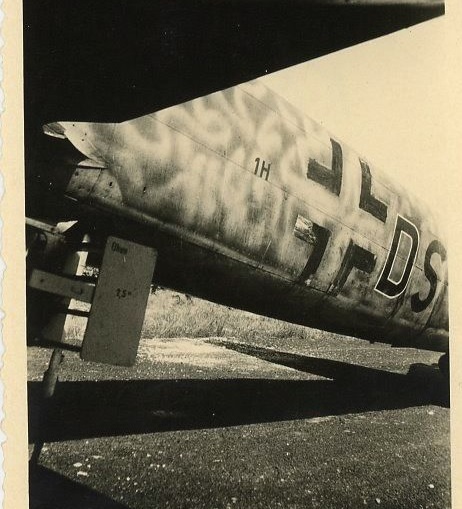
KG 26 Ju 88 "1H+DS", Rumanian Ju 88, JG 51 Fw 190 - daily ebay photo find #166


More  Stabsstaffel JG 51 Fw 190s on this blog here


On offer here 


currently on offer here

Tuesday, 20 October 2015

3./ KG 26 He 111 torpedo bomber, Salon de Provence, spring 1943


  3./ KG 26 He 111 torpedo bomber carrying two LT F5b torpedoes and seen taxiing out for a sortie from Salon (Provence), southern France, spring 1943 according to the original album caption. Superb Mäandertarnung camo scheme. Note the yellow wingtips, rear fuselage band and the spinner ring. Click on the images to view large


Taxiing out for a combat sortie; "Jakel und Lerche als Kutscher" -   'Kutscher', lit. 'coach driver',  a slang word for pilot