Showing posts with label Luftwaffe gliders. Show all posts

Friday, 28 March 2025

IBG Models Gotha Go 242 A - German cargo glider new-tool 72nd scale. Build review day 4

 Day 4 of the IBG Models Gotha Go 242 A kit build.

Day 4 of this build has mostly been 're-visiting' steps 5 & 6 from yesterday.  I worked out how to fit the frame parts into the fuselage sides - the aerofoil-shaped part slips into the aerofoil-shaped recess - and ultimately this seemed an easier option for joining it all together. The frames for the rear fuselage are also fitted at this stage.


I made another error - as I knew I would - by getting two of the  'open' fuselage 'portholes' the wrong way round so these had to be removed and swapped around. I also looked at the MG 15s as supplied in the kit. Not bad. They are going to have to be inserted into their mounts before the fuselage roof goes on.


Here everything is stuck together and I'm putting it aside to dry. 


A quick 'dry-fit' of the roof and the cockpit glazing. Again, a pretty good fit, any gaps you might notice here will disappear when it is all glued down. Next, detailing the canopy. There are etch control levers and the pilots' instrument panel to be inserted inside the cockpit glazing before securing to the fuselage. Note the open section is another gunner's position which can be shown either open - with MG - or closed. There's also a PE harness for this section...


That's it for Day 4. Thanks for looking in...


Thursday, 27 March 2025

IBG Models Gotha Go 242 A - German cargo glider new-tool 72nd scale. Build review day 3


Day 3 of the IBG Models Gotha Go 242 A kit build


At the end of day 3 the cockpit has been 'detailed' with the kit PE harnesses and I've done a little 'chipping' by scratching the 02. Not really a fan of etch but IBG have done well here with some excellent scale details in etch that is thin and flexible. The forward internal frames  have been fitted along with the fuselage glazing.

Thanks to Jerzy (George) for answering the question about the Gotha's MG 15s that we asked yesterday.

Jerzy writes.." a diagram of the MG mountings in the Gotha from a friend. The MGs were mounted vertically, supported from the bottom in boxes - you can see them in the drawing below .."

Step 5

Deals with the fitment of the cargo hold/fuselage lattice-like frame as seen in the manual drawing above. As another modeller appears to have done, I deviated slightly from the instructions which would have you fit these pieces into the side of the fuselage halves - where placement is a little uncertain - to mount them directly on the side of the floor where there are recesses designed to accept them. This method has the advantage of allowing you to concentrate on installing the window/portholes into the fuselage halves.


Step 6

The fuselage halves are finished in a red-brown (doped canvas) not unlike the interior of the Swordfish for example (a build on my modelling blog). It does appear that IBG missed some information about interior colors in the manual. I've painted  these areas slightly less red-brown than others - more of a 'filter' over the 02. But the frame is steel rod, so I've picked this out with a silver pencil. 


The windows are easy to install being mounted in a frame which appears that it should be of wood - although this may just be IBG's method of ensuring the window fits securely. There are obviously options to fit open windows at the MG mount locations easily identified on the internal framework.


BMW 801 'power egg' being unloaded


This image taken inside the Gotha shows a gunner at his window..the spent cartridge 'collector bag' is a separate part on the cockpit and tail gunner's positions.


Tuesday, 25 March 2025

IBG Models Gotha Go 242 A - German cargo glider new-tool 72nd scale. Build review day 1


Between 1937 and 1940 the Gothaer Waggonfabrik AG (Ltd) had constructed some 80 DFS 230 combat gliders for the Luftwaffe. The RLM recognised early on that a bigger glider than the DFS was required for transport duties and in 1941 GWF was awarded a development contract to build a machine roughly twice as large as the DFS. Capable of carrying 20 fully-equipped soldiers the Gotha 242 proved to have decent flight characteristics and its high-wing, twin-boom double tail, rear-end opening cargo door gave it an easily recognisable silhouette that would soon become familiar to German troops in Africa, the Mediterranean, the Balkans, but more especially in Russia..

The Luftwaffe blog has been lucky enough to pick up the new IBG models Gotha Go 242 (thank you Adam!) and we'll attempt to build it this week. This is the first boxing of a series of the type with the  Go 242 with fixed landing gear and the motorised Go 244 already announced. As usual with IBG you get a beautifully crafted product, from the fantastic box-art to the full-colour instruction sheet. The cockpit and interior are fully detailed, the cargo hold door/ramp can be deployed open, a full set of defensive MG 15s are also provided with open/closed mounts and bench seating for the hold. 3D printed accessories are also available- pilot seats, wheels, and MGs and an option to fill the hold with a set of seats for paras. Big box. Lots of highly detailed plastic parts cellophane-wrapped with four markings options. 

The first thing that struck me was how easy it will be to set up a little diorama or even just a small base showing a couple of BMW 801 replacement engines, a BMW bike and sidecar or a 2 cm Flak 38 being loaded or unloaded (Be-und- Entladen). The provision of a nicely detailed wing spar is welcome because you might want to leave the  wings 'detachable' for transport to shows etc. although on reflection the large strut might make that 'option' a little problematic. We'll see. 


A few sprue shots...click on these to get in closer..


Wing parts still in cellophane - ailerons and flaps are separate parts of course.


A little more tomorrow... we'll leave you with two of the four kit markings options in the BA photo below..the aircraft coded "8-12" is decal option No. 4 in the kit and depicts a Schleppgruppe 2 machine in 1944 in the East.  Note the red '2' is not visible in this photo. The lighter colour  here may be 79. "8-5" is the airframe at bottom in the mottled finish. The mottles are most likely in 02 or possibly even in 65. These have been crudely brush-painted. Note the absence of upper wing crosses and the small Hakenkreuze - which are available on the decal sheet. Both these aircraft operated in southern Ukraine ferrying supplies to troops cut off in Crimea from late 1943 through early 1944..


Monday, 24 March 2025

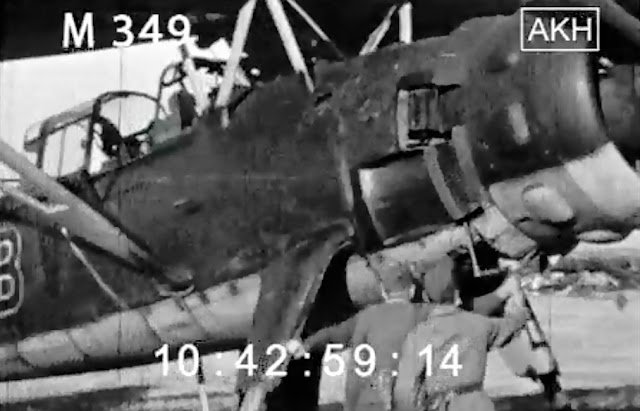
Hs 126 and DFS 230 Agentur Karl Höffkes film archive


Del has been trawling through the footage made available via the Agentur Karl Höffkes film archive (AKH) and has come across some DFS 230 colour footage;

 " ...from the Agentur Karl Höffkes film archive - home movie taken by a Luftwaffe officer while training on the DFS 230.." 


This footage almost certainly looks to have been filmed in the south of France presumably during the summer of 1943, prior to Gran Sasso. Either Valence Chabeuil or Lézignan-Corbières. It features a Staffel of Luftlandegeschwader 1 equipped with DFS 230 gliders and Henschel Hs 126 and Avia B.534 tugs training for a new mission... Hauptmann Joseph Karl, Gruppenkommandeur of III./LLG.1 is seen in the footage. 

On 19 August 1943, 12./LLG1 was transferred to Ottana (Sardinia), then on 11 September 1943 to Pratica di Mare (south of Rome). Its mission in Italy was the transport of 1./FJR.7 (Fallschirmjäger-Regiment) to Gran Sasso for the ‘liberation’ of Mussolini. I have extracted a couple of time codes which correspond to the stills below... 

 10:40:11  arrival by train at a town in France, possibly Valence. Does anyone recognise it? 
 10:43:00  engine start Hs 126 tugs of LLG 1 on the airfield.
 10:43:27  pilot in cockpit of DFS 230. Note MG 34 with muzzle flash guard  attached to the fuselage and MG 15 mounted above the cockpit
 10:42:47  a group of officers chatting. In the white cap the Kommandeur of III./LLG 1  (I think..). Another officer in white cap shows off his "Kreta" cuff band for the camera.
 10:48:13  colour section - a DFS 230 with nose-mounted braking rockets, also shown in close-up
 10:49:10   DFS 230 comes into land and the glider's braking rockets are fired. This section concludes with a few shots of the DFS 230 passengers disembarking...  

 At this point I would provide a link to view reel M349 ..but since preparing this post I can no longer find the film... 

 As always these stills are reproduced here with the kind permission of Karl Höffkes


Wednesday, 19 March 2025

LLG 1 DFS 230


 An ECPA-D image from the FALLAOK files depicting an LLG 1 DFS 230 coming in to land on an airfield in the south of France during training for the Gran Sasso 'raid' (Mussolini rescue, September 1943)). Photo by Bildberichter Wolfgang Stocker  via the imagesdefense.gouv.fr website. Stocker died in Italy in 1944. 


Tuesday, 17 December 2024

Gotha Go 242 reference photos for the new IBG Models 1:72 scale kits


Following on from their announcement last Friday (see below), IBG Models are releasing a pdf on Facebook featuring an illustrated history of the Gotha Go 242. This to coincide with the imminent release of their new 1:72nd scale kit. 

There is another option for modellers looking for Go 242 images, especially as I doubt that SAM will be publishing an 'Aircraft in Profile' feature any time soon - the ECPA-D web site has some great images of the type. 

The photos taken by PK reporter Karl Ottahal are of note - his report shows Gothas on Crete en route to North Africa to resupply the Afrika Korps. File reference is DAK 238. 

Ottahal was posted missing on 5 September 1944, flying as the gunner on board an Aufklärungsgruppe 123 Ju 88 coded '4U+KK' that failed to arrive in Crete on a flight from Athens..
 

Monday, 18 November 2024

Eugen Gremelsbacher, Bildberichter Fallschirmjäger A.O.K (formerly XI. Flieger.Korps), Heinkel 'Zwilling' and Gotha Go 242 transfer flight from France to Sicily


To bolster their forces preparing to defend the Allied landings in Sicily, the Germans organised an ‘air bridge’ to bring in reinforcements. On 17 July 1943, 16 Gotha Go-242 gliders from Luftlandegeschwader 2 (with the heavy equipment of the 1st parachute division: 1.Fallschirm-Jäger.Division) departed the huge airfield at Istres in southern France for Italy, landing at Torre di Faro (Sicily) between 20 and 27 July 1943 after a stop in Naples. The photo-report in ECPA-D file 11FLG F 1396/7 by PK photographer Eugen Gremelsbacher depicts a Heinkel He-111 ‘Zwilling’ tug on the transfer flight between France (Istres) and Italy (Naples-Pomigliano). Each Heinkel towed two Gotha Go-242 gliders and carried the heavy equipment (eg 2cm Flak 38) of 1. Fallschirm-Jäger-Division.

Below; He 111 Z coded 'DG+DX' taxying in after landing in Naples. Note three of the five engines already shut down.


The reporter on board the Heinkel followed the progress of the mission from the empty starboard cockpit of the Zwilling and photographed the crew: bombardier, radio-navigator, pilot and co-pilot. As the transfer mission drew to a close, the aircraft flew over Vesuvius before landing on the runway at Naples-Pomigliano airfield. The port of Naples is not far from the airfield, and the reporter took a shot of the docks, cranes and a medieval tower. In the shade of the Naples airfield buildings, paratroopers from the 1 Fallschirm-Jäger-Division were photographed recovering after the trip. The glider pilots had to destroy the Gotha Go-242s in Sicily.


Eugen Gremelsbacher was an Uffz. and photographic reporter for the Fallschirmjäger A.O.K (formerly XI. Flieger Korps). He was born on 13 March 1911 in Elbing (Westpreußen) and died on 08 March 1944 on the Eastern Front (see report reference FALLAOK F2024 for his grave) after being wounded the previous day. He is buried in Perwomaisk cemetery, grave N°24, row 8 (source Bundesarchiv). He filed photo reports from France (Orange, Istres) and Italy (Naples, Torre di Faro in Sicily, Livourno region in Tuscany). 

Thursday, 31 October 2024

SS Fallschirmjäger Btl. 500 Drvar May 1944, "Rösselsprung" - ebay photo find #380


 "Rösselsprung" was a failed German airborne and ground operation aimed at capturing or killing the Yugoslav Partisan leader Marshal Josip Broz ('Tito') in the Bosnian town of Drvar. Launched on 25 May 1944, the 'airborne' part of the assault was carried out by the SS-FJ battalion 500 - some 340 paratroopers were transported on board 34 DFS 230 gliders, the remainder of the battalion jumping from TG 4 Ju 52 Transporter. Meanwhile the town of Drvar was also bombed by the Luftwaffe. The gliders were towed by Hs 126 and Ju 87 tugs. A number of these images appeared in subsequent German newpaper reports - almost certainly taken by PK Berichter. In the end the operation was a failure - the area was well-defended by strong partisan forces while German intelligence regarding Tito's exact location was faulty. 


This was the image of victory that was publicized. These F-J paras show off their trophies including the flags of the Allied Mission. The rifle of the man in the middle has a grenade launcher on its muzzle.