Showing posts with label Erik Mombeek. Show all posts

Tuesday, 21 August 2012

Werner Girbig's Jagdgeschwader 5 vs. Erik Mombeek's Jagdgeschwader 5 history, Oblt. Frank Liesendahl's Jabostaffel


" Much as I appreciate all the work that went into making such a book, I'm not very willing to pay $70 for it (not to mention shipping costs). Especially when I see books like Werner Girbig's Jagdgeschwader 5, a hardcover, 320-page book to be published this month by Schiffer (in English), which I have just pre-ordered at Amazon at a mere $27.10..."

The comment above was posted on the TOCH forum in response to an announcement regarding the publication of the latest volume in Erik Mombeek's history of Jagdgeschwader 2 which was previously covered on the Luftwaffe blog here. Erik Mombeek is of course the leading author of self-published Luftwaffe fighter unit histories and has already produced the histories of JG 1, JG 4, and JG 5. The two volume history of Jagdgeschwader 4 was translated from the original French and German text by this blog author. The third volume of Erik's on-going series devoted to JG 2 has just appeared in French. Volume 1 in English, translated by myself, is still available from Erik's website. I post Erik's response to the comment above here, not only because I had a hand in composing it, but because it offers a rare insight into the trials and tribulations of self-publishing large Luftwaffe unit histories and because of the rare information contained in Erik's reply on a member of Oblt. Frank Liesendahl's noted Jabostaffel...


" ...First of all, thank you for starting this debate and my thanks to those who have participated or who are willing to offer a comment here. I am very interested to read all your opinions since I have recently been considering exactly how to proceed with my book series especially with regards to the sensitive issue of pricing. In fact on price I have already taken a decision communicated just last month to the various bookshops stocking my books and which I will attempt to explain here.

To return to certain points raised in the various posts here. In my view the general and ‘elderly’ history of JG 5 – dating from the 1970s- that Schiffer are finally publishing is frankly a long way from my detailed JG 5 history published over four large-format volumes representing more than 1,000 pages and nearly 2,000 photos in a day-by-day diary format. Incidentally, while the Schiffer book appears under Girbig’s name, it was largely researched and compiled by Erich Mikat. The original manuscript was entrusted to me by the JG 5 veterans association along with their archive when I took on the task of writing the history of this Geschwader.  Of course if a general Osprey-style overview is all that the reader is looking for then this new book is probably fine – so far as it goes.

I suppose we should note – if not perhaps entirely understand – a work that skims the surface is probably adequate for a certain readership. However if the enthusiast wants more detail, more pictures – in short much more depth - then we get into much more specialised areas. That of course involves its own costs.

Speaking personally, lists of names whether of aces or their claims has never been enough for me. Those who know my books will appreciate that I always try where possible to place a person in a precise historical context, both militarily and, where I can, on a human level. I tend to think that this is not just ‘history’ but on one level ‘psychology’ and such a presentation lends itself to a better understanding of events that took place seventy years ago and helps to inject a ‘spark of life’ into the stories of those young men whose lives were cruelly cut short in their 20s. Perhaps some readers are not at all interested in the sort of information that appear in letters such as the one that follows, but these are the types of details – if I can find them - that I want in my books.

Take one particular example that comes to mind from the latest volume of my JG 2 history; the death of Gottfried Weiser, a member of Liesendahl’s Jabostaffel, who was KIA on 31 March 1942. Does the following letter add anything to our understanding of events in the history of JG 2. I personally tend to think so. Others though may find it superfluous;

“ Dear Mr. Oblt. Liesendahl,

.. I received your news that our son Gottfried is not coming back home. We have received his personal effects. Unfortunately on the day that Uffz. Mücke delivered them to Brieg, my wife was visiting me at Schießwasser. We only returned home the following day. We so much wanted to talk to your officer!

“ So we know that Gottfried has died. He has thus joined his elder brother Erich, an Oberleutnant in a Stuka unit, who was killed on 1 June 1940 near Dunkirk as he was leading an attack against a troop transport vessel in the port itself. What a horrible coincidence of fate! Erich’s last words as reported to us were “ I am attempting an emergency landing..” Despite all our efforts we have been unable since to ascertain the whereabouts, either of Erich himself, his radio operator or his aircraft. Gottfried was driven to avenge the death of his brother. He was eager to go into combat and now he has been taken in his prime.

“ And can you imagine, Monsieur Liesendahl, that on the very same day in Schießwasser that we learnt of Gottfried’s death we were told that our last son had also fallen on the Western Front on March 1st. For us as parents this is an unbearable burden, especially if we tell you that our brother-in-law Doctor Strauss was also killed last February with the rank of Leutnant on the Eastern Front.

In three months we have received three death notices in the family! Yet we carry on because we want to win this war, we must win this war and a war such as this demands sacrifices. Has any trace of Gottfried been found on a beach somewhere or has the Channel swallowed up both our sons so completely that we shall never know where either one lies.

“ In conclusion I would like to send to both you and your Staffel, to which Gottfried was so proud to belong, and to all his comrades, our best wishes and much success, but also our hopes that you will all one day return home to us here in Germany..

Sincere greetings,

your J. Weiser Hauptmann”


So you will probably say, "OK, that’s fine, but is it a reason to make your books so expensive?” Well, try to put a cost on 50 hotel nights per year in Germany, two or three hours of work on a manuscript per day over the past twenty five years; printing and postage costs, storage costs and wholesalers who offer you a margin of just $1 per book for your own book - you can appreciate that only a small percentage of my costs in writing, research and book production, whether financial, or in time and energy, are covered. It is easy to get discouraged and sometimes I wonder whether the amount of work and effort involved in producing such volumes is appreciated at all. It has never been my intention to ‘make money’ from this hobby (which by definition brings no financial reward) but the past twenty five years has been rich in rewarding contacts...even so to pay for the second volume in a series, the first has to pay its way..


Take the example of the first English-language volume in this series, JG 2/1. As I believed the American market would be interested in this work, I organised a print run in China for distribution via the West coast of the US. With hindsight this was a mistake – the print and binding quality was inferior to what I could have expected from a book produced in Europe – Jukka’s remark hit the nail on the head. Importing the book into the US was out of the question since my original distributor ripped me off and I am now paying to ‘re-import’ my books back to Europe. Roughly speaking I have covered my production and distribution costs when I have sold two thirds (2/3) of the print run. The last third is not exactly ‘profit’ but represents a cash sum that is re-invested into the production of the following volume in the series. Thus far I have sold only 300 copies of JG 2/1 in English – I need to sell an equivalent number before even considering JG 2/2 in English.

Of course the numbers of veterans that I can contact is diminishing rapidly and with their disappearance my travel costs are also decreasing – there are correspondingly fewer trips to Germany and Austria to make. Therefore the costs of producing each book are consequently decreasing. This is why I have recently decided that I can price my large unit history volumes at under 50 Euros for those books purchased directly from myself. However I doubt whether my books are price sensitive – the audience is simply too restricted.  I also doubt whether book sellers will bring their prices down in line with my new pricing structure as they of course have their own costs and sales criteria to take into consideration. So much for my contribution to this debate. Thanks for reading!

Erik Mombeeck

Friday, 27 July 2012

Dans le ciel de France - Jagdgeschwader 2 Vol III 1942 - first look at the new volume due this summer from Erik Mombeeck !


Cover illustration - Fw. Martin Reichherzer of 7./JG 2 seated on a JG 2 Bf 109 “Friedrich”


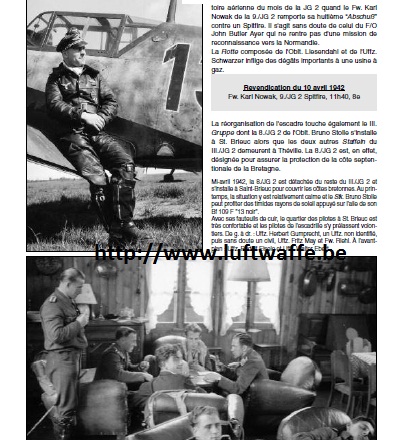
While it may have taken more than 60 years for the first installment of a detailed history of the second fighter wing of the Luftwaffe to appear with the publication of volume I of 'Dans le ciel de France' ('In the skies of France') back in 2009, Erik Mombeeck is already preparing to launch volume 3 of his French-language chronicle of Jagdgeschwader 2 due this summer. Conducting operations principally over France and the Channel, JG 2 was destined to become one of the most celebrated of German fighter units, accorded extensive coverage by the propaganda services of the Reich. Awarded the honour title "Richthofen" as early as 1935, JG 2 spearheaded the campaign in the West and the assault against England in the Battle of Britain. The unit remained in France when the majority of German fighter units were dispatched eastwards for the invasion of Russia during the spring of 1941. Tasked with defending the airspace of Brittany, Normandy and much of Picardy along the French Channel coastline, JG 2 constituted a bulwark against the incursions of the RAF and the USAF through to the summer of 1944.
This new volume covers the year 1942 with JG 2 continuing  to counter RAF raids over the continent, while for the first time the pilots of the leading Kanal Geschwader would come up against the first examples of what would ultimately become the nemesis of the Jagdwaffe - the long-range P-51 Mustang escort fighter and the B-17 Flying Fortress bomber. This new volume also covers in depth JG 2's conversion on to the first variants of the famed Focke Wulf 190 fighter, the break-out of the German battleships (Donnerkeil) and 
the huge air battle over Dieppe on 19 August 1942 which saw the Geschwader claiming almost 60 Allied aircraft shot down in one day of bitter fighting. And l
ater in the year elements of the Geschwader - including Jules Meimberg's special high altitude Bf 109 Gustav Staffel 11./ JG 2 - would be dispatched to Tunisia following the Anglo-American landings in north-west Africa. An exclusive text extract follows..


       " A murderous summer"

Having completed their conversion training, 2./ JG 2 flew out of Le Bourget on  1 June with ten Fw 190s and headed back to Triqueville. However on their return to Normandy an unpleasant surprise awaited them - their quarters had been taken over by their 6. Staffel comrades under Oblt. Erich Rudorffer. In the event the cohabitation of the two Staffeln on the airfield would be short-lived. Elsewhere Bruno Stolle's 8.Staffel, who had also spent the last two weeks of May at Le Bourget alongside 2. Staffel, now departed St. Brieuc for Morlaix and the coasts of Brittany. The intensity of the fighting along the Channel and the transfer of a number of JG 2 veterans to Geschwader engaged in fighting on the Eastern Front saw the Richthofen receive a number of reinforcements during the month of June. One of the most notable departures to the East was Fw. Otto Pohl, the 5./JG 2 pilot who had registered the Geschwader's 1,000th combat success on 17 April 1942 (his victim on that day an early production RAF Lancaster sent out as part of the low-level raiding force on the MAN diesel engine works at Augsburg, deep in Bavaria). Another transfer was Wolfgang Wehrhagen of 4./JG 2. Both pilots went to JG 77 while a third, Kurt Rose, was posted to JG 51 - of these three pilots only Otto Pohl survived the war. Several JG 77 pilots were posted back to the Kanal Front with JG 2 - among them Lt. Bruno Siekmann who had achieved ten victories in a year of fighting in the East with II./ JG 77 and Lt. Hermann Staege, an aerobatics champion of the pre-war Kunstflugstaffel, incorporated into I./LG 2 during 1939-40, a Gruppe that had been re-designated I./ JG 77. He had been credited with sixteen victories at the time of his transfer to the West. As most of these Eastern Front veterans were Bf 109 pilots they too underwent the Fw 190 conversion course before joining JG 2.


On 21 July 1942 Hptm. Helmut-Felix Bolz, Kommandeur of II./JG 2 shot down an unknown aircraft type that he initially identified as a 'Tomahawk'. A short while later he visited the crash site at Caudebec-en-Caux between Rouen and Le Havre and was able to inspect at first hand what he later learnt was a 'Mustang' (more usually 'P-51' in  American parlance). The Mustang's pilot F/Lt Veal Rowland of No. 239 Squadron had been taken captive.


Vol III of 'Dans le Ciel de France - 1942' (French-language text only) will be available later this summer. This title, along with Luftwaffe Gallery 3, can be pre-ordered at Erik Mombeeck's site http://www.luftwaffe.be

Monday, 16 January 2012

Storming the bombers Volume II - first review. JG 4 Sturmgruppe Defending the Reich


During March 1945, high-ranking Wehrmacht officers undertook a number of tours of Luftwaffe aerodromes with the aim of relaying the following exhortations emanating from the Reichsmarchall Göring and Genraloberst Stumpf:

" The battle for the Reich, for our people and our homeland is entering its decisive phase. In blind hatred the nations of the world have come together to destroy us. We must draw on our last remaining forces to resist this evil tide. Never in our history has our German homeland been threatened with such total destruction from which there will be no rebirth. We can resist this danger only by manifesting the highest qualities of German combativeness. This is why I am turning to you in our most decisive hour of need: save the nation through the sacrifice in battle of your own life! I call upon you now to one last taking up of arms from which there is only a small probability of return. Those who respond to this appeal will immediately enrol for a flying training programme. Comrades - a place of honour awaits you in the roll call of the Luftwaffe's most revered fighting men. By your sacrifice you will give the German people renewed hope of victory and become an example for future generations in this hour of their greatest danger." (s) Göring

Several dozen pilots responded to this appeal - among them senior and experienced pilots from diverse backgrounds. It was explained that they would be called upon to dive their aircraft onto those of the enemy, as well as troop concentrations, pontoon bridges and other kinds of strategic objectives. Many of the contingent of volunteers were to train for the 'suicide' mission mounted by the Sonderkommando Elbe mentioned previously, while other volunteers were kept in reserve for other types of Selbstopfer – or 'self-sacrifice' - operations. For many of them life itself had already lost all meaning following the death of loved ones and the destruction and loss of all their possessions. Having lived since a young age in the Third Reich, they had in all likelihood been convinced by the Nazi Party propaganda machine of the superiority of their nation and their race. Many doubtless considered that their own fate was indivisible from that of the nation. If this value system was to collapse then everything they held dear would be destroyed for ever. For most the only possible outcome was to die in action - to go down with the Third Reich in its death throes.

Those remaining members of JG 4 who had some contact with the activities and operations of these suicide pilots - usually as a result of being assigned to escort them into action - would remain deeply affected by the experience. Lt. Ewald Kraas, of the Stab III./JG 4 recalled;

" In early April 45 - as the Soviet advance along the Oder front was showing signs of stalling - there were a number of discussions on the subject of suicide missions at the level of the Geschwaderstab in JG 4 - we had become aware that a group of volunteer pilots were being called upon to fly their aircraft - packed with explosives - into the pontoon bridges that had been thrown across the Oder. During this period of inflammatory calls to the German fighting spirit it came as no surprise that some of our pilots were coming forward to undertake these kinds of 'self-sacrifice' missions - after all there had never been any shortage of volunteers for the Sturmstaffeln in our Geschwader. However a Rammjäger always had the option of bailing out at the last minute after ramming an enemy bomber - but these Selbstopfer pilots were prepared to make the ultimate sacrifice, diving their fully fuelled fighters onto enemy targets..

During the middle of April our Kommodore, Obstlt. Michalski, accompanied by several staff officers paid a visit to Jüterbog/Altes Lager - the aerodrome where the suicide volunteers were assembling. On his return he described the situation there to Hptm. Gerhard Strasen- I was present during this conversation. Michalski had seen eighty volunteers - pilots of all ages, ranks, backgrounds and experience. There was even an Oberfeldwebel among their number who had been decorated with the Ritterkreuz. The discussion turned to the motivations of these men and what drove them to want to sacrifice themselves in this way. Michalski turned to me and said : "well, Lt. Kraas, would you ever consider putting yourself forward to fly this kind of mission?"

Without hesitation I replied: "Herr Oberstleutnant, frankly - not at all!" _" No, neither would I" he admitted..


A link to Adam Norenberg's review of "Storming the Bombers - Vol. 2".

" ...The rare oral testimonies found here are backed up by excellent photographs from pilots and crew’s private collections. Credit must go as well to Neil Page who has produced the translation of the text and has made sure the book is never just a dry account of history as many books are when translated into the English language..."


http://www.themodellingnews.com/2012/01/review-storming-bombers-chronicle-of.html