Showing posts with label JG 3. Show all posts

Saturday, 11 October 2025

Focke-Wulf Fw 190 A-8/R2 Butcherbirds / Rammjäger of IV./JG 3 - archive photo scan #42


New Fw 190 decals in 48th from the Czech ASK Art Scale Kit (Art Scale Kit Item No. D48075 - Focke-Wulf Fw 190 A-8/R2 Part 2) features Butcherbirds / Rammjäger of IV./JG 3.

Reference photos are provided in the package ..but here is a better view of 'black 12' which was apparently lost during the transit from Germany to Normandy making a forced landing in France shortly after the Gruppe was sent west following the D-Day landings. Note over-painted rear fuselage band. Click on the image for a wide-screen view.


Fw-190 A-8/R2, 'black 12', Wnr.730282, IV.(Sturm)/JG 3,  June 1944.

Sunday, 20 July 2025

'Ardennes 44 - four days of Hell' AÉROJOURNAL HS N°51


new from caraktere.com " Ardennes 44 " - the air battles of 17, 18, 23 and 24 December 1944

"...In the collective imagination, the Battle of the Bulge was a gigantic land battle in which bad weather grounded German and Allied aircraft for most of the time, until a break in the weather allowed the Luftwaffe to launch its disastrous ‘Bodenplatte’ operation on 1 January 1945. This was only partly true. The 17th, 18th, 23rd and 24th December 1944 were in fact the most violent days of aerial combat of the entire war in the West, between the Normandy landings and the surrender of the Reich. While the German fighters sacrificed a large proportion of their manpower and aircraft resources in an attempt to challenge the Allies' control of the skies over the Ardennes battlefield, their American and British adversaries had to work harder than ever to retain it. A fascinating dive into the heart of this titanic air battle!.."

Piotr Forkasiewicz cover artwork depicts 391st BG B-26 Marauders en route for the viaduct at Ahrweiler being attacked by the Bf 109s of Maj. Karl-Heinz Langer's III./JG 3 on the morning of 23 December west of Liège. After the guns of his K-4 jammed, Fhr. Adolf Tham of 10. Staffel voluntarily rammed the 574th BS B-26 coded 4L-P (s/n 42-107597 flown by 1st Lt Ralph Lesmeister). Tham's wing sawed into the tail of the B-26 instantly killing the tail gunner. The rest of the American crew bailed out and were taken captive. Despite having his port wing torn off in the collision Tham himself managed to take to his chute and thus also survived the attack..he re-appeared at Lippspringe several days later with it under his arm..

Wednesday, 12 February 2025

II./JG 3 over Canterbury on 26 August 1940


" At 11.30am on Monday August 26, 1940, a large raid, including 12 Dornier Do 17’s and 40 Heinkel He 111’s, escorted by over 80 Messerschmitt Bf 109’s and Messerschmitt Bf 110’s approached Dover. While around 70 Hurricanes and Spitfires fought the Heinkels and their escorts, from Dungeness to Maidstone, the Boulton Paul Defiants of No.264 Squadron were directed alone onto the Do 17s, in the vicinity of Herne Bay. As they attacked the bombers from below, the Bf 109s immediately dived to protect the Do 17s..." (Hawkinge Battle of Britain museum FB page)

Among the Me 109 escorts over the coasts of north Kent was II./JG 3. Uffz Willy Finke of 4. Staffel JG 3 pressed home an attack on a Defiant but was spotted by P/O Kenneth Marston of No.56 Sqd. Marston opened up from close range (70 yards) sending Finke's Me 109 E-4 down. Finke crashed on the Chislet Marshes, south of Grays Farm near Reculver at around 12:30. In fact Finke was Marston's second Emil that morning - he had already also shot down Uffz. Fritz Buchner of 6./JG 3. Most sources have Buchner coming down in the sea (see below). Posted missing over the Thames estuary on 26 August 1940, Buchner's fate was only confirmed 44 years later when his Emil was excavated at Westgate on the north Kent coast..

"..During 1984, this crash site was the subject of a major excavation. The main wreckage was discovered at a considerable depth (between 35 and 40ft) and within the compacted tail section and cockpit were found the remains of the pilot. Evidence from the excavation, in the form of Uffz. collar tabs found on the uniform, an embroidered handkerchief with the initials "FB", a lucky charm and serial plates indicating the identity of the aircraft, seemed to provide compelling proof that the pilot was Unteroffizier Fritz Buchner, who had been officially listed as missing 44 years previously. However, it took a further two years for British and German authorities to agree on his identity. He was finally laid to rest, in the presence of surviving members of his family, with full military honours in the German War Cemetery at Cannock Chase on the 8th May, 1987.."   (dunkirk1940.org)

 Now that certain relics of Buchner's E-1 have been given to my local museum I was asked if I knew anything about his machine. The quick answer was not a lot! The loss listing does not reveal much about his Bf 109 aside from the variant and Werknummer. No Kennung given. Extract from the now-digitised Bundesarchiv "GQM Verluste und Unfälle" file RL 2- III/1574-75 covering the period Jun 40-Jan 41. See line 11. (Click to view full screen)


From the Breuer/Waiss " Heinz Sannemann -Ein Jagdfliegerleben in Berichten, Dokumenten, Fotos" (Helios, 2018)

 " Flug 924 am 26.08.1940. Start mit Bf 109 um 12:25 Uhr in Wierre au Bois. Landung um 13:50 Uhr in Wierre au Bois, 'Begleitung Do 17 Sauterborg, Defiant abgeschossen.."

On 26 August 1940, II./JG 3 were up from Wierre au Bois (12 km south-west of Boulogne on the Channel coast) to escort bombers raiding London. Gruppe TO Lt. Heinz Sannemann flying as Rottenflieger to the Kommandeur recorded in his 'Gefechtsbericht' that he shot an RAF fighter off the tail of his Kommandeur as the latter was downing a Defiant. It was Sannemann's second victory claim. A trail of white smoke streamed out behind the British fighter as it dove away heading back over the Kent coast. In a letter to his wife sent the next day, Sannemann wrote;

" Gestern haben wir über der Themsemündung eine Mords-Luftschlacht gehabt. Berstende Maschinen, Rauchsäulen und Fallschirme über Fallschirme!. Es is schon schoen, nur die armen Bomber sind dabei zu bedauern. Die müssten alle das EK I haben. Wir waren schon wieder in unserem Wigwam!  " 

.." Yesterday we had a hell of an air battle over the Thames estuary. Exploding machines, columns of smoke and parachutes upon parachutes! Everything's fine now, but the poor bombers are having a hard time. They must have all earned the EK I. We were already back in our wigwam!.."  (pilots accomodation 'Villa Wigwam' in Le Touquet that Sannemann shared with von Werra, until 5 September of course..)

After the chaos of the clash over the north Kent coast/Canterbury area that morning Sannemann spent the afternoon paddling a dinghy in the canal in Le Touquet and swimming with Simba the lion cub. Pfundig! ..just great!

Sunday, 25 September 2022

GFM Rommel an der Kanalküste, Vendeville, January 1944


..some screen grabs from Wochenschau film footage showing Rommel (CO Heeresgruppe B ) and entourage visiting a fighter Gruppe somewhere in northern France  some time ahead of the Allied D-Day landings...


..given that GFM Rommel is accompanied (right) by Kommodore Obstlt. Priller (JG 26) it would not be unreasonable to assume that this must be Abbeville and JG 26 (III./Gruppe flew 109s) some time in the weeks leading up to D-Day. 

This would appear not to be the case. The original PK Berichter caption states 'bei Lille' and is dated January 4, 1944. On this date JG 26 had no Messerschmitt Gruppe in France, III./JG 26 being based at Mönchengladbach under Lw.-Befh. Mitte, while I./JG 3 was based at Denain and Vendeville (Lille). On January 9, 1944 I./JG 3 and III./JG 26 swapped bases with III./JG 26 returning to its Geschwader. Therefore when the photos and the Wochenschau-film were taken on or before January 4 the only Bf 109 Gruppe at Vendeville was I./JG 3. 

 In the picture below a badge on the cowling of the Gustav - the JG 3 Udet badge - appears to have been over-painted. Pilot and ground crew stand to attention as the party walks down the taxiway. The G-6 in the background (left) is 'white 15'  (..of I./JG 3. Note absence of Gruppe Balken aft of the fuselage cross) 


..Rommel's party makes its way into a hangar - where Priller shows Rommel (one of ) his  Fw 190 A-8  'Jutta' - not a 'black 13' as the Kommodore chevron is just visible. Note also the area of the pilot's hand-hold on the windscreen coaming  which appears to have either been damaged or 'cut-out' - or maybe a fault on the film. I have no idea what this is, although  regular blog reader Stephen F. suggested that it might be some sort of improved gun sight....


Also on this blog;

Priller's 'Jutta' - Focke Wulf Fw 190 A-8 'Black 13'


Wednesday, 17 August 2022

Oblt. Herbert Kutscha IV./JG 3, Bf 109 G-6 'yellow 13' - ebay photo find #355


Oblt. Herbert Kutscha earned his Knights Cross with 5./ZG 1 in the East. Appointed Staffelkapitän 12./JG 3 in Italy during 1943, he briefly led IV./JG 3 in the air during early 1944 after 83-victory ace and IV. Gruppe Kommandeur Franz Beyer was shot down and killed on 11 February 1944 (a successor not immediately appointed). 

 Airborne from Venlo/NL on 24 February 1944, Kutscha was shot down in combat with P-47s at the controls of this Bf 109 G-6, WNr. 411048, "yellow 13" (below). Despite his wounds he was able to take to his parachute over Quakenbrück and was out of action for several months.

(caption data via Jochen Prien's 'Chronik einer Jagdgruppe' )


On offer here

Saturday, 7 May 2022

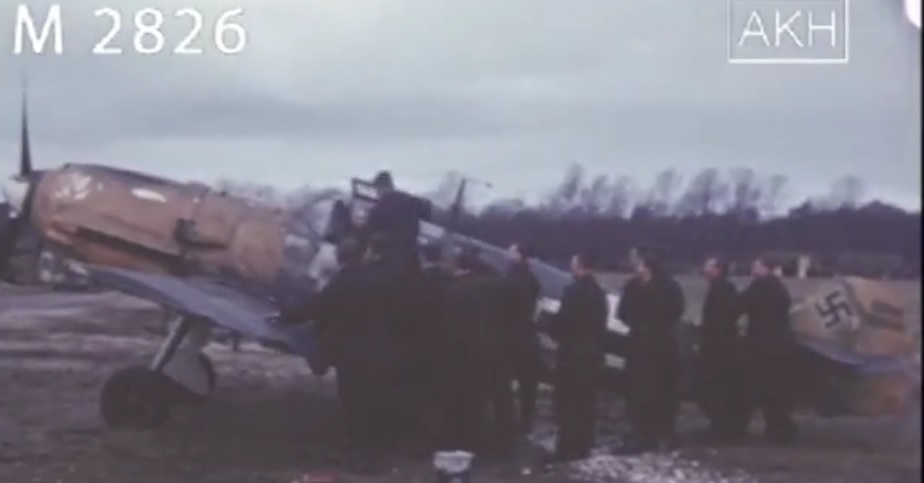
Battle of Britain Emil in colour - future 9./JG 3 Staffelkapitän Viktor Bauer's 'yellow 7' III./JG 3 Desvres late 1940


Film 2826 from the Agentur Karl Höffkes film archive features colour material depicting JG 3. The following stills are reproduced here with the kind permission of Karl Höffkes and feature "gelbe 7", the usual machine of the future Staffelkapitän 9./JG 3, Oblt. Viktor Bauer seen wearing a life jacket alongside his Emil speaking to a group.


 III./JG 3 was based at Desvres from Aug 8 1940 to Feb 16, 1941. The yellow rudders and full yellow noses would date this footage to between late October 1940 and Feb 1941. "Schwarze 5" of 8./JG 3 appears briefly in the background and was the machine of Oblt. Franz Beyer.


 " ..The camouflage appears to be in the new greys RLM 74/75 or the famous "mixed greys" - these aircraft do not seem to be in 02/71. Also, if you freeze the shot of the tail of "gelbe 7", you can see that the Hakenkreuz has been masked and a new, lighter shade of 65 (or 76?) has been applied to the airframe... the deeper blue of the original 65 is still visible between the arms of the Hakenkreuz.. The shiny finish on these aircraft is particularly noteworthy- these were well cared for..."

Note this colour section of the footage opens with the this Emil below taxying in.  Either a 'yellow 2' or 'yellow 7' again - note the two rows of Abschussbalken on the rudder. Bauer did not return his third until November. There are not many BoB candidates for this sort of victory total.. any candidates @G.R. Morrison ?


Thanks to GRM and L. Ritger for the captions


Wednesday, 3 November 2021

Oblt. Winfried Schmidt - ace of III./JG 3 -article extract


On 23 June 1941, Schmidt was appointed Staffelkapitän of 8. Staffel of Jagdgeschwader 3, replacing Oblt. Willy Stange, KIA the previous day, the first day of Operation Barbarossa. On 11 July, Schmidt was severely wounded in combat near Fastiv, hit in the chest by the defensive fire of a Tupolev SB tail gunner. His wingman Lt. Wilhelm Lemke managed to guide him back to the airfield at Polonne for a crash-landing (Bf 109 F-2 WNr. 8236). The next day, Schmidt was replaced by Oblt Franz Beyer as commander of 8. Staffel...


On 18 September 1941, while still in his hospital bed, Oblt Schmidt learned that he had been awarded the Ritterkreuz. Given his rather modest victory scoreboard the award of the RK may appear a little surprising. While, at the beginning of the war, the Knight's Cross was often awarded for about twenty victories (17 for Galland, 20 for Mölders), the criteria for the award became increasingly more difficult to fulfill -especially after the "carnage" both real or ‘over-claimed’ on the new front in the East, where some aces with fifty+ victories never received the award. It may have been the case that the Luftwaffe high command wanted to honour the courage and obstinacy of its recipient through this distinction. Although 'only' a reservist, Schmidt had been officially credited with thirteen victories, had been shot down three times, had baled out once but had always returned to combat (except after July 11). A short but full career that certainly deserved recognition.

After convalescence, the pilot from Cologne was assigned to a staff position with 7. Jagddivision. This enabled him not only to survive the war (out of the ten pilots of 8./JG 3 identified at the beginning of 1941, only three survived) but also to find happiness. As his wife recalled during the 1990s;

In 1942, together with my parents, I travelled to Cologne from München-Gladbach to visit relatives. Our train was late and we had to wait at the station buffet. It had been partially destroyed and the buffet was now in a narrow and crowded hut. A young Luftwaffe officer entered in an impeccable uniform. He was also wearing the Ritterkreuz. Admiringly, I said to myself; 'This one is not for me'. But there was an empty seat at our table and he asked to sit down. We got chatting and exchanged addresses. Two weeks later, he contacted us and, six months after that, we were married. And we have been for over fifty years…”

But misfortune struck the couple when their only son was killed on 8 February 1988 in the crash of Nürnberger Flugdienst Flight 108 at Düsseldorf airport. All twenty-one occupants perished in the crash after the aircraft, a Swearingen Fairchild Metroliner, was apparently hit by lightning on the approach. "Fortunately, we have excellent contacts with our daughter-in-law and often see our grandchildren”.

Winfried Schmidt passed away in his home town of Cologne on 3 August 2009 as far from the spotlight as he had fought in the skies of Europe...

Below; 

Flying with 5./JG 77 Lt. Winfried Schmidt shot down an RAF Wellington on December 18, 1939 in Bf 109 E-1 ‘red 1’ during the so-called ‘Luftschlacht über den Deutschen Bucht’ (Heligoland Bight). The machine is still finished in the dark green splinter scheme. The ‘seagull’ Staffel badge forward of the cockpit would soon be replaced with a more war-like eagle..


A full biography of Oblt. Winfried Schmidt appeared in Avions magazine No. 235  authored by Jean-Louis Roba.

Sunday, 13 December 2020

Messerschmitt Bf 109 G-6/R6 "yellow 3" 6./JG 3, Sachau, May 1944.


Bf 109 G-6/R6 "yellow 3"  6./JG 3, Sachau during one of the hardest periods in the defence of the Reich. Fhj.Fw Becker seated on the wing.


Above; ..the experienced Lt. Paul Draeger of 5./JG 3 was KIA on 2 November 1944, his G-14 'white 8' shot down in combat with P-51s  in the Halle-Naumburg area. Below, pilots of 6.Staffel in front of 'yellow 3' - second left with the cap is Fw. Albert Zanterl.


Also on this blog;
Lt. Walter Bohatsch I. & II./ JG 3 - Bf 109 Gustavs defending the Reich, Reichsverteidigung

Saturday, 7 March 2020

Vom Feindflug nicht zurückgekehrt - Berlin Gatow Fw 190 A-8/R2 WNr. 682 060 IV./JG 3 Walkaround


The Militärhistorisches Museum Flugplatz Berlin-Gatow have what is billed as a Focke-Wulf Fw 190 A-8/R-2 "Uncoded" on display. "Bismarck" from the Military Aviation history channel has just posted a three-minute walkaround of Gatow's Fw 190 A-8 on youtube which is well worth watching. I've embedded the video at the bottom of this post and it can be viewed here with a single click.

 Gatow's Fw 190 is a Flug Werk static display replica with several original parts, designated Focke Wulf - Flug Werk GmbH Fw 190 A-8/N (N for Nachbau or replica). Flug Werk number is 99007. The original parts are from Fw 190 A-8 Werk Nummer 682060 coded "rote 5". This aircraft was flown by Leutnant Rolf Lahne, a 16./JG 3 pilot..

 IV./JG 3 operated from Gütersloh late in the war. On December 17, 1944 IV. Gruppe were launched on a ground attack mission in support of the Ardennes Offensive. Lahne was airborne with his Rottenflieger Unteroffizier Werner Talkenberg at 10:50 and the two machines took up a south-westerly heading. Lahne was flying Fw 190 A-8/R2 WNr. 682 060. However he never arrived in the target area. In the vicinity of Cologne (Köln) the Fw 190s ran into a force of P-47s from the 373rd Fighter Group. A wild dogfight developed. Uffz. Talkenberg pursued a P-47 and lost sight of his comrade. He managed to shoot down one American for his first victory, before catching sight of Lahne's "red 5" pursued by Thunderbolts north of Cologne. Shortly afterwards he observed hits on the Fw 190 and saw it burst into flames. It went down vertically - there was no parachute. The Americans reported two Fw 190s shot down in this combat. The pilot who had been able to get clear of his Fw 190 was Lt. Hecker of 15./JG 3. Hecker's Kaczmarek was Uffz. Karl Kapteina and in his account (Prien, p265) Hecker bailed out after his engine started running very roughly. A single P-47 fighter was reported missing by the 373rd FG. An American pilot bailed out in this combat area injured and later succumbed to his injuries. As Talkenberg was attacked again, he did not see Lahne's machine impact the ground and had also moved some distance away from the air combat, so that he could not remember the exact crash site. No German aircraft from the area was reported as having crashed that could match the "red 5". Lt. Rolf Lahne remained missing until road construction work in 2003 in Pulheim north of Cologne turned up his Erkennungsmarke 'dog-tag' and steel helmet along with parts of his Fw 190. Lahne had flown Ju 88s with KG 3 and had been awarded the Frontflugspange (combat clasp) in silver. He had subsequently been posted to ZG 76 and flew the Me 410 the defence of the Reich before retraining on Fw 190s and being posted to JG 3. He had shot down a B-24 bomber on December 2, now he himself had met this fate. One of the many unexplained and missing airmen over the territory of the Reich.


A single click to view the video here


Sunday, 1 March 2020

Kommandeur III./JG 3 Maj. Wolfgang Ewald - ebay photo find #327


The Kommandeur III./JG 3 in the cockpit of a Stab JG 3 Bf 109 preparing for a sortie during the first few months of 1943. The aircraft is WNr. 14 859, Kennung is "schwarzer Doppelwinkel Strich"- a Gondelwaffen-toting G-4 'gunboat' written off after a crash-landing on April 1, 1943. It is not known if Maj. Ewald was the pilot on this occasion. The Stab, II. and III./JG 3 bore the brunt of the fighting against 8 VA and 17 VA during this period, making some 342 claims for 24 losses.

Wolfgang Ewald was a veteran of Spain where he claimed a single victory. He shot down a Spitfire on September 2, 1940 during the Battle of Britain for his 1st in WW II. He achieved the first victories in Russia on 20 May 1942 and was appointed Kommandeur III./JG 3 on July 23, 1942. His 'best' day was 26 October 1942 when he claimed four II-2 Shturmoviks shot down for his victories 44 - 47. He was awarded the RK after 53 victories (December 9, 1942). On July 5, 1943 he claimed three Pe-2-bombers for victories 65-67 but on 14 July 1943 he was shot down by Russian flak near Belgorod and taken captive (Bf 109 G-6, 20220 "schwarzer Doppelwinkel"). He returned home in late December 1949. Published on page 250 of "Bf 109 im Einsatz bei der III./JG 3" (Prien, Stemmer)

Sunday, 9 February 2020

"Doppelabschuss!" Auf dem Feldflugplatz eines Jagdgeschwaders......more Messerschmitt Bf 109s - ebay photo find #326


Press photo of Oblt. Johannes Steinhoff at the controls of his 10.(N)/JG 26 Dora


"Doppelabschuss!"  Auf dem Feldflugplatz eines Jagdgeschwaders......


Ofw. Max Martin 8./JG 26


  Bf 109 E ‘black 5’ flown by Leutnant Gustav Langanke of 5./JG 27


Messerschmitt Bf 109 G-6 Major "Tutti" Müller Stab JG 3 Mai 1944. Left, Dahl


Bf 109 G-2 of I./JG 54 in winter 1942-43.


Bf 109 E-3/N flown by Hptm Herwig Knüppel Kommandeur II./JG 26 Westfeldzug 1940. As an Oberleutnant, Knüppel was one of the first German fighter pilots in Spain (departed Germany on July 31, 1936). Knüppel was killed near Valenciennes on May 19, 1940 in WNr. 1452 while leading II. /JG 26. He had 3 victories to his credit (in addition to his 8 in Spain).


Thursday, 2 January 2020

Herbert Kutscha IV./JG 3 - Bundesarchiv photo report series #5


Oblt. Herbert Kutscha (left) earned his Knights Cross with II./ZG 1 in the East (see link below). He briefly led IV./JG 3 in the air during early 1944, 83-victory ace and IV. Gruppe Kommandeur Franz Beyer having been shot down and killed on 11 February 1944 (a successor not immediately appointed). IV./JG 3 operated in concert with the Sturmstaffel from Salzwedel during February-April 1944. Kutscha would be shot down by P-47s near Venlo on 23 February 1944 and was out of action for several months.


Monday, 8 April 2019

Sturmstaffel 1, IV.(Sturm)/JG 3 - ebay photo find 316


..it is not every day that you come across new Sturmstaffel or Sturmgruppe images. Given the Bf 109 with IV. Gruppe bar these images possibly date from the period April/May 1944. In early May 1944 Sturmstaffel 1 was re-designated as 11. Staffel of IV./JG 3 under new Gruppenkommandeur Hptm Willi Moritz.  IV./JG 3 was to be re-equipped with the Fw 190 and further develop von Kornatzki's assault concept. The Sturmstaffel experiment had patently enjoyed a measure of success - all told some 62 heavy bombers had been claimed shot down between 11 January and 29 April 1944 for the loss of 11 of the original pilot complement killed in action. Their actions heralded a more general expansion of units using these methods with both II./JG 300 and II./JG 4 converting to the Sturm role during the summer of 1944..


The Fw 190 with the bulged cowl cover and the mid-wing pitot tube is an A-7 and is kitted out with 'blinkers', fuselage bands and the 'lightning bolt' emblem on the cowl..


my bids are in ..here