Showing posts with label KG 6. Show all posts

Wednesday, 31 January 2024

Hptm. Helmut Fuhrhop Gkr. I./KG 6 - archive photo scan (9)


Seen here in Soesterberg during March 1943, Hptm. Helmut Fuhrhop - hand on rudder gust lock - helps push his Ju 88 out of its hangar. The Gruppenkommandeur of I./KG 6 was shot down and killed during February 1944. 


Sunday, 29 October 2023

Death of the Kommandeur - Maj. Helmut Fuhrhop I./KG 6 (Junkers Ju 188 E)


Above; I./KG 6 Ju 188 E medium bombers were based in Chièvres, south of Brussels for the Steinbock raids over England during the first quarter of 1944.


Just after mid-day on the afternoon of 29 February 1944 (1944 was a leap year) two Junkers Ju 188 Es took off from Melsbroek, north of Brussels, and headed for Dreux, 50 miles east of Paris. They were part of a force scheduled to fly another 'Steinbock' bombing mission over southern England later that day which was transferring to Dreux in small groups. One of the Ju 188s (coded '3E+AB') was flown by the Kommandeur of I./KG 6, Maj Helmut Fuhrhop. An Eastern Front veteran with KG 51, Fuhrhop was an experienced career aviator and RK-holder credited with sinking at least 30,000 GRT of shipping in 250 missions. He had also flown over one hundred sorties at the controls of a Legion Condor K 88 He 111 (Taghon p.49) and was an obsessive athlete who made his crews run around the airfield almost daily! (Taghon, p.166) At the controls of the second machine was Uffz. Wilhelm Mayer of 1. Staffel. Both machines carried five aircrew and a handful of groundcrew, while Fuhrhop had his two dogs, Chica and Ciro, on board. Meanwhile, seven Hawker Typhoon Mk.1b aircraft of 609 Squadron were getting airborne from Manston (Kent) to carry out a fighter sweep in the sector Le Culot-Florennes-Cambrai across Belgium/northern France. Led by Sqn Ldr Johnny Wells the group comprised, in addition to the Englishman, one Australian, one Canadian and four Belgian pilots. They had already strafed barges and tugs when they sighted the two Ju 188s flying south-west past Cambrai at about 1,000 ft. One of the Belgian pilots flying that day, Fg. Off. Charles Demoulin, later recalled; 
 “..We were at 150 ft and had our hands full keeping station in the flurries of snow that alternated moments of zero visibility with sudden clear breaks. Suddenly, two shadows loomed out of the gloom, flitting across our heading, just feet above us, to then rapidly disappear to our left into skeins of broken cloud. But not quick enough to prevent me from identifying them. They were Ju 188s, night fighters (sic!) and medium bombers.."

“ All three of us (the two other Typhoon pilots were Flt Lt Lawrence Smith and Fg. Off. Georges Jaspis) banked into a sharp turn at the same time and at some risk of collision since the other Typhoons did likewise. The chase was on ('C'est l'hallali'!). Throttles wide open and engine screaming we went flat out after the Ju 188s and within a matter of moments come across them in a clear patch of sky.

“In front of me, a multi-coloured ribbon streamed towards my Typhoon and I could see the gunner of the second bomber bracketing my Typhoon with tracer. A little right rudder to correct and the turret fell silent as the body of the gunner slumped in his seat. At that moment the gunner of the first Junkers opened up - his rounds flashed just past my cockpit. Left rudder and gun-button depressed I rapidly shifted target - there were flashes on the grey fuselage and an explosion and the port engine of the Junkers burst into flames. ”


Below; I./KG 6 Ju 188 E "3E+KL" on a transfer flight - these machines were seen only rarely in the air during daylight hours during 1944, usually during transfer flights..


The combat was a slaughter and both bombers were sent down in flames. Meyer crashed at Bohain-en-Vermandois while Fuhrhop’s aeroplane came down three miles further south at Seboncourt, some 20 miles south-east of Cambrai. Everybody on board was killed, including Fuhrhop's long-time observer Ofw. Alfred Schuber.  According to one account, Fuhrhop's wrist watch was stopped at 13:13. The Adjutant of I./KG 6, Oblt. Roters, identified the recovered bodies wrapped in parachutes the following day laid out in a nearby monastery. Fuhrhop's wife and her sister attended the funeral in Mons. Fuhrhop's replacement as Kommandeur I./KG 6 was Hptm. and RK-holder Hans Thurner.

Below; Fuhrhop's widow and her sister in black at the Kommandeur's funeral. To the right in the front row  are, from the left, the Kommodore, Maj. Hermann Hogeback, the Kommandeur II./KG 6, Hptm. Hans Mader and  Fuhrhop's successor, Hptm. Hans Thurner..


Extracted and adapted from Peter Taghon's superb 328-page large-format French-language history " La Kampfgeschwader 6"  published by Lela Presse. Published in June 2021, an 18-page PDF extract of Peter's book is available on the publisher's web site here

Friday, 22 May 2015

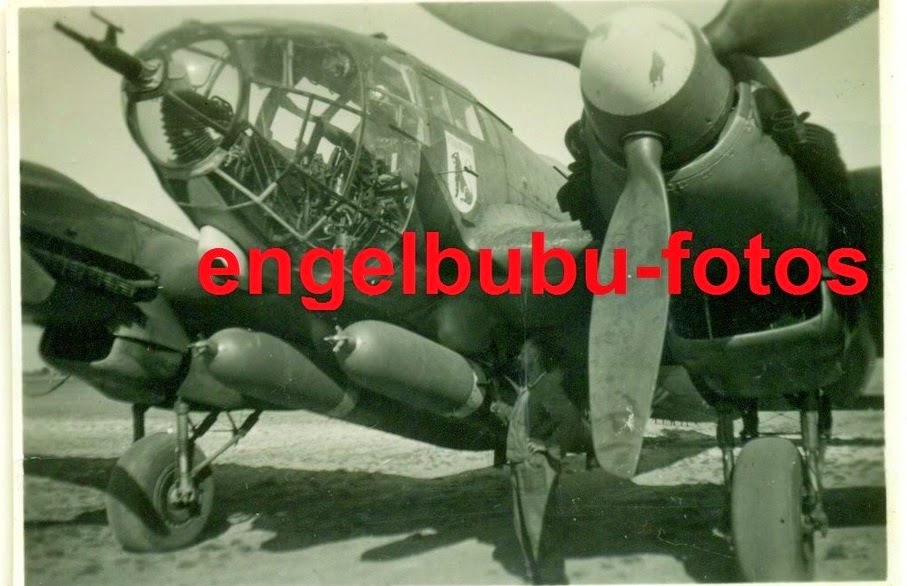
KG 6 Junkers Ju 188, Ju 88 - daily Ebay photo find # 117


Edit- just sold via ebay.de seller Manuel Rauh at 'engelbubu fotos', are these nice images from a KG 6 album featuring Ju 188s and a Ju 88 Nachtjäger. 
Edit- currently at 350 euros with over two days of bidding still to go. 
Edit 01/06..final selling price on this one image 611 euros! 

Click on the image to view large!


On offer here

along with this nice KG 26 torpedo bomber


Monday, 1 March 2010

Me 262 'Karoband' checker fuselage band - KG (J) units Gefechtsverband Hogeback - edit 11 January 2019


This Me 261 A-1a Jabo is reportedly "gelbe 3" of 3./KG(J) 54 and was found at a small airfield across the river from the town of Moosburg (NE of Munich on the Isar River). Other extant photos reveal that the lighter portions of the Karoband were originally white. They were lightly but deliberately oversprayed with 81 Braunviolet to mute to contrast with the dark blue cheques and not compromise the aircraft's overall camouflage that was also oversprayed with denser Wellen of 81. There is also evidence of the KG 54 "Totenkopfwappen" ahead of the windscreen. It too was overpainted with 81 but in this instance with a brush.

The overpainting of unit markings may well reflect the time when the remnants of Me 262 units operating in the Protectorate (KG(J) 6, KG(J) 54 and JG 7) were combined and folded into the ad hoc unit Gefechtsverband Hogeback in late April 1945.


Brown and Wadman were the first researchers to indicate that the Karobands were linked to the Kampfgeschwader (Jagd) units. This was based on photos of an Me 262 A-1a “Yellow 3+I” displaying a large style blue and white checker fuselage band ( originally interpreted as green/white) and most importantly, the famous KG 54 “Totenkopf” Geschwaderwappen.

An article by Jan Horn on KG(J) 6 indicated via pilot testimony that red and black were the colours for KG(J) 6 and blue and white for KG(J) 54 respectively. Recent photographic and crash report documents has linked an Fw 190 A-9 with KG(J) 27. The colour photo of the Bf 109 G-10 at Kaufbeuren shows it wearing a green/white band.
It is generally supposed that the various KG(J) units adopted fighter-style tactical markings, ie fuselage bands, sometime during March 1945. Since early 1944 and the deployment of Sturmstaffel 1 several units on the Western Front had been wearing colour fuselage bands for recognition purposes and it is thought that similar tail bands were adopted for Me 262 Kampfgeschwader units now operating as fighters. Interestingly - as pointed out by David E. Brown - the colours selected for the KG(J) unit’s bands shared the same dominant colour used by those fighter units that used the similar numerical designations;

Red – JG 6 & KG(J) 6
Green – JG 27 & KG(J) 27

(article credit David E. Brown)


posted by David on TOCH 11 Jan 2019


" Those are great photos and assist with research on this machine that I believe it comes from the late 1105xx to 1106xx(ish) werknummer series.

I base this on its original underlying camouflage of RLM 81/82 uppersurfaces with a light overspray of RLM 76 over the lower half of the fuselage to create a reverse mottle effect. This is characteristic of machines from the 1105xx to 1106xx series. Over this was oversprayed a Wellen pattern of a dark colour, my guess a green shade. These machines also have the faired-in tail light that disappeared after this group to be replaced by the small bulb type. The national markings styles fit with the series too. The blue and white KG(J) 54 small style Karoband is definitive to its I. Gruppe, and is the painted over “Totenkopfwappen” on the nose exhibiting the same dimensions and position visible on other aircraft. Based on the available photographs, it is possible to see how its V-kenn. changed through time:

• February(?) to mid-March 1945: “B3+??” - I./KG(J)54
• Mid-March to late April 1945: “ge.10+” – 3./KG(J) 54 (addition of dark green wellen and muting / overpainting of unit markings)
• Late April to early May 1945: “3+” – I./KG(J) 54? (addition of '3' over existing number '10')

Who the pilot was is a mystery but definitely someone who did not want to partake in Russian hospitality when they arrived in Prague on 8/9 May.